

A burr grinder crushes beans between two abrasive surfaces set at an adjustable gap, producing near-uniform particles every time. A blade grinder spins a metal blade that chops beans into a random mix of dust and chunks. The difference sounds mechanical, but it shows up directly in your cup. Buy a burr grinder if you brew espresso, pour-over, or any method where flavor clarity matters. A blade grinder is only defensible for occasional French press or if your budget is genuinely under $30. The Specialty Coffee Association has long treated grind uniformity as a foundational variable in extraction quality, and the burr-vs-blade gap is where that principle hits home most clearly.
Key Takeaways
A burr grinder produces uniform particles that extract evenly; a blade grinder produces random particle sizes that cause simultaneous over- and under-extraction, making a burr the better choice for any brew method where flavor clarity matters.
| Point | Details |
|---|---|
| Burr = uniform grind | Fixed gap between two abrasive surfaces produces consistent particle sizes and cleaner extraction. |
| Blade = inconsistent output | Spinning blade creates fines and chunks in the same dose, leading to bitter and sour notes together. |
| Match grinder to brew method | Espresso and pour-over require a burr; occasional French press is the only defensible blade use case. |
| Entry-level burr covers most needs | A $50–$150 conical burr delivers most of the performance gain without high-end pricing. |
| Burrs are serviceable; blades are not | Burr grinders allow burr replacement, extending lifespan well beyond a typical blade grinder. |
Table of Contents
- How burr grinders actually work
- Why blade grinders fall short
- Burr vs blade: side-by-side comparison
- Which grinder fits your brewing method?
- What does a burr grinder actually cost, and is it worth it?
- Cleaning, noise, and practical trade-offs
- A quick checklist to make your decision
- The grinder is where the roast either lives or dies
- Sources
How burr grinders actually work
A burr grinder passes beans through a gap between two abrasive surfaces called burrs. The gap width determines particle size. Tighten it for espresso, open it for French press. Because every bean travels through the same gap, the output is near-uniform in particle size, which is exactly what even extraction requires.
Two burr shapes dominate the market:
- Flat burrs sit face-to-face in a horizontal stack. They tend to produce the tightest particle distribution, which is why espresso-focused grinders often use them.
- Conical burrs use a cone-shaped inner burr inside a ring-shaped outer burr. They run quieter, retain fewer grounds between doses, and cost less at the entry level, making them the go-to for most home setups. Flat burrs edge out conical for uniformity; conical burrs win on noise and retention, and both generate less heat than any blade grinder.
- Manual burr grinders use hand-cranked force. Low cost, completely portable, zero noise. The trade-off is time, roughly 1–2 minutes per dose.
- Electric burr grinders are faster and more consistent across doses, though a weak motor can add minor heat if the grind takes too long.
Key components to know when shopping:
- Hopper: the bean reservoir on top
- Burrs: the grinding surfaces (steel lasts longer; ceramic runs cooler)
- Adjustment dial or collar: sets the gap (stepped = fixed click positions; stepless = infinite fine-tuning)
- Retention: grounds that stay inside after grinding (lower is better for single-dosing)
Pro Tip: If you’re dialing espresso, go stepless. For everything else, a stepped grinder with 30+ settings gives you plenty of control without the fuss.
Why blade grinders fall short
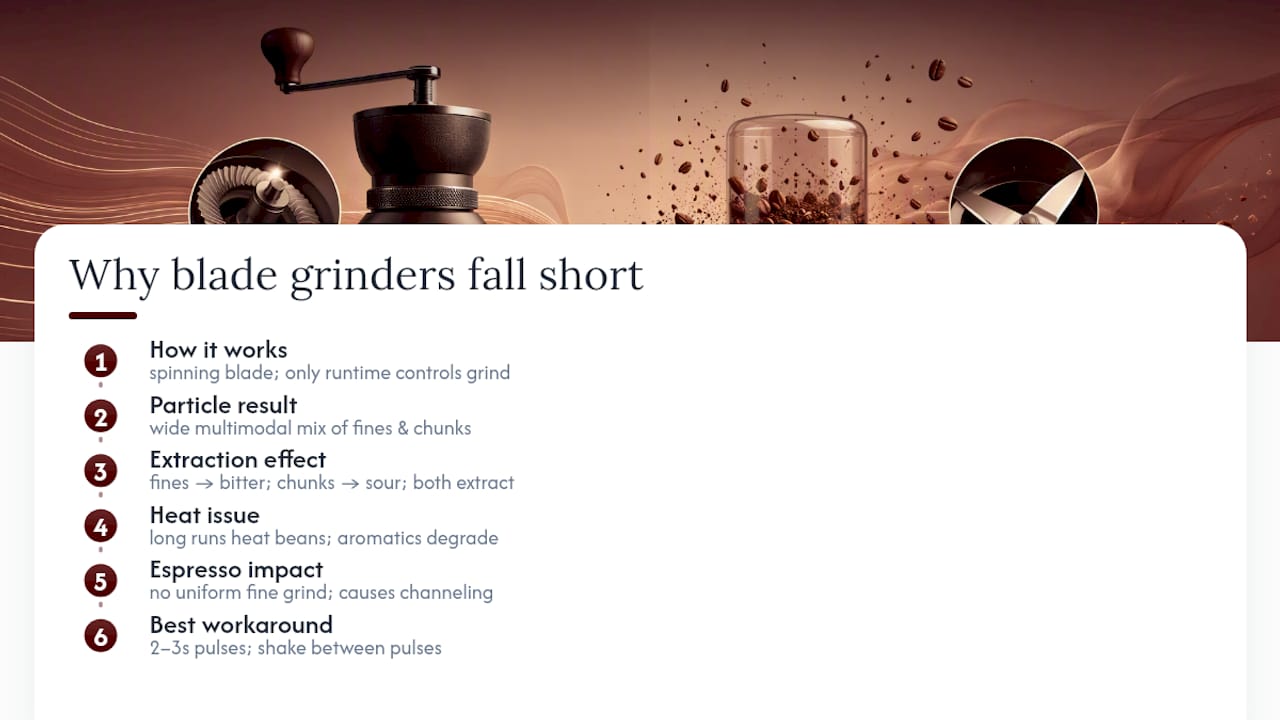
A blade grinder works like a tiny food processor. A spinning blade chops beans in a chamber, and the only variable is how long you run it. There’s no fixed gap, no controlled particle size. The result is a wide, multimodal distribution of fines and large chunks in every single dose.
That mix is the core problem. Fines extract fast and go bitter. Large chunks extract slowly and stay sour. Both end up in the same brew. The cup tastes muddy because it literally is: simultaneous over- and under-extraction happening in the same filter. Longer run times also generate heat, which degrades volatile aromatics before the water even touches the grounds.
For espresso, the situation is worse. Blade grinders cannot reliably produce the uniform fine grind espresso requires, and no amount of technique fixes a multimodal distribution. Uneven particles create uneven resistance in the puck, which causes channeling, where water finds the path of least resistance and bypasses most of the coffee entirely.
Pro Tip: If you’re stuck with a blade grinder, use short 2–3 second pulses and shake the grinder between each pulse to redistribute the beans. It won’t fix the fundamental inconsistency, but it reduces the worst clumping and cuts down on fines. This pulse-and-shake technique is the most effective workaround available for blade users.
Burr vs blade: side-by-side comparison
| Feature | Blade grinder | Entry-level burr | Mid-to-high-end burr |
|---|---|---|---|
| Grind consistency | Poor (random particle mix) | Good (uniform within a range) | Excellent (tight distribution) |
| Control over grind size | None (time-based only) | Moderate (stepped settings) | High (stepped or stepless) |
| Heat generation | High with longer runs | Low | Very low |
| Best-for brewing methods | Occasional French press only | Drip, pour-over, French press, moka pot | Espresso, pour-over, all methods |
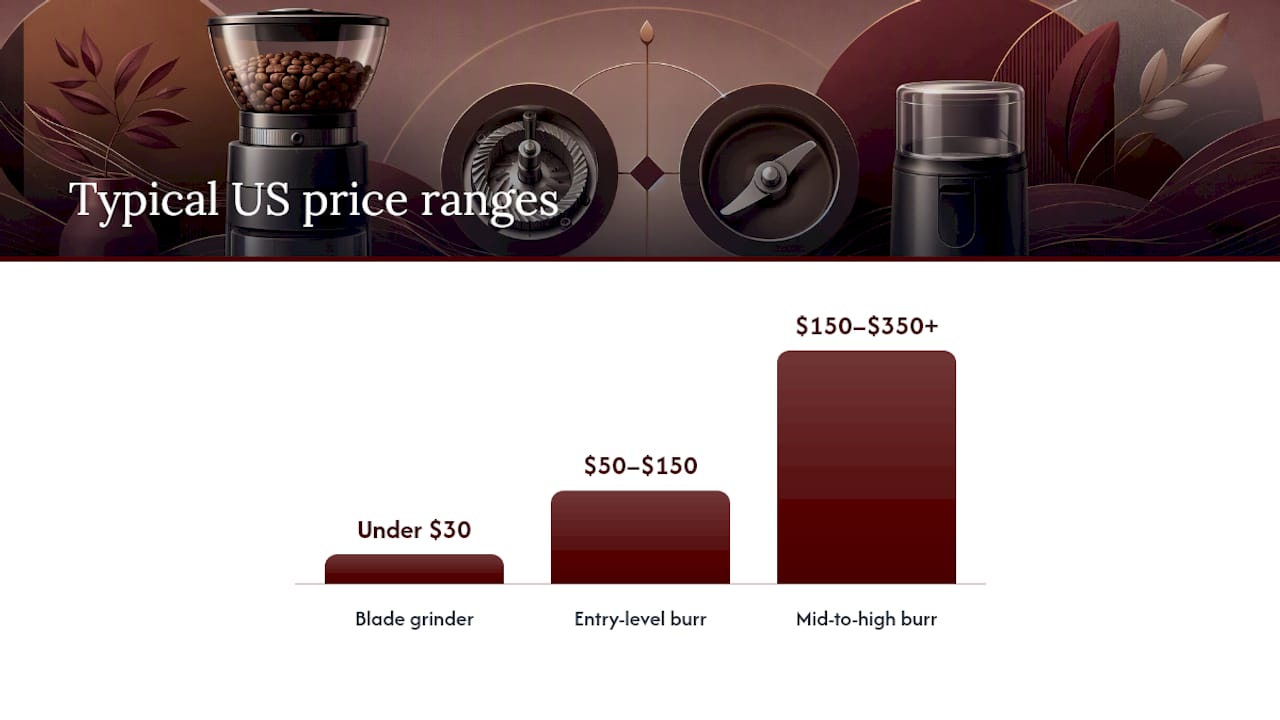
| Typical US price range | Under $30 | $50–$150 | $150–$350+ |
| Durability / serviceability | Low (blades dull, hard to replace) | Moderate (burrs replaceable) | High (burrs replaceable, robust motors) |
| Noise and portability | Loud; compact | Moderate noise; countertop | Varies; quieter with conical burrs |
| Ease of cleaning | Simple (wipe chamber) | Weekly brush; monthly deep clean | Same cadence; more parts |
Independent taste testing confirms burr-ground coffee is cleaner and more repeatable, with blade grinders producing measurably more fines after sieving. That fines surplus is what pushes the cup toward bitterness.
Which grinder fits your brewing method?
The burr-vs-blade decision is really a brew-method decision. Here’s how it maps:
- Espresso: Burr required, no exceptions. Uniform fine grind is the only way to build even puck resistance and avoid channeling. A coffee grind chart makes the target range concrete.
- Pour-over (Chemex, V60, Kalita): Strong burr advantage. For pour-over and filter methods, a modest burr produces noticeably cleaner, brighter cups than blade-ground beans. The improvement often outweighs swapping the brewer itself.
- Automatic drip: Entry-level burr delivers most of the gain. Blade works in a pinch but muddies the cup.
- French press: Coarser grinds are more forgiving. A blade is defensible for occasional weekend use, though a burr still reduces sediment and improves clarity. See French press brewing explained for the full picture.
- Cold brew: Similar to French press. Coarse grind tolerates some inconsistency, but burr still wins on flavor.
- Moka pot: Medium-fine consistency matters here. A blade can produce the right coarseness by accident, but a burr hits it reliably.
Pro Tip: Brewing espresso daily? Learn to dial in your espresso shot alongside your grinder purchase. The two skills compound fast.
What does a burr grinder actually cost, and is it worth it?
Typical US price bands:
- Blade grinders: under $30
- Entry-level electric burr: $50–$150
- Mid-range burr: $150–$350
- High-end burr: $350+
The jump from blade to entry-level burr is where most of the flavor gain lives. Entry-level electric conical burr grinders give most users a meaningful improvement over blade grinders, and you don’t need a $300 machine to notice it. Burr grinders are also more serviceable: the burrs themselves can be replaced when they dull, which extends the machine’s useful life well beyond what a blade grinder offers.
Factors that shift the value calculation:
- How often you brew (daily use justifies more investment)
- Which brew methods you use (espresso demands more precision)
- How much you spend on whole beans (specialty beans deserve a grinder that extracts them properly)
- Whether you want to dial in recipes vs. just make coffee
A good burr grinder is widely considered the highest-impact equipment upgrade for consistent flavor control. If you’re already buying quality beans, a blade grinder is the weakest link in the chain.
Cleaning, noise, and practical trade-offs
Maintenance cadence:
- Light brush after every few uses; weekly for daily drinkers
- Deep clean every 1–3 months, more often with oily dark roasts
- Blade grinders: wipe the chamber; simple but the blade dulls over time
Noise: Conical burr grinders run quieter than flat burr models. Manual grinders are the quietest option by far. Blade grinders are loud and abrupt.
Portability: Manual burr grinders pack flat and need no power, making them the clear pick for travel. Electric burrs stay on the counter.
Single-dose vs hopper: Hoppers are convenient but expose beans to air and light. Single-dosing (loading only what you need per brew) preserves freshness, especially for specialty roasts with delicate aromatics.
Static and mess: A brief tap on the grinder body before opening the grounds bin reduces static cling. Low humidity environments make static worse.
Pro Tip: Grinder cleaning tablets (such as Urnex Grindz) dissolve residual oils and stale grounds from burr chambers without disassembly. Run a small dose through after the tablets to clear any residue before your next brew.
A quick checklist to make your decision
Work through these five questions and the answer becomes clear:
- Do you brew espresso? Yes → buy a burr grinder, no exceptions.
- Is flavor clarity a priority? Yes → burr, even at the entry level.
- Do you spend $15+ per bag on whole beans? Yes → a blade grinder is wasting that investment.
- Do you need portability? Yes → manual burr grinder.
- Is your budget under $30 and you brew French press occasionally? Blade is acceptable for now.
If you answered yes to any of the first four, an entry-level burr in the $50–$150 range covers most home brewing needs. Espritkaffe’s guides on grind size adjustment walk you through dialing it in once you have the right tool.
The grinder is where the roast either lives or dies
There’s a version of this conversation that gets lost in specs: the grinder isn’t just equipment, it’s the last decision between the roaster’s work and your cup. At Espritkaffe, every roast is built around a flavor profile worth tasting clearly. A blade grinder doesn’t give you that. It gives you a statistical average of over- and under-extracted particles, and you taste all of them at once.
The readers who get the most out of Espritkaffe’s medium roast or dark roast blends are almost always brewing with a burr grinder. Not because it’s a rule, but because the grinder is where the roast either comes through or gets flattened. An entry-level conical burr at $75 does more for the cup than a $200 bag of beans ground on a blade.
The grinder upgrade is the one most home brewers delay the longest and regret the most.

Ready to taste what your beans are actually capable of? Espritkaffe’s freshly roasted medium roast and dark roast blends are roasted to order and certified free of mycotoxins, heavy metals, mold, and yeast. Pair them with a burr grinder and you’ll taste the difference in the first cup.
Sources
- Burr vs Blade Grinder: Does It Matter? - Kitchen Kit
- Burr vs. Blade Grinders: Which Is the Best for Coffee? - Serious Eats
- Burr vs Blade Grinder: What is the difference? - Moccamaster blog
- Burr vs blade grinder - America’s Test Kitchen
- Best coffee grinder - Bon Appétit
- Burr vs Blade Grinder: Which Is Better for Coffee? - CoffeeBot
- Burr vs Blade Coffee Grinder: Which Should You Buy? - My Home Espresso
- Professional Coffee Grinder Buyer’s Guide: Burr vs Blade - The Coffee Dispatch