

Your environment shapes your ability to focus more directly than motivation, willpower, or habit stacking. Light, sound, temperature, visual clutter, air quality, and spatial cues all alter the brain’s attention systems in measurable ways. The single highest-leverage change most people can make right now: clear your immediate visual field of everything unrelated to the task at hand.
Three things you can do in under five minutes:
- Close unnecessary browser tabs and remove objects from your desk that aren’t needed for the current task.
- Adjust your lighting to a cooler, brighter setting (aim for daylight-balanced bulbs if natural light isn’t available).
- Open a window or step outside briefly to reset CO2 levels and body temperature before a focus session.
Pro Tip: Set up one dedicated spot you use only for focused work. Your brain will begin associating that location with concentration, and the transition into focus will get faster every time you use it.
Key Takeaways
Your environment shapes focus through measurable neural mechanisms, and the highest-leverage changes (lighting, sound, temperature, clutter) can be made in under an hour.
| Point | Details |
|---|---|
| Clear your visual field first | Removing task-irrelevant objects reduces biased competition and lowers attentional cost immediately. |
| Hit the thermal sweet spot | Studies point to — as the range where concentration scores peak for most people. |
| Use 300–700 lux of cool light | Daylight-balanced task lighting (4,000–6,500 K) increases frontal beta activity, a marker of sustained attention. |
| Keep ambient sound low | Intelligible speech is the most disruptive sound type; steady low-level noise or noise-canceling headphones protects performance. |
| Espritkaffe as a ritual anchor | A consistent brew at a dedicated spot conditions a focus response over time; the Coffee with Mushrooms Medium Roast offers a calm, alert state as an optional adjunct. |
Table of Contents
- How does environment trigger focus? The main levers explained
- What the brain is actually doing when your setting shifts attention
- What studies actually measure: concrete targets you can use
- How to design your space so it reliably triggers focus
- Why one-size-fits-all targets don’t always work for you
- Quick troubleshooting: what to fix when focus breaks down
- The thing most focus advice gets backwards
- A focused ritual that works with your environment, not against it
- Sources
How does environment trigger focus? The main levers explained
The connection between surroundings and concentration isn’t abstract. Each environmental variable acts on a specific neural system, and understanding which lever does what lets you make targeted adjustments rather than guessing.
Lighting
Light is the most direct environmental input to the brain’s alertness system. Retinal melanopsin cells, which are separate from the rods and cones used for vision, detect blue-spectrum light and drive the circadian clock and arousal pathways. Cool-white light in the 4,000–6,500 K range during daytime hours increases markers of sustained attention in lab settings, while warm, dim light in the evening suppresses melatonin and disrupts sleep without meaningfully boosting daytime focus. Natural light access is one of the highest-ROI environmental factors for sustained attention and mood, and aligning light color temperature to time of day amplifies the benefit while protecting downstream sleep quality.
Sound and noise
Not all noise is equal. Steady, low-level ambient sound (think a quiet café hum or a brown-noise track) tends to be less disruptive than intelligible speech. Background conversation is particularly corrosive to focus because the language-processing centers of the brain engage involuntarily, pulling resources away from the task. Research on open-plan study environments found that intelligible speech increased perceived disturbance and reduced performance on logical reasoning tasks, though task engagement could sometimes buffer the effect. Noise-canceling headphones, white or brown noise generators, and physical relocation are the practical responses.
Temperature
Thermal comfort sits in a narrower band than most people realize. A smartwatch-enabled ecological momentary assessment study found that even modest thermal discomfort in everyday settings predicted worse scores on an N-back executive-attention task, with acclimatization moderating the effect. Feeling slightly too warm or too cold doesn’t just feel bad — it draws prefrontal resources toward thermoregulation and away from the task.
Air quality and ventilation
Elevated CO2 from poor ventilation is a quiet focus killer. Indoor environmental quality research links ventilation and air quality to alertness and productivity outcomes, with high CO2 concentrations associated with cognitive sluggishness. Opening a window, running an air purifier, or simply taking a short outdoor break can reset the air quality in a small room within minutes.
Visual clutter and color
Every object in your visual field competes for neural representation. The brain’s biased competition mechanism means that more visible, task-irrelevant items raise the processing cost of maintaining attention on the target task. Neutral wall colors (soft gray, off-white, muted green) reduce visual noise. Warm reds and oranges can increase arousal but also agitation, making them better suited to brief, high-energy tasks than sustained deep work.
Furniture layout and spatial cues
Physical arrangement sends signals about what kind of work happens here. A desk facing a wall with minimal visual interruption supports deep, single-task focus. A desk facing a window or open room invites distraction. Spatial cues also work through conditioning: the brain learns to associate specific configurations with specific modes of work, which is why a dedicated workspace outperforms a multipurpose table even when the physical setup is otherwise identical.
Nature and biophilic elements
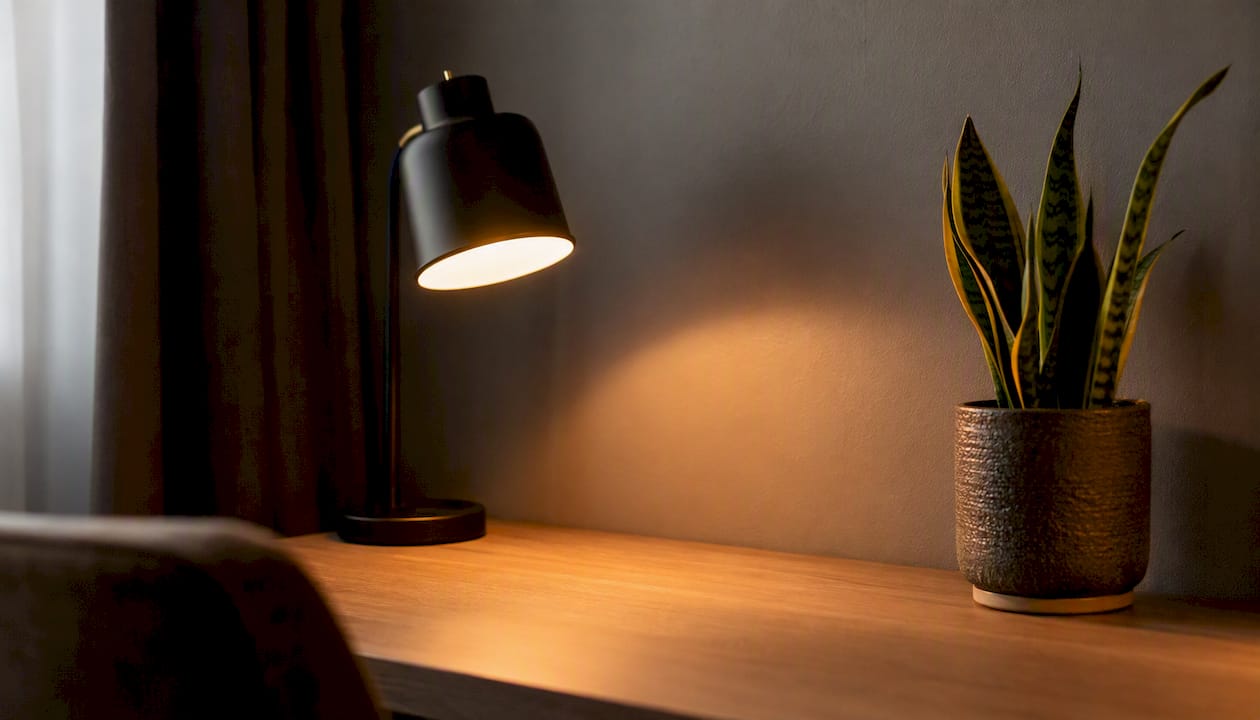
Even a partial view of greenery or a small plant on the desk reduces mental fatigue. Biophilic design research consistently shows that nature exposure, even indirect, lowers cortisol and supports the restoration of directed attention. You don’t need a forest view; a single potted plant or a nature photograph at eye level produces a measurable, if modest, effect.
Scent
Scent is a fast-acting sensory channel with direct access to the limbic system. Peppermint and rosemary have been associated with increased alertness in small studies, while lavender tends to reduce arousal. More practically, a consistent scent used only during focus sessions can become a conditioned cue, much like a specific location or sound.
Digital environment
The physical space isn’t the only environment that matters. Notification badges, open tabs, and a cluttered desktop impose the same biased-competition cost as physical objects. Turning off all non-essential notifications before a session and using a full-screen or distraction-free writing mode removes competing stimuli at the source.
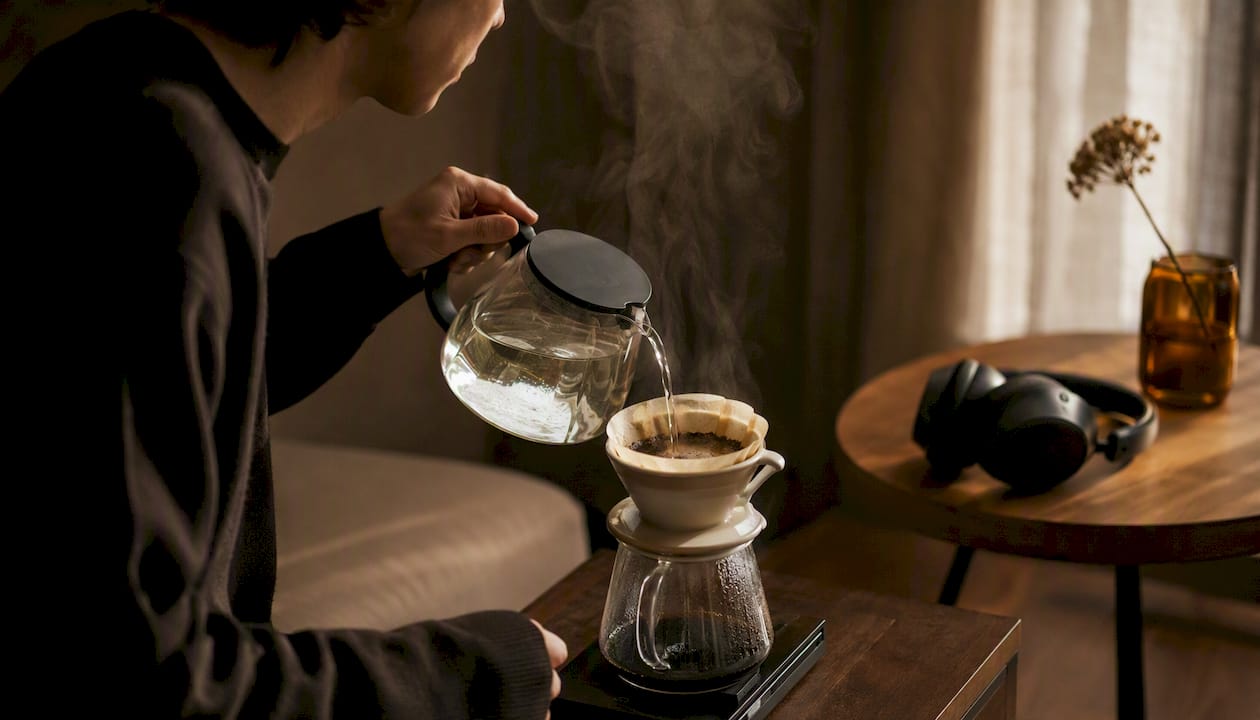
Pro Tip: Use a simple ritual to mark the start of a focus session: clear your desk, put on a specific playlist or sound, and brew a consistent drink. Repeat it every time. Within a few weeks, the ritual itself becomes a conditioned trigger that speeds up the transition into focused work.
What the brain is actually doing when your setting shifts attention
Your surroundings don’t just set a mood. They directly alter which neural circuits are active, how much processing capacity is available for the task, and how long you can sustain attention before fatigue sets in.
The core mechanism is biased competition. The brain cannot process every incoming signal simultaneously, so neural populations representing different stimuli compete for dominance. A cluttered visual field means more competitors, and the task-relevant signal has to “win” against more noise. Reduce the competitors, and the task representation strengthens without any additional effort on your part. Visual crowding research confirms that fewer task-irrelevant objects in view directly reduce attentional cost.
On the auditory side, the salience network responds strongly to unpredictable or meaningful sounds, particularly speech. A sudden voice or an unexpected alert triggers an involuntary orienting response, pulling attention away from the current task. Predictable, steady-state sounds (white noise, a consistent fan hum) don’t trigger this response because the brain habituates to them quickly.
Light is the most powerful non-pharmacological tool for shifting brain state. Melanopsin-containing retinal ganglion cells respond to short-wavelength (blue) light and drive the suprachiasmatic nucleus, which governs circadian timing and feeds into arousal pathways. Cool, bright light during morning and midday hours increases frontal beta activity on EEG, a marker associated with sustained, alert attention. Dim or warm light in the same period produces the opposite shift.
Temperature affects focus through a different route: thermoregulation competes with cognition for prefrontal resources. When the body is working to maintain core temperature in uncomfortable conditions, the prefrontal cortex, which handles working memory, planning, and sustained attention, has less capacity available for the task. This isn’t a minor inconvenience; EEG and behavioral data show measurable drops in concentration indices outside the comfortable thermal range.
Rituals and repeated environmental cues work through a third mechanism: stimulus-response conditioning in the caudate nucleus. The caudate nucleus plays a central role in linking recurring stimuli to behavioral responses. When you repeatedly enter a specific environment and engage in focused work, the brain encodes that context as a reliable predictor of the focused state, eventually triggering it automatically. This is why a dedicated workspace, even a small one, outperforms working from a couch or kitchen table over time.
Pro Tip: If you have access to a consumer EEG headset (such as a Muse or a Neurosity Crown), run a simple before-and-after test: measure your frontal beta or focus score in your current setup, make one change (lighting, noise, clutter), and measure again after 10 minutes. Even a single session can reveal which variable matters most for your brain.
What studies actually measure: concrete targets you can use
The research on environment and focus is unusually specific. Several controlled studies have produced numeric targets rather than vague recommendations, which makes them directly applicable to workspace setup.
A few honest caveats. The PMC EEG study used 30 young adults, which limits how broadly the exact numbers transfer. The temperature and acoustic targets are a useful starting point, not a universal prescription. The EMA thermal study was a pilot, and its N-back findings are suggestive rather than definitive. That said, the direction of each effect is consistent across multiple independent sources, which gives the ranges practical credibility even if the exact figures shift slightly for different populations.
The 300–700 lux range for task lighting covers most desk work, with the higher end of that range supporting more demanding cognitive tasks. A standard office is often lit at 200–300 lux, which is below the level associated with peak alertness. A dedicated task lamp is one of the cheapest, fastest upgrades available.
How to design your space so it reliably triggers focus
The most important step is physical separation: assign one spot exclusively to focused work and never use it for anything else. Everything else builds on that foundation.
0–5 minutes: quick wins
- Clear your desk surface of everything except what the current task requires.
- Close all browser tabs and apps unrelated to the task.
- Set your phone to Do Not Disturb and place it face-down or in another room.
- Adjust your lighting: turn on a task lamp, open blinds for natural light, or switch to a cooler-temperature bulb.
- Check the room temperature. If it feels warm or stuffy, open a window for two minutes before starting.
30–60 minutes: setup improvements
- Position your desk so your back is to the room’s main traffic flow, reducing peripheral movement in your visual field.
- Add a task lamp rated for 300–700 lux at desk level. Daylight-balanced bulbs (5,000–6,500 K) work well for morning and midday sessions.
- Use a designated coffee corner or a specific brewing spot to create a spatial ritual anchor separate from your work surface.
- Install a white or brown noise app (Krisp, Noisli, or a simple fan) if your space has unpredictable sound.
- Remove or face away any decorative items that draw your eye repeatedly.
1–3 days: structural changes
Add a small plant (pothos, snake plant, or peace lily) within your sightline. Position it so it’s visible without requiring you to turn your head. If your workspace has a window, orient your desk to give you a partial outdoor view rather than a wall.
For a remote work setup, consider a simple CO2 monitor (Aranet4 is a widely used option) to track ventilation quality in real time.
2–4 weeks: conditioning rituals
Repeat the same short sequence every time you begin a focus session: same location, same sound environment, same drink, same physical arrangement. The sequence doesn’t need to be elaborate. Three consistent steps are enough to build a conditioned response. After two to four weeks of daily repetition, the ritual itself will begin to trigger the focused state before you’ve done any actual work.
Mini A/B experiment: For one week, work in your current setup and log your subjective focus rating (1–10) and a simple performance measure (words written, problems solved, tasks completed) at the end of each session. The following week, change one variable (lighting, sound, or temperature) and log the same metrics. Compare. This within-subject design controls for day-to-day variation and gives you personal data on which change actually moved the needle.
Pro Tip: When you’re working from a café, hotel, or coworking space, bring your ritual with you. A specific pair of headphones, a consistent drink order, and a two-minute desk-clearing routine can recreate enough of the conditioned cue to trigger focus even in an unfamiliar space.
Why one-size-fits-all targets don’t always work for you
The numeric targets above are population averages. Your optimal settings may sit outside them, and the gap is often explained by a handful of well-documented individual factors.
Task type matters first. Creative, generative work (writing, brainstorming, design) tends to benefit from slightly higher ambient noise (around 65–70 dB, the level of a busy café) and warmer, softer lighting, which reduces inhibition and encourages associative thinking. Analytical work (coding, accounting, editing) benefits from the quieter, cooler, brighter conditions the studies above describe. Matching your environment to the task type is often more effective than optimizing for a single universal setting.
Individual factors that shift your optimal range:
- Personality: Introverts typically reach their noise threshold faster than extroverts and may need quieter conditions to reach peak focus.
- Sensory sensitivity: People with heightened sensory processing (common in ADHD and autism spectrum profiles) often need lower stimulation across all channels, not just sound.
- Acclimatization: The EMA thermal study found that people acclimatized to warmer climates showed different performance responses to the same temperature than those from cooler climates. Your thermal comfort zone is partly learned.
- Gender: The PMC EEG study noted sex-based differences in response to temperature and lighting conditions. Women in that sample tended to prefer slightly warmer temperatures for peak performance.
- Chronotype: Morning types benefit from cool, bright light earlier in the day; evening types may find that the same light at 7 AM feels harsh and counterproductive.
Running your own personalization experiment
- Pick one variable (temperature, sound level, or lighting).
- Set a baseline: work in your current default setting for three sessions and log focus rating and a simple output measure.
- Shift the variable by one step (e.g., lower the thermostat by 2°F, add a noise track, switch to a brighter bulb).
- Work for three sessions in the new setting and log the same metrics.
- Compare and decide. If the change helped, keep it and move to the next variable. If it made no difference or hurt, revert.
This within-subject approach takes about two weeks per variable and produces personal data that no population study can give you.
Pro Tip: Make changes incrementally, not all at once. Changing temperature, lighting, and sound simultaneously makes it impossible to know which variable drove any improvement or decline. One change at a time, three sessions minimum per condition.
Quick troubleshooting: what to fix when focus breaks down
When concentration drops mid-session, the cause is usually environmental before it’s motivational. Run through this list before reaching for your phone.
- Feeling sluggish or foggy: Check ventilation first. If the room has been closed for more than an hour, CO2 may be elevated. Open a window for five minutes. Also check temperature: if the room has warmed above 77 °F, that alone can explain the fog.
- Easily distracted by background speech: Intelligible conversation is the most disruptive sound type for cognitive tasks. Move to a quieter space, put on noise-canceling headphones, or switch to a brown or white noise track that masks the speech frequencies.
- Eyes keep drifting around the room: Your visual field has too many competing objects. Take 60 seconds to clear everything off the desk surface except your current task materials. Face your monitor toward a plain wall if possible.
- Restless, can’t settle into the task: You may not have completed your entry ritual. Run through your standard sequence (clear desk, set sound, brew your drink, set a timer) before trying to force focus.
- Headache or eye strain after 90 minutes: Likely a lighting issue. Check whether your screen brightness is much higher or lower than your ambient light. Add a task lamp or reduce screen brightness to match the room. The 300–700 lux target applies to the room, not just the screen.
- Waking up groggy and unable to focus in the morning: Get bright, cool light within 30 minutes of waking. Open blinds fully or use a daylight lamp. This resets the circadian clock and accelerates the shift into an alert state.
- Afternoon energy crash: Temperature and ventilation are the first suspects. A brief outdoor walk resets both. If that’s not possible, lower the thermostat slightly and open a window.
Pro Tip: Keep a two-line focus log for one week: note the time, your environment (location, sound, light), and your focus rating at the start and end of each session. Patterns emerge quickly, and you’ll identify your personal worst-performing conditions within a few days.
The thing most focus advice gets backwards
Most productivity content treats focus as a mental discipline problem. You need more willpower, a better morning routine, a stricter schedule. The research tells a different story.
Changing your environment produces larger, lower-friction focus gains than willpower-based techniques because it alters the brain’s state directly rather than asking you to override competing impulses through sustained effort. Decluttering a desk takes two minutes. Sustaining willpower against a cluttered, noisy, poorly lit room takes continuous effort for the entire session.
The deeper point is that environment works whether you’re paying attention to it or not. A poorly designed space drains focus passively, and a well-designed one supports it the same way. You don’t have to “try harder” in a quiet, well-lit, thermally comfortable room. The conditions do part of the work for you.
What I find most underappreciated in the research is the conditioning effect. The caudate nucleus doesn’t care whether you consciously chose to associate a location with focus. It encodes the pattern regardless. That means every time you use your focus space for something else (scrolling, eating, watching videos), you’re actively weakening the conditioned response you’ve built. Protecting the space is as important as setting it up.
The practical implication: spend less time optimizing your mindset and more time auditing your physical space. The five-dimension framework (visual clarity, soundscape, lighting, thermal comfort, spatial cues) gives you a complete checklist. Work through it once, make the changes, and let the environment carry more of the cognitive load.
A focused ritual that works with your environment, not against it
A consistent, sensory-specific ritual is one of the fastest ways to condition a focus response, and a deliberate coffee moment fits that role well. The mechanism is straightforward: pair a specific sensory experience with the act of beginning focused work, repeat it daily, and the sensory cue begins to trigger the focused state on its own.

Here’s a two-step version that takes under three minutes. First, brew a consistent cup at your dedicated brewing spot, using the same beans and method each time. The smell, the sound of the grind, the warmth of the cup: these become the sensory anchor. Second, carry the cup to your cleared desk, set a timer for your first work block, and begin. That’s the full ritual. The consistency matters more than the complexity.
Espritkaffe’s Coffee with Mushrooms Medium Roast works well as a ritual anchor because the flavor profile is consistent and the functional mushroom blend (lion’s mane, chaga) supports a calm, alert state without the sharp spike-and-crash of a high-caffeine brew. It’s an optional adjunct, not a requirement. The ritual works with any consistent brew.
For timing, the research on caffeine and circadian rhythms suggests waiting 90 minutes after waking before your first cup to avoid blunting the natural cortisol peak. If you’re sensitive to caffeine, consider a half-strength brew or a lower-caffeine option. Caffeine is a tool, not a substitute for the environmental setup described above.
Sources
- EEG response and productivity outcome under changing indoor environment - PMC
- Pilot EMA study on thermal discomfort and cognition (IOPscience)
- Sound scenarios and study performance in open-plan study environments (Frontiers in Built Environment, 2021)
- Build a focus environment using brain science | Neurosity
- Optimizing your environment for focus: A science-backed blueprint (Goals & Progress)
- Why changing your environment works better than most focus techniques - Asian Efficiency
- The environment shapes attention | How to Think AI
- Caudate nucleus (Duke Today)
- Indoor environmental quality and productivity (MDPI Buildings)