

The Swiss Water Process removes up to 99.9% of caffeine from green coffee beans using only water, temperature, time, and carbon filtration. No methylene chloride, no ethyl acetate, no solvents of any kind touch the beans. For coffee drinkers who want a decaf that still tastes like actual coffee, that distinction is the whole reason to seek out the Swiss Water® label on a bag.
TL;DR:
- Swiss Water Process removes up to 99.9% of caffeine using only water and carbon filtration, without any chemical solvents touching the beans.
- The process preserves flavor better than solvent methods but may mute bright top notes, especially in darker roasts.
- Swiss Water decaf generally costs a dollar or two more per pound and is ideal for brew methods like pour-over and drip.
- Authentic Swiss Water labels or clear process descriptions on packaging are key to identifying water-processed decaf.
- Choose Swiss Water decaf if you prioritize clean taste, solvent-free processing, and mostly brew with filter methods; consider CO2 or solvent options if price or espresso body are more important.
Table of Contents
- How the Swiss Water Process Works, Step by Step
- What Swiss Water Decaf Tastes Like, and What It Costs You
- Swiss Water vs. Solvent and CO2 Decaf: What Actually Differs
- What “99.9% Caffeine-Free” Actually Means in Your Cup
- How to Actually Find Real Swiss Water Decaf
- Why Esprit Kaffe Treats Decaf as Its Own Craft
- When Swiss Water Is Right, and When to Look Elsewhere
- Try Solvent-Free Decaf From Esprit Kaffe
- Where This Information Comes From
- Sources
How the Swiss Water Process Works, Step by Step
Every batch starts with green, unroasted coffee beans, and the process runs on a simple principle: caffeine dissolves in water, and if you control the conditions carefully, you can pull it out without dragging the flavor compounds along with it.
Hydration and pre-soak. Green beans are soaked in hot water to swell their cell structure and loosen caffeine molecules from the bean matrix. This stage typically runs for several hours and is what makes the next step possible. Without proper hydration, caffeine stays locked in the bean’s fibers.
Green Coffee Extract (GCE) creation. Here is the part most people never hear about. Before beans are decaffeinated at scale, a batch of green coffee is saturated in water until the water itself becomes fully loaded with everything solvable in coffee: caffeine, sugars, acids, oils, and flavor compounds. That water, now called Green Coffee Extract, is the engine of the entire method.
Diffusion. The soaked green beans are transferred into a bath of that same GCE, which is already flavor-saturated but has had its caffeine stripped out (more on that next). Because the surrounding water already carries a full flavor profile, osmotic pressure pulls caffeine out of the beans without pulling the flavor and aroma compounds out along with it. This flavor-preserving diffusion is the mechanical trick that separates the Swiss Water Process from earlier decaf methods.
Activated carbon filtration. The caffeine-rich GCE is circulated through activated carbon filters engineered to trap caffeine molecules while letting smaller flavor and aroma compounds pass through. The now caffeine-free GCE gets reused in the next diffusion cycle, which is why Swiss Water describes its system as closed-loop.
Drying and shipment. Decaffeinated beans are dried back down to a stable moisture content for storage and roasting, then shipped to roasters as green coffee, indistinguishable in appearance from caffeinated lots.
Key stages in order:
- Hydration of green beans in hot water
- Diffusion into caffeine-free Green Coffee Extract
- Activated carbon filtration to strip caffeine from the GCE
- Drying beans back to shipping-stable moisture
- Delivery to roasters as standard green coffee
All certified Swiss Water decaf runs through one facility, in Delta, British Columbia, a detail that traces back to the process’s Swiss origins in the 1980s.
What Swiss Water Decaf Tastes Like, and What It Costs You
Swiss Water decaf coffee tends to land on the clean, chocolate-forward, low-acid end of the flavor spectrum. Specialty tasters generally find it holds onto sweetness and origin character better than solvent-processed decaf, though it can mute the brightest top-note aromatics that make a washed Ethiopian or a bright Kenyan pop in its caffeinated form. You are not getting a flawless twin of the original lot. You are getting the closest thing available at commercial scale.
The practical upsides go beyond taste:
- No solvent residue concerns, since the entire process runs on water and carbon
- Closed-loop GCE reuse cuts down on water waste compared to running fresh water through every batch
- Carbon filters are reusable across many cycles rather than discarded after one pass
- Works on a wide range of origins without requiring bean-specific chemical treatment
That said, water processing generally costs more per pound than solvent-based decaffeination, and that premium usually shows up at checkout. A bag of Swiss Water decaf typically runs a dollar or two higher than a comparable solvent-processed decaf from the same roaster.
Pro Tip: If a top note matters more to you than body and sweetness, ask your roaster for a lighter roast on Swiss Water decaf. Lighter roasts preserve more of the aromatics the process leaves intact, while darker roasts mask them anyway.
If you already like roasted decaf for its mellow profile, a dark decaf coffee built on a water-processed base tends to hide the aromatic trade-off almost entirely, since roast char dominates by that point.
Swiss Water vs. Solvent and CO2 Decaf: What Actually Differs
The three mainstream decaffeination methods separate cleanly by mechanism, and that mechanism drives everything else: taste, cost, and which brew method suits the result.
Water-based (Swiss Water). Uses hydration, GCE diffusion, and carbon filtration exclusively. No chemical solvent ever contacts the bean. Removes up to 99.9% of caffeine and, per specialty reviewers, tends to preserve origin character better than older solvent methods.
Solvent-based (methylene chloride or ethyl acetate). Beans are steamed and then washed directly with a chemical solvent that bonds to caffeine molecules. These methods are cheaper to run and often yield a smoother, sweeter cup, which is part of why they still dominate mass-market decaf. Regulatory bodies set strict residue limits, and decaffeination overviews confirm approved solvent methods fall well under those thresholds. But the “chemical touched my bean” optics push a lot of solvent-averse buyers toward water processing anyway.
CO2 (supercritical carbon dioxide). Pressurized CO2 acts as the extraction medium instead of a liquid solvent or water bath. This method tends to preserve flavor almost as well as water processing and is often favored for espresso blends because it holds onto body and crema-supporting oils better than some water methods. It is also the most capital-intensive method to run, which limits it mostly to larger-scale operations.
A rough breakdown of where each method tends to land:
- Flavor fidelity: CO2 and Swiss Water are closest to caffeinated coffee; solvent methods vary more by execution.
- Espresso suitability: CO2 often edges out Swiss Water for retained body; both beat solvent decaf on this front.
- Filter brewing: Swiss Water’s clean, sweet profile suits pour-over and drip particularly well.
- Price: Solvent methods are cheapest, CO2 and Swiss Water command a premium.
None of the three methods leave measurable amounts of harmful residue when done to specification. The real difference is what buyers are willing to accept, not what regulators allow.
What “99.9% Caffeine-Free” Actually Means in Your Cup
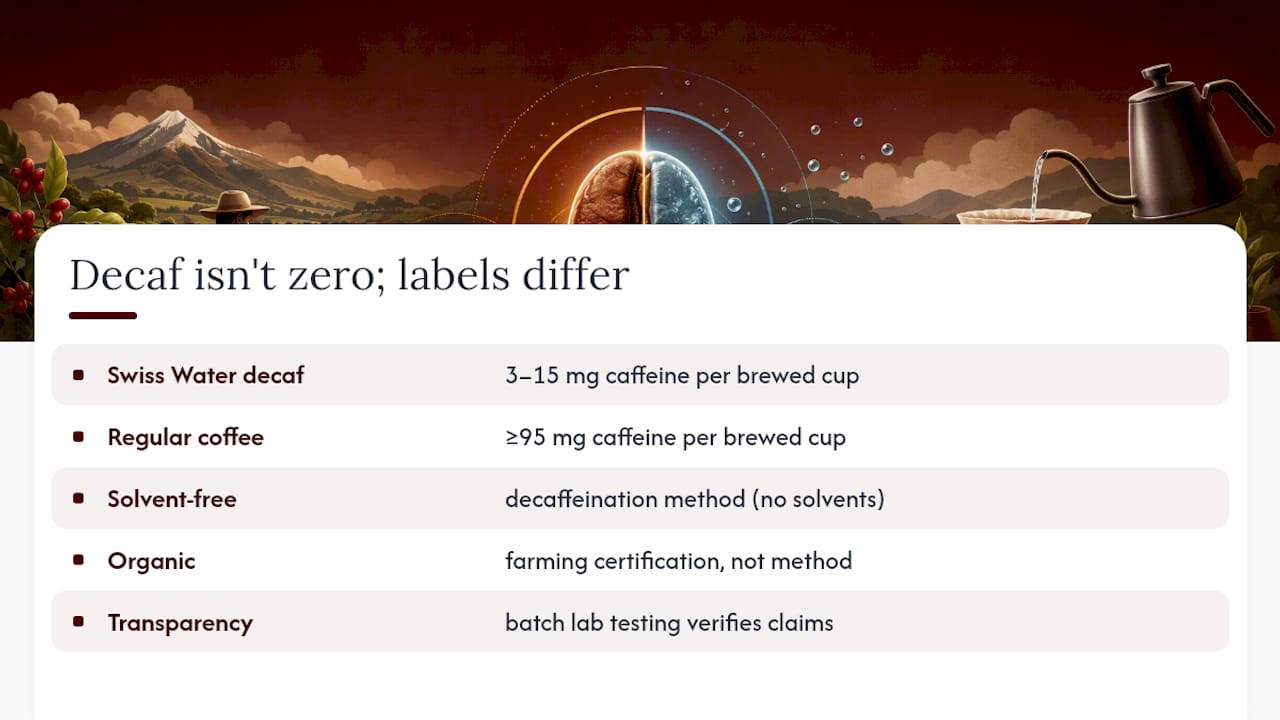
A brewed cup of Swiss Water decaf typically carries roughly 3 to 15 milligrams of caffeine, depending on serving size and brew method, against 95 milligrams or more in a regular cup. That is a meaningful reduction, not a total absence.
Two labels get confused constantly: “solvent-free” describes the decaffeination method, while “organic” is a separate certification tied to how the coffee was farmed. A bag can be Swiss Water processed without being organic, and a decaf can be organic without being water processed.
Trustworthy brands back these claims with batch-level lab testing for residual caffeine and contaminants, a practice clean-label analysis treats as the real marker of transparency, more than any single certification badge. Look for roasters who can point to that testing when asked directly.
How to Actually Find Real Swiss Water Decaf
Marketing language on decaf bags gets loose fast, so the label itself is your first real signal.
- Check for explicit process language. The Swiss Water® badge, or plain phrasing like “water-processed” or “solvent-free,” confirms the method. Terms like “EA processed” or “methylene chloride” signal a solvent-based method instead, no matter how clean the packaging looks.
- Read the roaster’s product page or FAQ. Reputable roasters disclose decaffeination method on the product listing itself, not buried in a policy page. If a bag says only “decaf” with no method named, treat that as a gap, not an oversight.
- Start with a small bag and check the roast date. Decaf beans lose aromatic punch faster than caffeinated beans once roasted, so a fresh roast date matters more here than almost anywhere else in coffee buying.
- Contact the roaster directly if the method is unclear. A roaster serious about sourcing should answer a direct question about decaffeination method within a day. Silence or vague answers are your signal to look elsewhere.
Why Esprit Kaffe Treats Decaf as Its Own Craft
Decaf sourcing gets less attention across the industry than it deserves. Author Jett covers processing and brewing on this site precisely because the mechanics behind a bean, whether it is wet milled or water decaffeinated, shape the cup as much as the roast does.
Esprit Kaffe evaluates decaf lots the same way it evaluates caffeinated ones: origin first, then processing method, then a roast profile chosen to work with what the beans already give you, not against it.
- Roast profiles for decaf lots are adjusted to compensate for muted top notes
- Sourcing prioritizes origins known to hold up well through water processing
- Batch consistency gets checked before a decaf lot goes into rotation
When Swiss Water Is Right, and When to Look Elsewhere
Choose Swiss Water decaf if you brew mostly filter or pour-over and want clean, sweet, chocolate-leaning cups without solvent concerns. It rewards patience and a decent grinder.
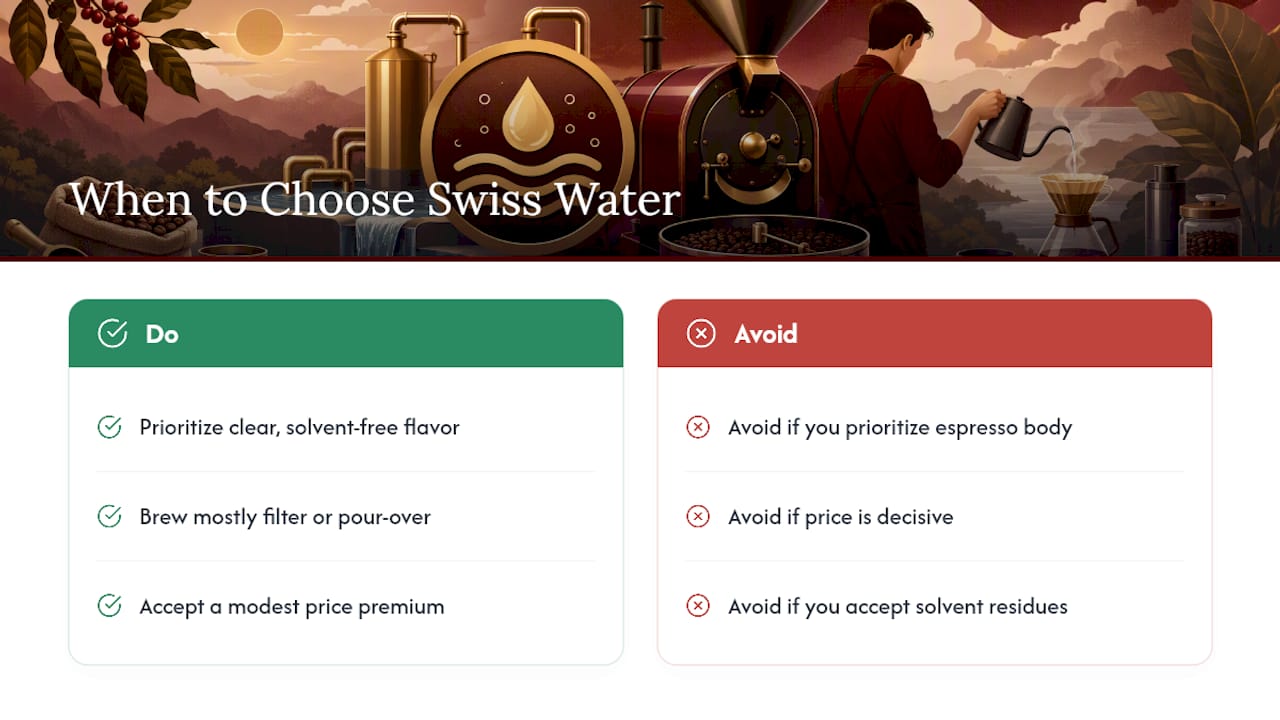
Consider CO2-processed decaf instead if espresso body matters more to you than perfect flavor fidelity, or lean toward solvent-processed decaf if price is the deciding factor and you are not worried about trace solvent residue, which regulated methods keep well under safety limits.
Quick decision checklist: prioritize taste clarity and solvent-free peace of mind, brew mostly filter methods, and accept a modest price premium. If two of three fit you, Swiss Water is the right call.
— Jett
Try Solvent-Free Decaf From Esprit Kaffe
Water-processed decaf is roasted with an origin-first approach and a profile designed to highlight what survives the process.
If you have been putting off decaf because you assumed it meant a flat, chemical-tinged cup, this is the moment to test that assumption against a bag that was never near a solvent. Browse the coffee and tea collection for current decaf offerings, or check the full coffee lineup to compare roast levels before you order. Pick a smaller bag first, note the roast date, and brew it within a few weeks of that date for the clearest read on what water processing actually preserves.
Where This Information Comes From
- Swiss Water’s own process pages detail the hydration, GCE, and carbon filtration stages directly.
- CoffeeReview’s decaf explainer covers professional tasting notes and flavor debate.
- Decaffeinate supplies caffeine-removal figures and brewed-cup ranges.
- Wikipedia’s decaffeination overview offers broader regulatory and comparative context.
Sources
- Our Coffee Decaffeination Process | Swiss Water® Process
- Coffeereview
- Swiss Water Process: how it works, what it tastes like, and whether it’s worth it | decaffeinate