

No. Under a regulation the Office of Environmental Health Hazard Assessment (OEHHA) adopted in 2019, coffee generally does not require a Proposition 65 cancer warning. OEHHA Section 25704 states that chemical exposures created by and inherent in roasting and brewing coffee pose no significant cancer risk. Exceptions exist for chemicals added on purpose or introduced through contamination, so sellers still need to check their specific product before assuming the exemption covers them.
TL;DR:
- Coffee inherently formed acrylamide during roasting is not considered a significant cancer risk under California law, provided it is not added or contaminated.
- The 2019 regulation exempts chemical exposures from roasting and brewing from Prop 65 warnings, but does not cover added ingredients or contamination from equipment or packaging.
- Darker roasts tend to have lower acrylamide levels than lighter roasts, as the compound degrades with longer and hotter roasting.
- Many warning labels prior to the regulation’s enforcement are outdated, and warnings should only persist if added chemicals or contamination sources are present.
- Testing for contamination other than acrylamide, such as heavy metals or mold, can differentiate brands and build consumer trust beyond legal compliance.
Table of Contents
- Prop 65 Coffee Rules: What OEHHA’s Section 25704 Actually Changed
- The Science Behind Acrylamide in Coffee and Cancer Risk
- When Coffee Still Needs a Prop 65 Warning
- A Compliance Checklist for Coffee Sellers and Retailers
- What This Regulatory Fix Means for Mindful Drinkers and Specialty Roasters
- Coffee Roasted With Testing and Transparency, Not Guesswork
- Sources
- FAQ
- A Straight Answer, Grounded in the Regulation Itself
Prop 65 Coffee Rules: What OEHHA’s Section 25704 Actually Changed
For years, coffee sellers in California operated under a cloud. A 2018 court ruling found that Starbucks and other retailers hadn’t proven coffee’s acrylamide exposure fell below the “no significant risk” threshold, which meant warning labels started showing up on cups and bags across the state. OEHHA closed that loophole with a regulation specifically written for coffee.
Section 25704 states that exposure to chemicals listed under Proposition 65 that are created by and inherent in the process of roasting coffee beans or brewing coffee does not pose a significant risk of cancer. That single sentence rewrote the compliance landscape for every roaster, café, and grocery chain selling coffee in the state.
The timeline matters here. OEHHA proposed the rule, ran it through public comment, and adopted it with an effective date of October 1, 2019. The regulation covers chemicals listed on California’s Prop 65 list on or before March 15, 2019, which includes acrylamide, the compound at the center of the original lawsuit.
By the numbers: OEHHA’s Final Statement of Reasons leaned on a review of more than 1,000 studies conducted by the International Agency for Research on Cancer (IARC), which found inadequate evidence that coffee causes cancer in humans.
That IARC review carried real weight. Key elements OEHHA cited in adopting the rule:
- IARC’s 2016 monograph reclassified coffee out of its “possibly carcinogenic” category after examining the full research base.
- Federal regulators, including the FDA, publicly questioned whether cancer warnings on coffee served any real public health purpose.
- The regulation gave sellers a defense in ongoing litigation, effectively ending the need for blanket warnings tied to roasting byproducts.
The Science Behind Acrylamide in Coffee and Cancer Risk
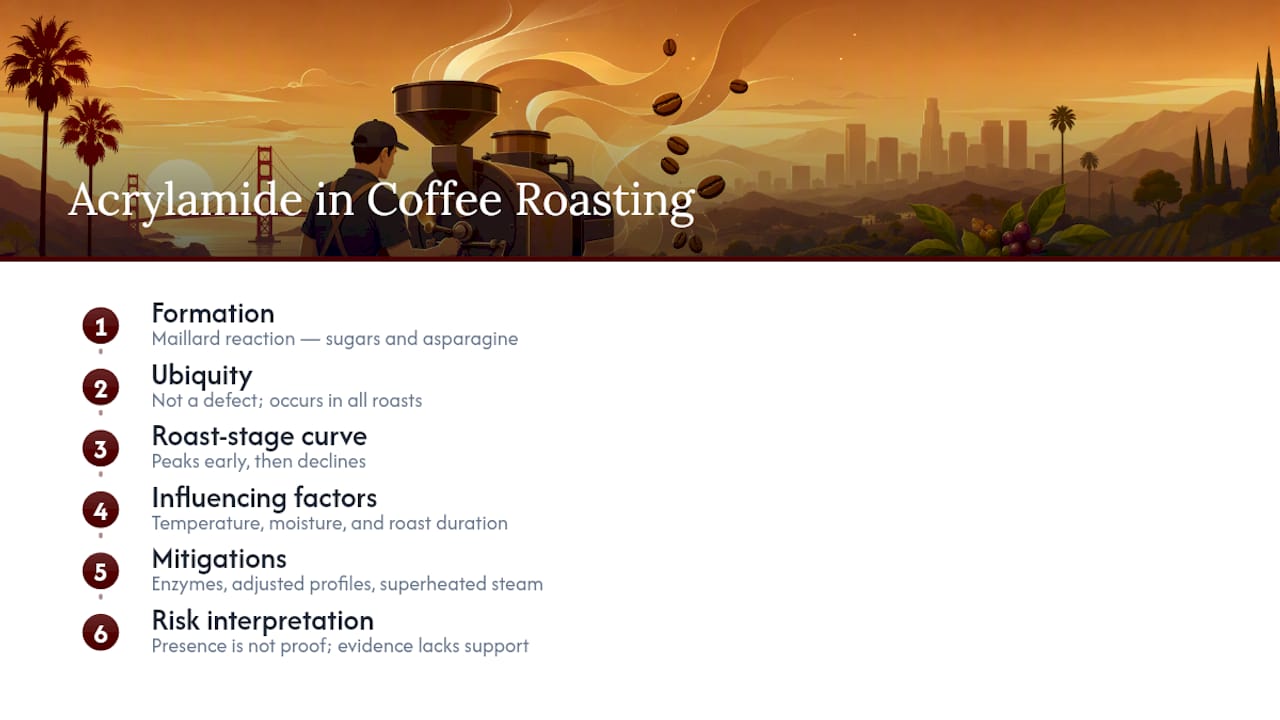
Acrylamide forms through the Maillard reaction, the same browning chemistry that gives roasted coffee its color and toasted aroma. It happens when sugars and the amino acid asparagine interact under high heat, and it’s unavoidable in any roasting process, not a defect specific to any one bean or brand.
A peer-reviewed review in PMC lays out the roasting dynamics in detail: acrylamide typically peaks early in the roast cycle and then declines as roasting continues, which is part of why darker roasts often contain less acrylamide than lighter ones. Roasting temperature, bean moisture, and roast duration all shift the final concentration, and the review catalogs mitigation approaches, including enzymatic treatments, adjusted roasting profiles, and superheated steam processing.
What the research actually shows: presence of a chemical is not the same as proof of harm at the levels people encounter. IARC’s review and OEHHA’s own findings concluded the overall evidence does not support coffee as a carcinogen, and some studies point toward protective associations rather than added risk.
That distinction gets lost in casual conversation about Prop 65 coffee lawsuits. A warning label was never proof that coffee causes cancer. It reflected a regulatory technicality about whether sellers had scientifically demonstrated safety under the old standard, not a finding that drinking coffee is dangerous. Curious readers who want the chemistry itself can dig into how the Maillard reaction works in coffee roasting for more detail on why this compound shows up in the first place.
When Coffee Still Needs a Prop 65 Warning
The OEHHA exemption covers chemicals inherent to roasting and brewing. It does not cover everything a coffee product might contain, and that gap is where sellers can still run into trouble.
- Added flavorings or ingredients. A flavored coffee, a cereal-based coffee substitute, or a specialty blend that includes an ingredient carrying a listed chemical falls outside Section 25704, because that exposure isn’t inherent to roasting coffee beans.
- Contaminated equipment or packaging. Lead or cadmium leaching from poorly manufactured brewing equipment, cans, or packaging materials is a contamination issue, not a roasting byproduct, and it triggers separate Prop 65 obligations.
- Non-inherent supply chain contamination. Heavy metals or mold toxins introduced through poor storage, contaminated soil, or subpar processing aren’t protected by the coffee-specific exemption either.
Pro Tip: Keep a simple file for every product line: a supplier certificate of analysis (COA), a note on any added ingredients, and a one-line rationale for why the product qualifies for the exemption. If a regulator or attorney ever asks, that file answers the question in thirty seconds instead of a scramble.
Sellers sourcing specialty or single-origin beans should also read up on pesticide exposure and how COAs help manage it, since supplier documentation is the backbone of any compliance argument.
A Compliance Checklist for Coffee Sellers and Retailers
Coffee sellers don’t need a legal team to get this right, but they do need a process. Here’s what that looks like in practice.
- Audit current labels and signage. Pull every SKU and check whether a Prop 65 warning is present, and if so, confirm whether it’s actually required under Section 25704.
- Confirm no listed additives. Review ingredient lists for flavorings, additives, or blend components that might carry a separately listed chemical.
- Collect supplier COAs. Request certificates of analysis covering heavy metals and contamination, particularly for imported beans or specialty blends.
- Consider targeted testing. Testing isn’t required for inherent roasting byproducts, but it’s worth it for contamination risks like lead in packaging or mold toxins in green coffee.
- Document the no-warning decision. Write down the reasoning, citing Section 25704 directly, so the file exists before anyone asks.
| Situation | Recommended action |
|---|---|
| Old inventory still shows a Prop 65 warning | Update labels going forward; existing stock generally doesn’t need a mandatory recall, but check with counsel if unsure |
| Flavored or blended product with added ingredients | Confirm ingredient sourcing and consider a targeted warning if a listed chemical is present |
| Unexplained legacy warning on a private-label product | Contact the co-packer or supplier for documentation before removing it |
| Customer asks about a warning label | Point them to plain-language messaging citing the OEHHA rule, not legal jargon |
Legal counsel becomes worth the call when a product doesn’t cleanly fit the exemption, or when a supplier can’t produce a COA on request. For everything else, the OEHHA FAQ on coffee and Proposition 65 answers most day-to-day questions directly, including why some packaging still shows outdated warnings.
What This Regulatory Fix Means for Mindful Drinkers and Specialty Roasters
OEHHA’s rule did something regulations rarely manage: it caught up to the science. Coffee was never hiding a secret cancer risk. It was caught in a legal standard that demanded proof of safety for a byproduct nobody had seriously studied at that scale until IARC did.
That resolution should push specialty roasters toward more transparency, not less. Testing for mycotoxins, heavy metals, and mold isn’t a legal requirement most roasters face, but it’s a real differentiator for buyers who’ve been burned by vague sourcing claims. A roaster willing to publish that data is telling customers something a warning label never could.
Coffee Roasted With Testing and Transparency, Not Guesswork
Some coffee roasters test their coffee for mycotoxins, heavy metals, mold, and yeast to address sourcing and contamination concerns. Every roast, whether light, medium, or dark, single-origin or blend, gets held to that standard before it ships.

If you’re the kind of coffee drinker who reads regulatory documents before your morning cup, you probably want more than a clean label. You want a roaster who treats testing as standard practice rather than a marketing line. Browse the current coffee lineup starting at $15.00 per bag, or check out the Esprit Kaffe Members Club Subscription if you’d rather have fresh beans show up on a schedule instead of remembering to reorder. Espritkaffe also carries merch starting at $19.99 for anyone who wants to represent the ritual, not just drink it.
Sources
For anyone who wants to read the regulatory record directly rather than take a summary at face value:
- Notice of Adoption — Section 25704: Exposures to Listed Chemicals in Coffee Posing No Significant Risk (OEHHA)
- Coffee and Proposition 65: Frequently Asked Questions (OEHHA / Prop 65 FAQ)
- Review article on acrylamide formation and mitigation in coffee (PMC)
This article is general information, not a substitute for advice from a qualified doctor. Consult a qualified healthcare professional about your own circumstances before acting on anything here.
FAQ
What Chemical Is in Folgers Coffee That Prompted Prop 65 Concerns?
The chemical at the center of Prop 65 coffee lawsuits is acrylamide, a compound formed during roasting through the Maillard reaction. It’s present in all roasted coffee, not unique to any single brand, and OEHHA’s regulation covers it as an inherent roasting byproduct.
Should I Worry If a Coffee Product Has a Prop 65 Warning?
Not necessarily. Many warnings still on packaging are leftover from before the 2019 regulation took effect, and OEHHA’s own FAQ states that general coffee warnings generally shouldn’t be given anymore. A warning is worth a closer look only if the product has added flavorings or ingredients outside the roasting and brewing process.
Which Type of Coffee Has the Lowest Acrylamide Levels?
Research summarized in a peer-reviewed review indicates darker roasts tend to have lower acrylamide levels than lighter roasts, since the compound often degrades further into the roasting cycle. Roasting time, temperature, and bean type all influence the final level, so this varies by batch rather than being a fixed rule.
Do Other States Have Prop 65-Style Coffee Warnings?
No other state has a law identical to California’s Proposition 65. It’s a California-specific statute, and OEHHA’s Section 25704 exemption only applies within that state’s regulatory framework, though the underlying science it’s based on isn’t limited by geography.
Does Espritkaffe Test Its Coffee for Contaminants Beyond Acrylamide?
Yes. Espritkaffe’s coffee is certified free of mycotoxins, heavy metals, mold, and yeast, addressing contamination concerns that fall outside the OEHHA roasting exemption entirely. Pricing for current roasts starts at $15.00 per bag on the Espritkaffe site.
A Straight Answer, Grounded in the Regulation Itself
The regulatory fix here is worth sitting with for a second. OEHHA didn’t lower a safety standard or grant coffee a special favor. It reviewed the science, found the roasting-related exposure didn’t meet the threshold for significant cancer risk, and wrote a rule that matched that finding. That’s the system working the way it’s supposed to.
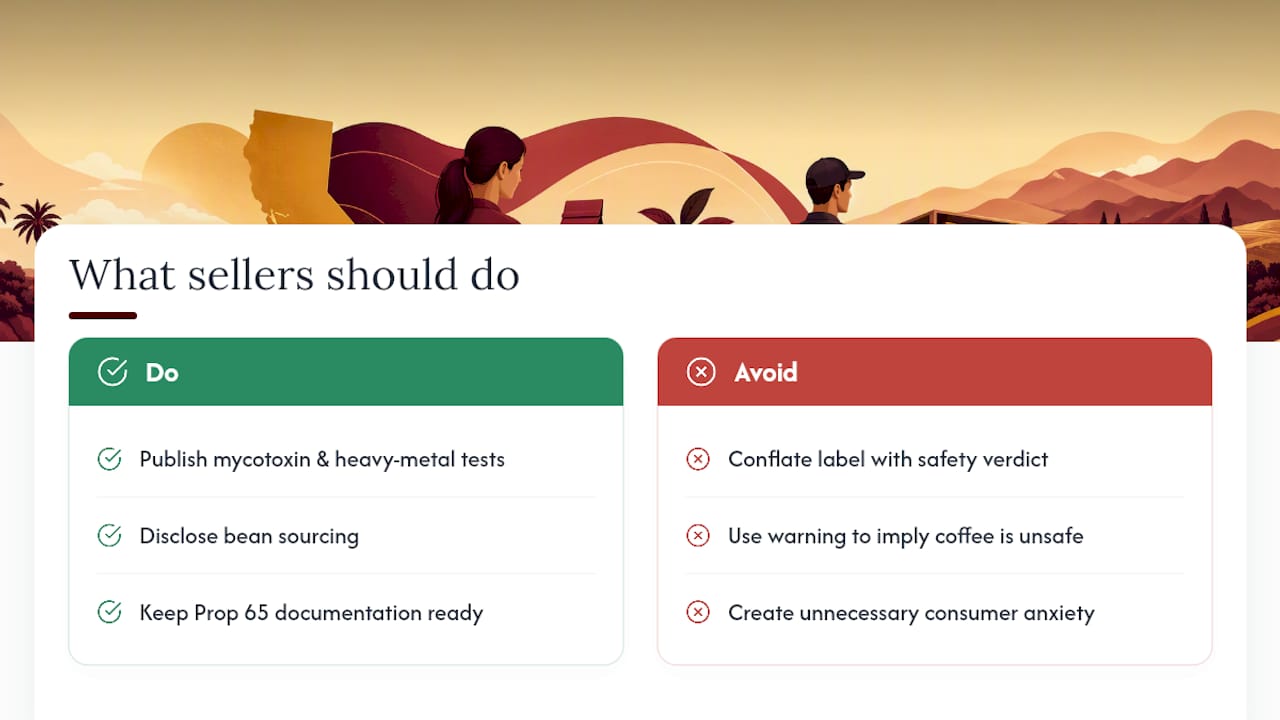
Where this gets interesting for buyers is the gap between what a warning label implies and what it actually meant, even before 2019. A Prop 65 warning was never a verdict on coffee’s safety. It was a legal technicality about who had the burden of proof. Conflating the two led to a lot of unnecessary anxiety over a beverage IARC’s own review found no solid evidence to convict.
Specialty roasters have an opening here that goes beyond compliance. Publishing test results for mycotoxins and heavy metals, disclosing sourcing, and keeping documentation ready isn’t required by Prop 65. It’s a choice that separates a roaster who treats coffee as a commodity from one who treats it as a product worth standing behind.
— Jett