

Start at 1:15, which is 1 gram of coffee for every 15 grams of water. Use a coarse grind, steep for 4 minutes, and pour off the brewed coffee the moment you finish plunging. Ratios below 1:15 (like 1:12) build a stronger, heavier cup; ratios above it (like 1:17) pull back toward something lighter and more tea-like. Weigh your coffee once and you’ll never guess again.
TL;DR:
- Using a water-to-coffee ratio of 1:15 is recommended as a starting point, but adjusting between 1:12 and 1:17 depends on desired strength and flavor.
- Weighing coffee with a scale provides consistency and helps account for differences in roast level, grind density, and brewing variables.
- French press immersion extraction pulls more body and fullness at the same ratio, requiring careful control of steep time, temperature, and decanting immediately after pressing.
- Roast level influences extraction speed, with darker roasts often benefiting from a slightly higher water ratio to smooth out sharper flavors.
- Water quality and freshness of beans significantly impact taste, and both should be optimized before fine-tuning ratio and steeping parameters.
Table of Contents
- What Is the Ideal French Press Coffee Ratio?
- Ratio Chart by French Press Size
- How Do You Brew French Press Coffee Using a 1:15 Ratio?
- Why Does My French Press Coffee Taste Weak or Bitter?
- Can You Measure French Press Coffee Without a Scale?
- Why the Immersion Method Changes How You Should Think About Ratio
- Quick Cheat Sheet: Three French Press Recipes to Memorize
- Does Bean Type or Roast Level Change the Ideal Ratio?
- Does Water Quality Affect Your Coffee-to-Water Ratio?
- How Does Coffee Freshness Change the Right Ratio?
- A Note on Weight, Roast, and Getting Out of Your Own Way
- Ready to Put This Ratio to Work?
- Sources
What Is the Ideal French Press Coffee Ratio?
Most professional brewing guidance lands on a range roughly between 1:10 and 1:17, with 1:15 sitting as the widely accepted starting point according to the National Coffee Association. That means for every gram of coffee, you’re using 15 grams (roughly 15 milliliters) of water.
The math is simple once you see it in action. A 1:12 or 1:13 ratio uses less water relative to coffee, so you end up with a denser, more intense cup. Push toward 1:16 or 1:17, and you’re diluting the same amount of coffee into more water, producing something lighter and easier to drink black. Neither end of that range is “wrong.” It’s a dial, not a rule.
Grind size, water temperature, and steep time all interact with your ratio, but ratio is the lever that determines strength most directly. Nail it first, then use the other variables to fine-tune texture and clarity.
Ratio Chart by French Press Size
Once you know your press size, scaling the recipe is just arithmetic. This chart uses 1:15 as the balanced default and 1:17 as the lighter alternative, since those two bracket what most drinkers actually prefer.
These tablespoon figures are close approximations pulled from common French press ratio charts, but roast level and grind coarseness change how densely coffee packs into a spoon. A scale removes that guesswork entirely, and once you’ve weighed a batch or two, you’ll start eyeballing volumes with real confidence anyway.
How Do You Brew French Press Coffee Using a 1:15 Ratio?
You don’t need fancy equipment, but a kitchen scale and a burr grinder make the difference between a repeatable cup and a lucky one. Blade grinders chop unevenly, which throws off extraction no matter how careful you are with water weight.
- Heat your water to about 200°F (93°C). No thermometer? Bring it to a rolling boil, then wait roughly 30 seconds before pouring. Full boiling water scalds grounds and drags out bitterness.
- Weigh your coffee on a coarse grind setting, similar in texture to sea salt.
- Add the coffee to the press, then pour the water over it, saturating all the grounds evenly.
- Break the crust at around the one-minute mark by stirring gently. This step keeps extraction even instead of leaving dry pockets floating on top.
- Let it steep for a total of 4 minutes, then press the plunger down slowly and steadily.
- Decant immediately into a carafe or mug. Coffee left sitting on the grounds keeps extracting and turns bitter fast.
For a solid medium batch, try 30 grams of coffee to 450 grams of water, which lands right at 1:15 following the standard step-by-step French press method. Adjust the grind size slightly if your beans are especially fresh or oily, since those brew a bit faster than drier, older stock.
Why Does My French Press Coffee Taste Weak or Bitter?
Dialing in French press coffee is a process of changing one variable at a time and tasting between adjustments. Jumping straight to a finer grind when your real problem is timing just muddies the diagnosis.
- Tastes weak or watery: Add 1 to 2 grams of coffee per 250 to 300 milliliters of water, or extend the steep by 30 to 60 seconds before touching the grind.
- Tastes bitter or harsh: Coarsen the grind slightly, cut the steep time by 30 to 60 seconds, or raise your ratio (use more water relative to coffee).
- Tastes muddy or overly thick: Check whether your grind is too fine, whether you pressed too aggressively, or whether the coffee sat on the grounds after plunging instead of being decanted right away.
Pro Tip: Keep a running tasting log with three columns: ratio, grind setting, and steep time. After four or five brews, patterns jump out that memory alone would never catch.
Small, deliberate changes get you to your ideal cup faster than overhauling everything at once, a point echoed in most detailed ratio breakdowns.
Can You Measure French Press Coffee Without a Scale?
You can get close with a tablespoon, though it’s an approximation, not a precise substitute. A level tablespoon of coffee generally weighs somewhere around 7 to 8 grams, but that number shifts depending on roast density and grind size, according to cup-size brewing charts.
- For an 8 oz press, use about 2 level tablespoons for a 1:15 result.
- For a 12 oz press, aim for roughly 3 tablespoons.
- For a large 34 oz press, closer to 9 tablespoons gets you in range.
A $10 to $15 kitchen scale is worth the investment if consistency matters to you. Volume measurements drift with humidity, grind coarseness, and how tightly the coffee settles in the spoon. Weight never lies.
Why the Immersion Method Changes How You Should Think About Ratio
A French press is an immersion brewer: every ground particle sits in contact with water for the entire steep, unlike pour-over where water passes through and moves on. That full, sustained contact pulls more body out of the coffee at the same ratio, which is part of why French press recipes often run slightly stronger-feeling than drip coffee brewed at similar numbers.
Immersion extraction means every particle gets equal contact time, producing fuller body at the same ratio compared to drip methods. That’s the mechanical reason French press coffee feels heavier in the mouth even when the math looks identical to a pour-over recipe.
Temperature matters just as much here. The accepted range is 93°C plus or minus 3 degrees (about 200°F), per NCA brewing standards. Water that’s too hot scalds the grounds; water that’s too cool under-extracts and tastes flat.
Decanting immediately after plunging isn’t optional if you care about consistency. Grounds still sitting in contact with brewed coffee keep extracting for as long as they touch it, which is how a perfectly balanced pour turns bitter ten minutes later sitting in the press.
Quick Cheat Sheet: Three French Press Recipes to Memorize
Pin this to your fridge or screenshot it. These three profiles cover almost everyone’s preference range.
| Style | Ratio | Steep Time | If It’s Off |
|---|---|---|---|
| Light | 1:17 | 3:30 | Too weak: drop to 1:16 or add 30 seconds |
| Balanced | 1:15 | 4 minutes | Too strong or weak: shift one full ratio step |
| Strong | 1:13 | 4:30 | Too bitter: coarsen grind or shorten steep |
Whichever row you pick, keep the grind coarse and decant the moment you finish pressing. Those two habits do more for cup quality than any ratio tweak alone.
Does Bean Type or Roast Level Change the Ideal Ratio?
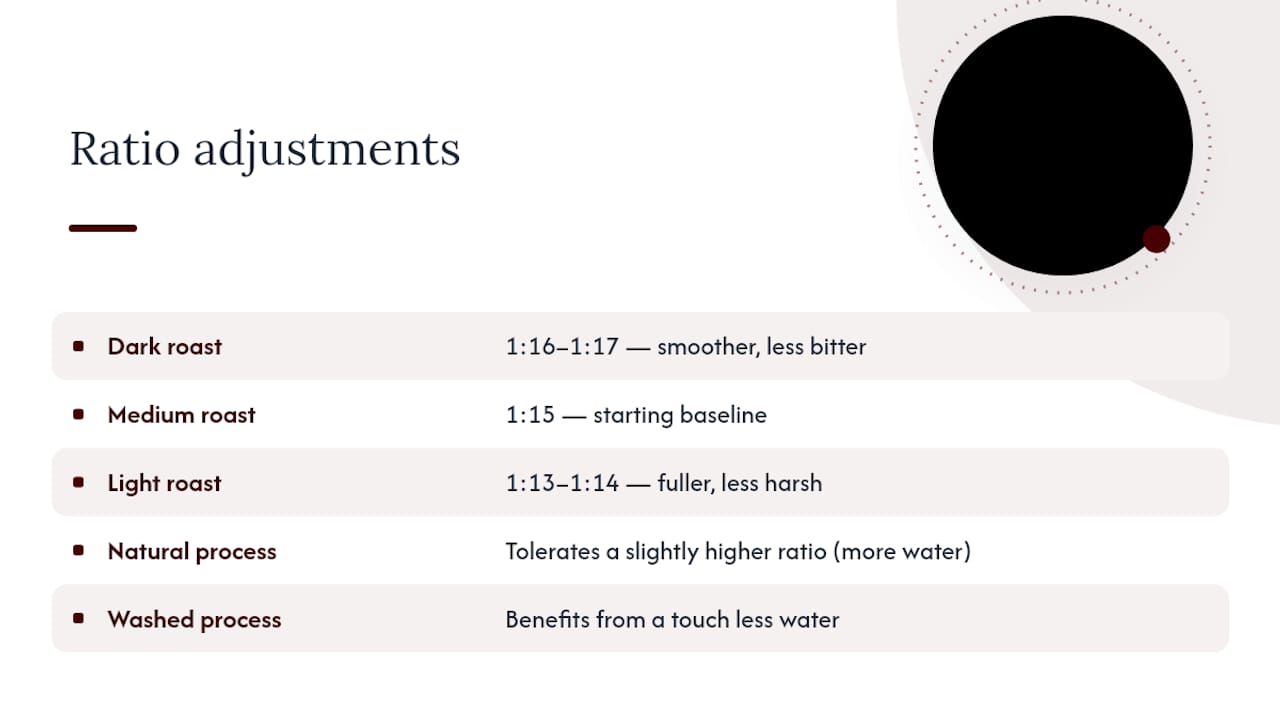
Roast level shifts how a bean behaves in water more than most people expect. Darker roasts are more porous and brittle from longer roasting, so they extract faster and release more soluble compounds at the same grind and time. That’s why a 1:15 dark roast can taste sharper or more bitter than a 1:15 medium roast brewed identically. Nudging the ratio toward 1:16 or even 1:17 for darker beans often smooths that out without losing intensity.
Lighter roasts are denser and extract more slowly. They tend to hold up well at 1:14 or even 1:13 without turning harsh, since there’s simply less soluble material breaking down that quickly. If you’re brewing a light roast at 1:15 and it tastes thin, that’s often a signal the ratio needs tightening rather than a flaw in the coffee itself.
Bean origin plays a smaller but real role too. Naturally processed coffees, common with many African-origin beans, tend to carry more inherent sweetness and fruit character, which can handle a slightly higher ratio (more water) while still tasting full. Washed coffees, often cleaner and more acidic, sometimes benefit from a touch less water to bring out body and round off sharp edges.
None of this means you need a different ratio for every bag you buy. It means 1:15 is a starting line, not a finish line, and roast level is usually the first thing worth adjusting for if a “correct” ratio still tastes off.
Does Water Quality Affect Your Coffee-to-Water Ratio?
Water that’s too soft, with very low mineral content, struggles to extract efficiently, which can leave a French press tasting flat even at a normally reliable ratio. Water that’s very hard, heavy in calcium and magnesium, can over-extract certain compounds and mute the coffee’s natural brightness.
If your tap water tastes off on its own, filtered water is worth using before you start adjusting ratios to compensate. Chlorine, sulfur notes, or excess minerals all show up more obviously in black coffee than in most other drinks. Bottled spring water or a basic carbon filter pitcher solves this for most home setups without needing anything elaborate.
Here’s the practical takeaway: if you’ve dialed in your ratio, grind, and steep time and the coffee still tastes muted or strange, look at your water before touching your recipe again. Swapping water sources sometimes fixes a “ratio problem” that was never really about ratio at all.
How Does Coffee Freshness Change the Right Ratio?
Freshly roasted coffee, particularly beans roasted within the past two to three weeks, releases carbon dioxide gas that interferes with even water saturation during brewing. That gas creates the thick foamy “bloom” you see when hot water first hits the grounds, and it can cause uneven extraction if you’re not stirring to break the crust.
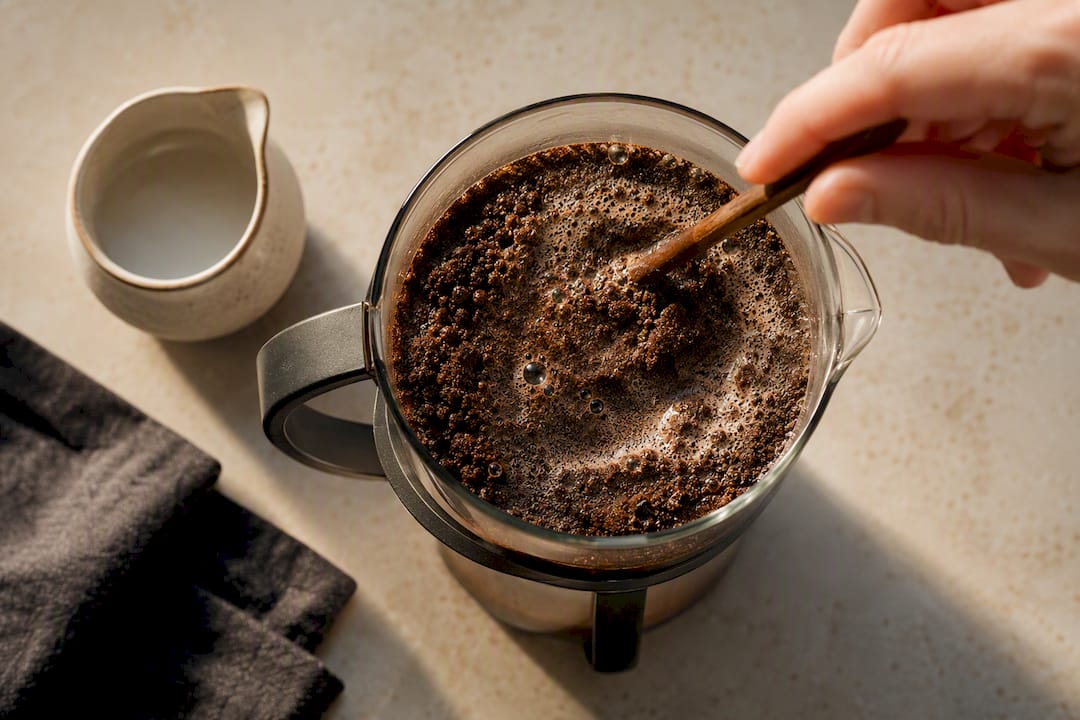
Very fresh beans often extract faster and can taste sharper at a standard 1:15 ratio than the same beans would a few weeks later, once the gas has settled down. If your coffee is only days old, nudging toward 1:16 or shortening the steep by 15 to 30 seconds can tame that intensity.
On the other end, stale coffee, beans sitting around for a month or more past roast date, loses volatile aromatics and often needs a slightly stronger ratio, like 1:14, just to taste like anything at all. No ratio adjustment brings back flavor that’s already gone, though, so freshness itself matters more than any recipe tweak.
The practical rule: taste your coffee within the first week of opening a bag whenever possible, and treat ratio adjustments for freshness as minor corrections, not a fix for beans that are already past their prime.
A Note on Weight, Roast, and Getting Out of Your Own Way
Weighing your coffee isn’t a barista flex. It’s the single fastest way to stop guessing and start actually tasting the differences between roasts, origins, and grind settings. Once you know your ratio is locked, every change you make is deliberate instead of accidental.
That precision matters more with a well-roasted bean, since a clean, carefully sourced coffee has more nuance worth protecting. Espritkaffe roasts with that in mind, so a dialed-in 1:15 recipe actually reveals what’s in the cup instead of masking it.
— Jett
Ready to Put This Ratio to Work?
A great ratio only matters if the coffee behind it is worth the attention. Freshly roasted beans, sold by roast level and origin rather than sitting on a shelf for months, are what actually reward the kind of precision this guide walks through. If you want beans roasted specifically to hold up to a careful 1:15 French press recipe, the Esprit Kaffe Members Club subscription delivers fresh roasts on a schedule so you’re never brewing coffee that’s already past its peak. Every order ships based on your chosen roast, whether that’s a light roast built for clarity or a dark roast that can handle a slightly higher ratio without losing its character.
Sources
- French press coffee - NCA - About Coffee
- French Press Ratio: How Much Coffee Per Cup (and Why It Matters) | Barista At Home