

French press brewing is a full-immersion brewing method where coarsely ground coffee steeps in hot water for approximately four minutes before a metal mesh plunger separates the grounds from the liquid, producing a rich, oil-forward, full-bodied cup. Also called a cafetiere or coffee plunger depending on where you live, the French press is one of the most direct and rewarding ways to brew at home. No paper filters, no complicated machines, no hidden variables. What you get is coffee in its most unfiltered form: textured, aromatic, and deeply satisfying when done right. This guide covers what is French press brewing explained in full, from the core mechanics to advanced techniques used by professionals.
What is French press brewing and how does it work?
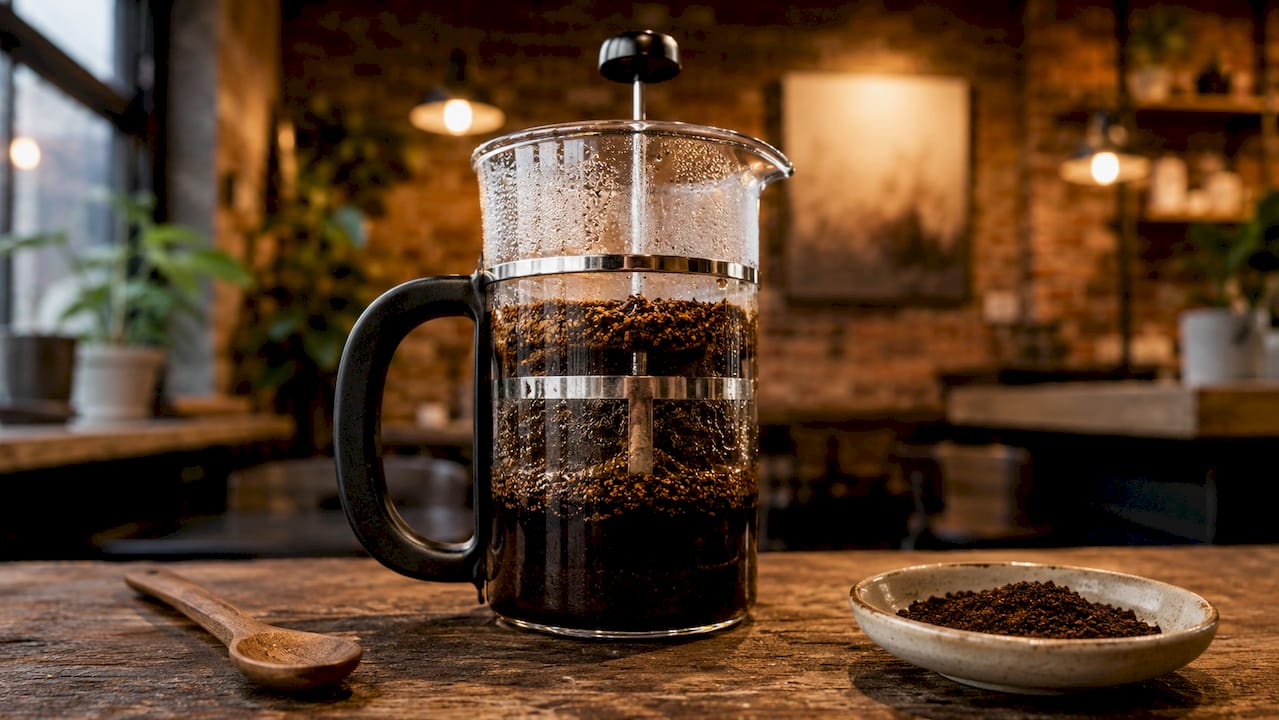
French press brewing works by submerging coffee grounds completely in hot water for the entire steep duration. This is what separates it from drip or pour-over methods, where water passes through grounds quickly and continuously. The standard steep time is 4 minutes with a recommended coffee-to-water ratio of 1:15, meaning roughly 30 grams of coffee to 450 milliliters of water. After steeping, you press the metal mesh plunger down slowly to push the grounds to the bottom, then pour immediately.
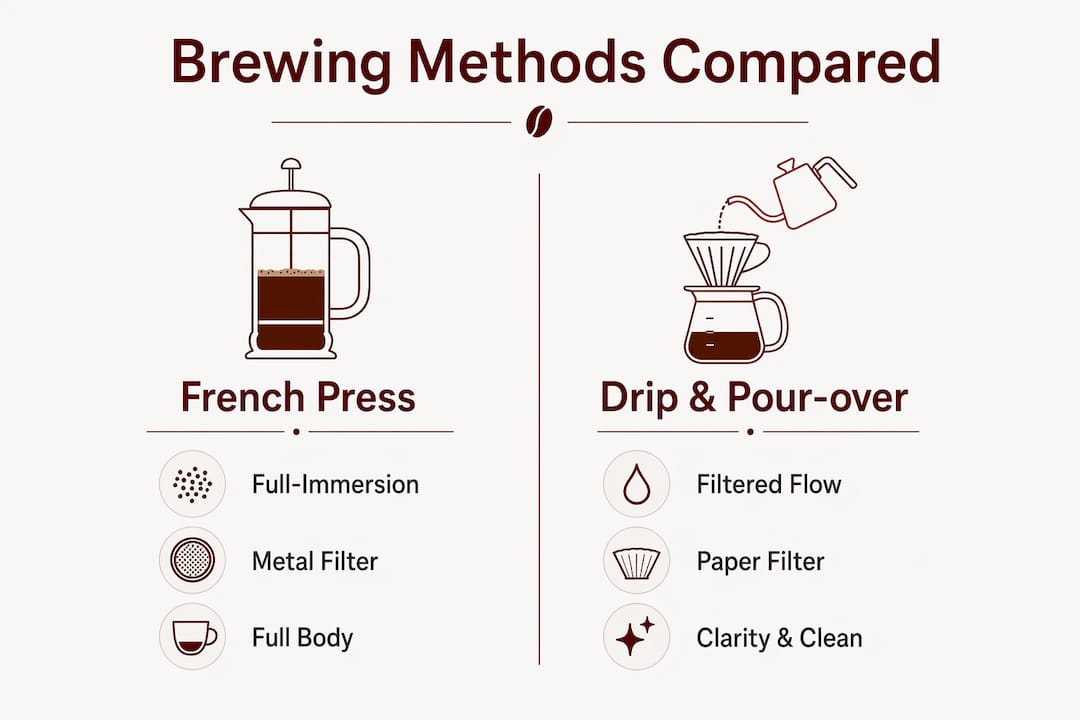
The metal mesh filter is what defines the French press flavor profile. Unlike paper filters used in drip machines or pour-over setups like the Hario V60, the mesh allows natural coffee oils and fine particles to pass into the cup. The result is a heavier mouthfeel, softer acidity, and a flavor depth that paper-filtered methods simply cannot replicate. If you have ever wondered why your French press coffee tastes richer than your drip machine produces, the absence of paper is the answer.
What variables affect French press brewing quality?
Getting the most from your French press depends on controlling five core variables. Each one influences the final cup in a measurable way, and understanding them is the difference between a good brew and a great one.
The five variables that matter most:
- Coffee-to-water ratio. The 1:15 ratio is the sweet spot for most drinkers. Measure by weight, not volume. A kitchen scale like the Hario V60 Drip Scale or any basic digital scale gives you repeatable results that tablespoons never will.
- Grind size. Coarse is non-negotiable. Think sea salt texture. A consistent coarse grind prevents fines from slipping through the mesh and turning your cup muddy or bitter.
- Water temperature. The target range is 195°F to 205°F. Water straight off the boil sits around 212°F and can scorch lighter roasts. Let it rest for 30 to 45 seconds after boiling, or use a temperature-controlled kettle like the Fellow Stagg EKG.
- Steep time. Four minutes is the standard starting point. Light roasts can benefit from a slightly shorter steep; darker roasts may need less time since they extract faster. Adjust in 30-second increments.
- Plunge speed. A slow, controlled plunge over 20 to 30 seconds keeps sediment at the bottom and preserves cup clarity.
Pro Tip: Preheat your carafe by filling it with hot water for 30 to 60 seconds before brewing. This is especially important with glass presses, where thermal shock and temperature loss can drop your brew temperature by several degrees mid-steep, throwing off extraction.
One variable many home baristas overlook is grinder quality. Blade grinders like basic models from Hamilton Beach produce wildly inconsistent particle sizes, which means some grounds over-extract while others under-extract simultaneously. A burr grinder, whether a hand grinder like the Timemore C2 or an electric model like the Baratza Encore, delivers the uniform coarse grind that French press demands.
How does French press compare to drip and pour-over?
The French press brewing technique sits in a different category from most home brewing methods. Understanding where it stands helps you choose the right tool for the right moment.
| Brewing method | Filter type | Body | Clarity | Skill level | Best for |
|---|---|---|---|---|---|
| French press | Metal mesh | Full, heavy | Low, some sediment | Beginner to intermediate | Rich, textured cups |
| Drip (auto) | Paper | Light to medium | High | Beginner | Convenience, volume |
| Pour-over (V60, Chemex) | Paper | Light to medium | Very high | Intermediate to advanced | Bright, clean cups |
| Espresso | Metal portafilter | Very full, concentrated | Medium | Advanced | Shots, milk drinks |
The most significant difference between French press and drip or pour-over is what ends up in your cup. Natural coffee oils remain in French press coffee because no paper filter absorbs them. This produces a heavier body and slightly softer acidity compared to a Chemex or Kalita Wave brew. For drinkers who love a bold, coating mouthfeel, French press wins. For those who prefer a bright, transparent cup, pour-over is the better fit.
French press versus drip coffee also comes down to control. An automatic drip machine like a Technivorm Moccamaster handles temperature and timing for you. A French press puts every variable in your hands. That is both the appeal and the responsibility of the method.
How to brew French press coffee: standard and Hoffmann methods
Two approaches dominate serious French press brewing: the classic four-minute method and James Hoffmann’s sediment-reduction technique. Both produce excellent coffee. The right choice depends on how much time you have and how much sediment you can tolerate.
The standard four-minute method
- Preheat the carafe with hot water for 30 to 60 seconds, then discard.
- Add coarsely ground coffee at a 1:15 ratio by weight (30g coffee to 450ml water).
- Start your timer and pour hot water (195°F to 205°F) over the grounds, saturating them fully.
- At 30 seconds, give the grounds a gentle stir to break up any dry clumps. This is the bloom phase.
- Place the lid on the press with the plunger pulled up. Do not press yet.
- At 4 minutes, press the plunger down slowly and steadily over 20 to 30 seconds.
- Pour immediately and completely. Do not leave coffee sitting on the grounds.
Decanting immediately after plunging is the step most home brewers skip. Coffee left in contact with the grounds continues extracting, and within minutes the cup turns bitter and astringent. If you cannot serve right away, pour into a separate thermal carafe.
The James Hoffmann method
- Add coffee and water at the same 1:15 ratio. Do not stir.
- At 4 minutes, break the crust of grounds floating on top with a spoon and skim off the foam and loose grounds.
- Place the lid on without pressing. Wait an additional 5 to 8 minutes. The fines settle to the bottom naturally.
- Lower the plunger very gently just below the surface of the liquid. Do not push it all the way down.
- Pour slowly and stop before the sediment at the bottom disturbs.
Hoffmann’s method trades total brew time of roughly 10 to 12 minutes for significantly less sediment and a noticeably cleaner cup. The flavor is still full-bodied compared to pour-over, but without the gritty finish that puts some drinkers off French press entirely.
Pro Tip: Try the Hoffmann method on a weekend when you have time to observe it. The difference in cup clarity compared to the standard method is immediately visible and worth experiencing at least once before deciding which approach fits your routine.
Troubleshooting common French press problems
Even experienced home baristas hit flavor walls. Most French press problems trace back to one of four variables, and fixing them is straightforward once you know what to look for.
- Bitter or harsh coffee. The most common cause is over-extraction. Check your grind first. If it is too fine, fines slip through the mesh and extract aggressively. Also confirm you are decanting immediately. Leaving coffee on the grounds after pressing is the fastest route to bitterness.
- Muddy or gritty texture. This points to grind size. Grinding too fine forces particles through the mesh filter, creating a muddy cup. Coarsen your grind by one or two steps on your burr grinder.
- Weak or sour coffee. Sourness signals under-extraction. Your grind may be too coarse, your ratio too low, your water too cool, or your steep time too short. Start by checking the ratio and grind before adjusting temperature.
- Plunger is hard to push. High resistance during plunging means your grind is too fine. The plunger should meet firm but manageable resistance, completing the press in 20 to 30 seconds. If it feels like pushing through concrete, coarsen the grind.
- Flat or stale flavor. This is almost always a freshness issue. Coffee degrades rapidly after roasting and even faster after grinding. Buy whole beans, store them in an airtight container away from light, and grind just before brewing.
Adjust one variable at a time when troubleshooting. Changing grind size and ratio simultaneously makes it impossible to know which fix worked. Isolate the variable, brew, taste, then decide.
Selecting and maintaining your French press equipment
The right equipment makes the French press brewing technique repeatable and enjoyable. You do not need to spend a fortune, but a few key choices matter significantly.
- Burr grinder over blade grinder. This is the single most impactful upgrade you can make. The Timemore C2, Baratza Encore, and 1Zpresso JX are all reliable options at different price points. Consistent particle size is what separates a clean cup from a muddy one.
- Carafe material. Glass presses like the Bodum Chambord show you the brew and are easy to clean, but they lose heat faster. Stainless steel options like the Frieling Double Wall retain temperature better and are more durable for travel or outdoor use.
- Mesh filter quality. The stock filter on most presses works well when new. Replace it when it shows warping, tears, or when sediment levels increase noticeably. Replacement filters for popular models like the Bodum are inexpensive and widely available.
- Scales and kettles. A basic digital scale and a gooseneck kettle with temperature control remove guesswork entirely. The Fellow Stagg EKG and Bonavita Variable Temperature Kettle are two well-regarded options.
- Cleaning routine. Regular cleaning prevents stale oils from building up and tainting future brews. Disassemble the plunger after every use, rinse all parts thoroughly, and deep clean with a mild dish soap weekly.
Key takeaways
French press brewing produces its distinctive full-bodied cup because the metal mesh filter retains natural coffee oils that paper-filtered methods remove, making grind size, ratio, and immediate decanting the three variables that matter most.
| Point | Details |
|---|---|
| Full-immersion method | Coffee steeps completely submerged for 4 minutes at a 1:15 coffee-to-water ratio. |
| Coarse grind is mandatory | Sea salt texture prevents fines from passing through the mesh and causing bitterness. |
| Decant immediately | Leaving coffee on the grounds after plunging causes over-extraction within minutes. |
| Hoffmann method reduces sediment | Breaking the crust, skimming, and waiting 5 to 8 minutes before a gentle pour produces a cleaner cup. |
| Troubleshoot one variable at a time | Changing ratio, grind, temperature, or time separately isolates the cause of flavor problems. |
The misconception that costs most home baristas their best cup
Most people treat the French press like a timer-based appliance. Set it, walk away, come back in four minutes, press, pour. That mindset produces acceptable coffee. It rarely produces great coffee.
The French press requires active management. The moment the plunger goes down, extraction does not stop. The grounds are still in contact with the liquid. Every extra minute the coffee sits in the press after plunging pushes it further toward bitterness. I have seen home baristas nail the grind, ratio, and temperature perfectly, then leave the press on the counter for ten minutes while they check their phone. The cup they pour is a shadow of what it could have been.
My honest recommendation: master the ratio and grind consistency before you experiment with anything else. Those two variables account for the majority of flavor outcomes. Minor shifts in water temperature or steep time matter far less than getting the grind right and measuring by weight every time.
The Hoffmann method is genuinely worth trying, but it is a trade-off, not an upgrade for every situation. If you want a cleaner cup and have 12 minutes, it delivers. If you want coffee in four minutes without thinking too hard, the standard method done correctly is excellent. The best French press technique is the one you execute consistently.
Experiment with different origin coffees to understand how the French press amplifies regional flavor characteristics. A Sulawesi bean brewed in a French press tastes completely different from the same bean through a pour-over. That discovery alone makes the method worth mastering.
— Jett
Espritkaffe coffees built for the French press

The French press rewards bold, well-developed roasts more than almost any other brewing method. The full-immersion process pulls deep flavor from medium and dark roasts that lighter, faster methods leave behind. Espritkaffe’s Coffee with Mushrooms Medium Roast was built for exactly this kind of brewing. The balanced body and earthy depth that define it come through fully in a French press cup. For those who prefer something bolder, the Coffee with Mushrooms Dark Roast delivers the kind of rich, coating mouthfeel the method was designed to produce. Both are roasted to order, which means the freshness you need for peak French press flavor is built into every bag.
FAQ
What is the correct coffee-to-water ratio for French press?
The standard French press coffee ratio is 1:15, meaning 1 gram of coffee for every 15 grams of water. For a typical 450ml brew, that equals approximately 30 grams of coffee measured by weight.
How coarse should the grind be for French press?
The grind should resemble coarse sea salt in texture. A burr grinder produces the consistent coarse grind that French press requires. Blade grinders create uneven particles that cause both over-extraction and muddy sediment.
Why does my French press coffee taste bitter?
Bitterness in French press coffee is almost always caused by over-extraction. The most common culprits are a grind that is too fine, water that is too hot, or leaving the coffee in contact with the grounds after plunging instead of decanting immediately.
How does the James Hoffmann French press method work?
Hoffmann’s method skips aggressive plunging. After a 4-minute steep, you break the crust, skim the foam, wait 5 to 8 more minutes for fines to settle, then lower the plunger gently and pour slowly. The result is a cleaner, less sediment-heavy cup.
Is French press coffee stronger than drip coffee?
French press coffee is typically fuller-bodied and more textured than drip coffee because the metal mesh filter retains natural oils that paper filters absorb. Strength depends on your ratio, but the mouthfeel and flavor intensity are noticeably greater than most automatic drip machines produce.