

A coffee grind chart is a reference guide that maps grind particle sizes to specific brewing methods, giving you a direct path from bean to optimal extraction. Grind sizes range from under 200 microns for Turkish coffee to over 1,000 microns for cold brew, with every point on that spectrum affecting flavor, clarity, and body. The industry term for this reference system is a “grind size chart” or “particle size guide,” and understanding it separates a flat, forgettable cup from one that actually tastes like the bean deserves. Whether you brew with a Chemex, a Moka pot, or a French press, your grind size is the single variable with the most leverage over the final result.
What the coffee grind chart actually shows
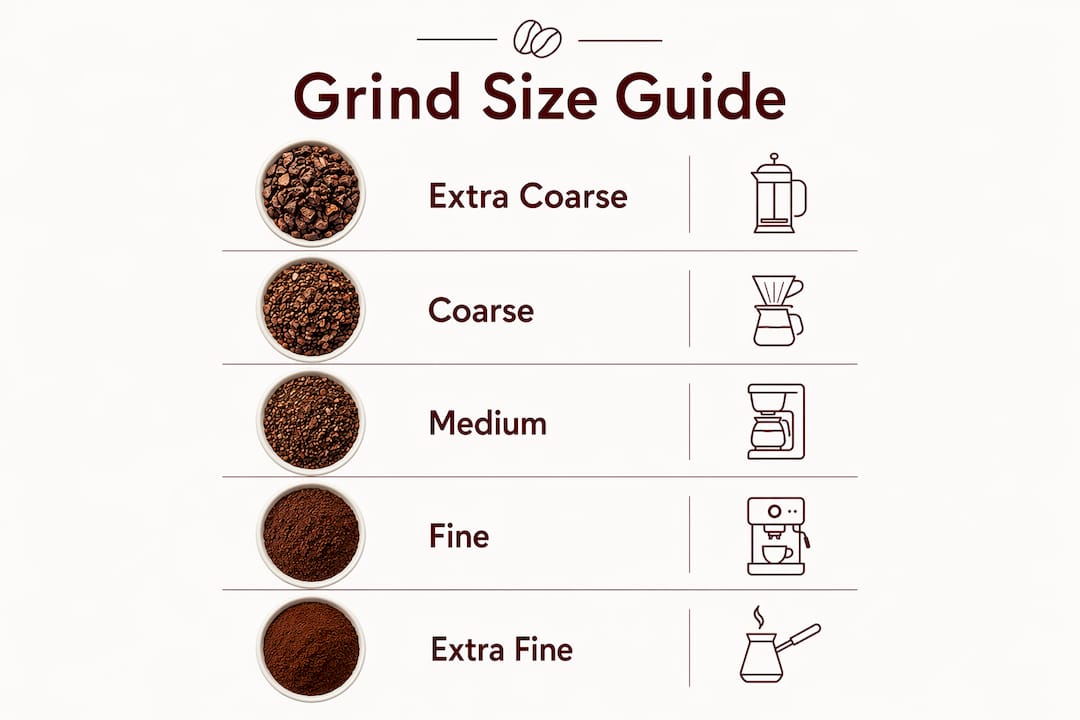
The grind chart organizes coffee into seven standard categories, each defined by a micron range, a texture analog, and a set of compatible brew methods. Knowing where your method falls on that spectrum is the foundation of every good cup.
| Grind size | Texture analog | Micron range | Best brew methods | Extraction time |
|---|---|---|---|---|
| Extra coarse | Cracked peppercorn | 1,000–1,800 μm | Cold brew, cowboy coffee | 12–24 hours |
| Coarse | Sea salt | 800–1,000 μm | French press, percolator | 4–8 minutes |
| Medium-coarse | Rough sand | 650–800 μm | Chemex, Clever Dripper | 4–6 minutes |
| Medium | Regular sand | 500–650 μm | Drip coffee makers, pour-over | 3–5 minutes |
| Medium-fine | Table salt | 350–500 μm | Siphon, AeroPress | 1–3 minutes |
| Fine | Powdered sugar | 200–350 μm | Espresso, Moka pot | 25–35 seconds |
| Extra fine | Flour | Under 200 μm | Turkish coffee | 3–5 minutes (unfiltered) |
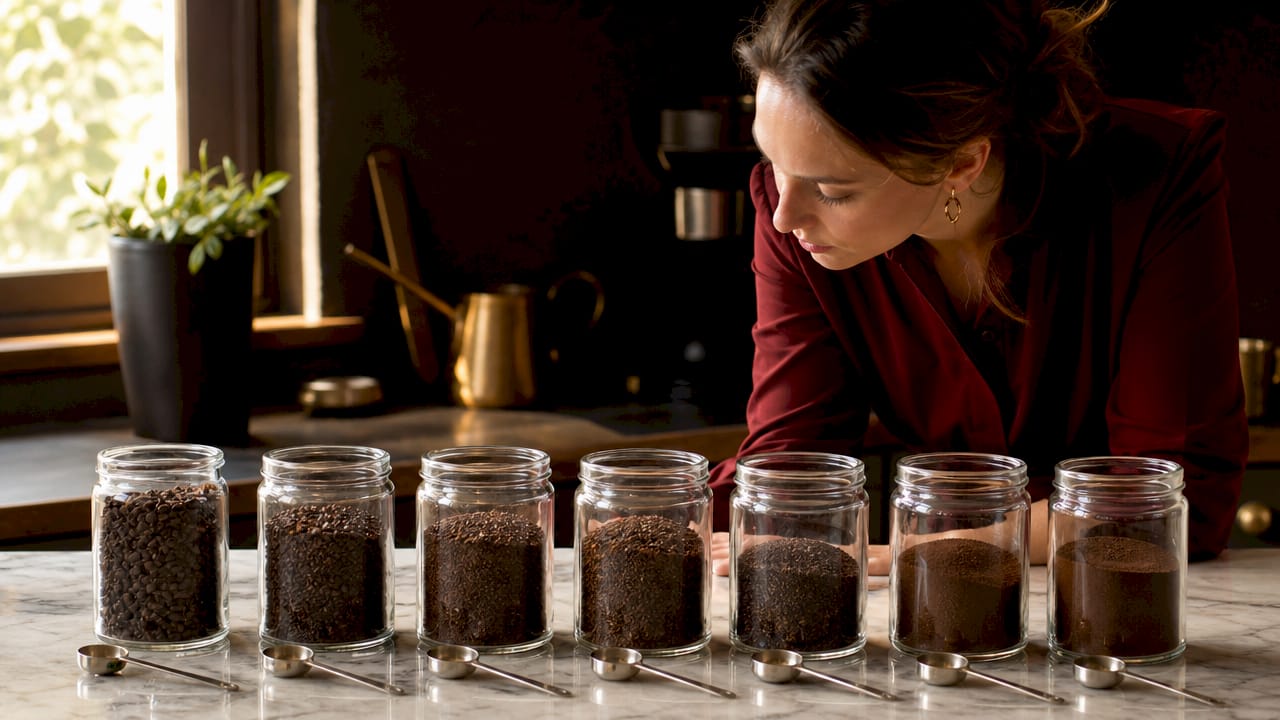
Texture analogies like cracked peppercorn for extra coarse and powdered sugar for extra fine give you an immediate visual check without needing a micrometer. These comparisons are practical because most home brewers calibrate by feel and sight before they ever measure. The micron ranges above reflect the 2026 industry standard, and they exist because brew contact time determines how much dissolved material ends up in your cup.
Pro Tip: Rub a pinch of ground coffee between your fingers. If it feels gritty and distinct, you are in coarse territory. If it smears like talc, you are approaching espresso or Turkish range.
Cold brew sits at the coarse end because water and coffee stay in contact for up to 24 hours. Espresso sits at the fine end because pressurized water passes through the puck in under 35 seconds. The chart is not arbitrary. It reflects the physics of water moving through particles at different speeds and pressures.
How grind size and brewing method interact to shape flavor
Grind size controls surface area, and surface area controls extraction speed. A finer grind exposes more of the coffee’s interior to water, pulling soluble compounds faster. A coarser grind slows that process down. Match the wrong size to the wrong method and you get either a sour, sharp cup from under-extraction or a bitter, harsh one from over-extraction.
Espresso is the most sensitive method on the entire chart. Even a 5-micron shift in particle size changes the resistance the water meets, altering flow rate and flavor noticeably. French press and cold brew, by contrast, tolerate more variation because the long immersion time compensates for minor inconsistencies. This is why beginners often find French press more forgiving than espresso when they are still learning to dial in.
Here are the most common grind-related mistakes and what they taste like:
- Too coarse for the method: Sour, sharp, thin body. Water moved through too fast and left most of the flavor behind.
- Too fine for the method: Bitter, harsh, astringent. Water extracted too much, pulling the unpleasant compounds.
- Inconsistent particle size: Muddy, uneven flavor. Fine particles over-extract while large ones under-extract simultaneously.
- Correct grind, wrong brew time: Flat or muted flavor. Even a good grind fails if the contact time is off.
- Stale grind: Papery or cardboard notes. Ground coffee oxidizes within 30 minutes of grinding.
Particle distribution quality matters as much as the target micron number. A grinder that produces a wide range of particle sizes around the target creates extraction chaos in the cup. This is why grinder quality is the most impactful upgrade a home brewer can make.
Pro Tip: Brew a cup, let it cool slightly, and taste it without milk or sugar. The flavor at 140°F is more diagnostic than at 200°F. Sourness and bitterness are easier to identify when the heat is not masking them.
How to adjust your grind based on taste and equipment
The practical grind adjustment process follows one rule above all others: sour means grind finer, bitter means grind coarser. This single guideline handles the majority of brewing problems without requiring any technical knowledge of microns or extraction chemistry.
Follow these steps to dial in your grind from scratch:
- Start with the chart. Use the table above to identify the recommended grind size for your brew method. This is your baseline, not your destination.
- Brew a test cup. Use your standard dose, water temperature, and brew time. Do not change multiple variables at once.
- Taste and diagnose. Sour or sharp means under-extracted. Adjust one step finer. Bitter or harsh means over-extracted. Adjust one step coarser.
- Change only the grind. Keep water temperature, dose, and brew time constant until you isolate the grind as the variable.
- Account for bean type. Light roasts are denser and often need a finer grind than dark roasts at the same brew method. Dark roasts are more porous and extract faster.
- Factor in water temperature. Hotter water extracts faster. If you brew at 205°F and the cup is bitter, try dropping to 200°F before going coarser on the grind.
- Repeat until the cup is balanced. A balanced cup tastes sweet, clean, and complex without sharp edges in either direction.
The AeroPress is the most flexible brewer on the chart because it works across medium-fine to fine ranges and allows you to compensate with brew time. Turkish coffee is the least flexible. It requires extra fine grounds and no filter, so particle size directly determines texture and strength with no room for adjustment.
Iterative testing with taste feedback is the professional standard for dialing in any brew method. Baristas at specialty cafes like Blue Bottle Coffee and Intelligentsia pull multiple test shots before service each morning because ambient temperature and humidity shift extraction even when the grind setting stays the same.
Burr vs. blade grinders: why your equipment defines your ceiling
The grinder you use sets a hard ceiling on how well any grind chart can work for you. Burr grinders produce consistent particle sizes by crushing beans between two abrasive surfaces at a fixed distance. Blade grinders chop randomly, producing a wide distribution of particle sizes from dust to chunks in the same batch.
| Grinder type | Particle consistency | Price range | Best for | Main drawback |
|---|---|---|---|---|
| Flat burr | Excellent | $150–$2,000+ | Espresso, filter | Retains more grounds |
| Conical burr | Very good | $50–$1,500 | All methods | Slightly wider distribution |
| Blade grinder | Poor | $15–$40 | Emergency use only | Unpredictable results |
| Hand burr grinder | Good to very good | $30–$200 | Travel, pour-over | Time and effort |
Poor grinders produce excessive fines that clog paper filters, cause channeling in espresso pucks, and create the muddy, bitter notes that home brewers often blame on their beans. Upgrading from a blade grinder to an entry-level burr grinder like the Baratza Encore or the Timemore C2 produces a more noticeable improvement than switching from a mid-range bean to a premium one.
Key maintenance practices that protect grinder performance:
- Brush out the burr chamber weekly to prevent rancid oil buildup from old grounds.
- Run grinder cleaning tablets like Urnex Grindz through the burrs monthly.
- Calibrate burr alignment annually on flat burr grinders if you notice inconsistent espresso shots.
- Store the grinder away from steam and heat to protect the burr coating.
The grinder quality impact on cup quality is not a matter of preference. It is physics. Consistent particle size means consistent extraction, and consistent extraction means a predictable, repeatable cup every time you brew.
Key takeaways
Matching grind size to brew method using a coffee grind chart, combined with taste-based adjustments and a quality burr grinder, produces the most consistent and flavorful results at home.
| Point | Details |
|---|---|
| Grind size drives extraction | Finer grinds extract faster; coarser grinds slow extraction to match longer brew times. |
| Use the chart as a starting point | Taste feedback overrides any chart number. Sour means finer; bitter means coarser. |
| Espresso demands precision | Even 5-micron changes alter espresso flow and flavor, making it the least forgiving method. |
| Burr grinders are non-negotiable | Consistent particle size from a burr grinder improves cup quality more than upgrading beans. |
| Adjust one variable at a time | Isolate grind changes from water temperature and dose to accurately diagnose flavor problems. |
Why the chart is a compass, not a destination
I have brewed on everything from a $20 blade grinder to a $600 flat burr setup, and the single most useful shift in my approach was treating the grind chart as a starting coordinate rather than a fixed answer. The chart tells you where to begin. Your palate tells you where to go.
The most common mistake I see from home brewers is over-relying on the chart and under-relying on taste. Someone reads that medium grind works for drip coffee, dials in exactly that, and then accepts a mediocre cup because “the chart said so.” But a light roast Ethiopian Yirgacheffe brewed at 205°F in a flat-bottom dripper needs a different medium than a dark roast Sumatra brewed at 195°F in a cone dripper. The chart cannot account for all of that. You have to.
What I recommend to anyone serious about their home brew is to spend two weeks brewing the same coffee with the same method and adjusting only the grind, one step at a time. Keep notes. Taste at the same temperature each time. You will learn more about extraction in those two weeks than in a year of reading about it. The flavor exploration that comes from that process is genuinely one of the more satisfying things you can do as a coffee enthusiast.
The chart is a tool. Your taste is the standard. Use both.
— Jett
Find the right coffee to match your grind

Getting your grind dialed in is only half the equation. The coffee itself has to be worth the effort. At Espritkaffe, every roast is built for brewers who care about what ends up in the cup. The medium roast mushroom coffee works beautifully across medium to medium-fine grind ranges, making it a strong choice for pour-over, drip, and AeroPress brewers who want a clean, complex cup with functional benefits. For those working with extra coarse grinds and a long steep, the cold brew blend is roasted specifically for immersion brewing. Your grind knowledge is ready. Now pair it with coffee that rewards the precision.
FAQ
What is a coffee grind chart used for?
A coffee grind chart maps grind particle sizes to specific brew methods, helping you match extraction time to contact time for optimal flavor. It serves as a starting reference that you refine through taste.
What grind size is best for espresso?
Espresso requires a fine grind in the 200 to 350 micron range. Even small particle size changes affect flow rate and flavor, so espresso demands the most precise grind adjustment of any brew method.
Why does my coffee taste sour or bitter?
Sour coffee means under-extraction. Grind finer or extend brew time. Bitter coffee means over-extraction. Grind coarser or reduce brew time. These two adjustments resolve the majority of flavor problems.
Do I need a burr grinder to use a grind chart effectively?
A burr grinder is strongly recommended. Blade grinders produce inconsistent particle sizes that cause simultaneous over-extraction and under-extraction, making it nearly impossible to apply grind chart guidance accurately.
How often should I adjust my grind setting?
Adjust whenever the flavor shifts noticeably, which can happen with a new bag of beans, a change in water temperature, or seasonal humidity changes. Iterative taste testing is the standard method for maintaining a consistent cup.