

Your ideal coffee strength is whatever recipe you can reproduce on a random Tuesday morning without thinking. Pick a target (weak, medium, or strong), lock in a brew ratio, then run a short tasting test to confirm it. The Specialty Coffee Association publishes brew ratio guidance that most home methods still follow, and James Hoffmann’s roast breakdowns explain why two “medium” bags can taste nothing alike. Try this now:
- Tasting plan: 30 to 45 minutes, three cups, same beans, same grind.
- Starter recipe: 1:16 ratio, medium grind, water at 200°F, 4 minute steep. A bag like Espritkaffe’s medium roast works well here.
- Brew three ratios side by side.
- Taste black, then with milk.
- Write down the winner.
Key Takeaways
Reproducible coffee strength comes down to three fixed variables, ratio, grind, and time, tested once with a short tasting protocol and then never changed again.
| Point | Details |
|---|---|
| Strength is concentration, not caffeine | TDS measures flavor concentration; caffeine content depends on brew method and roast separately. |
| Ratio is your primary control | Start at 1:16 and move toward 1:14 for a noticeably stronger cup. |
| Darker roast isn’t more caffeine | Extended roasting time actually reduces caffeine content even as bitterness increases. |
| Test with three cups, one variable | Brew weak, medium, and strong side by side using the same beans and grind. |
| Espritkaffe medium roast for testing | A consistent, clarity-focused roast that holds up black or with milk during your tasting protocol. |
Table of Contents
- What Does Coffee “Strength” Actually Mean?
- Which Brewing Variables Change Strength the Most?
- How Do You Test Your Own Ideal Coffee Strength?
- Starter Recipes for Every Method and Strength Level
- Common Mistakes That Throw Off Your Strength
- Why Espritkaffe Roasts for Clarity, Not Just Caffeine
- Find Your Match With Coffee With Mushrooms Medium Roast
- Sources
What Does Coffee “Strength” Actually Mean?
Most people use “strong” to describe two different things: how concentrated the coffee tastes and how much caffeine it delivers. Those are not the same measurement. Strength refers to total dissolved solids, or TDS, which is just a way of saying how much coffee flavor is packed into the water. Caffeine content is a separate chemical question entirely, and the two often move in opposite directions.
Roast level muddies this further. Light roasts hold onto more acidity and brighter, more complex notes. Dark roasts push toward bitterness and heavier body, which reads as “stronger” to most palates even though the roasting process actually reduces caffeine content as beans spend longer over heat. A dark roast espresso can taste like a gut punch and still contain less caffeine than a mellow light roast drip coffee.
- Light roast: brighter, more acidic, less perceived strength.
- Medium roast: balanced body and acidity, works black or with milk.
- Dark roast: bitter, full body, reads as strongest.
Pro Tip: If you drink coffee black, lean lighter to taste real complexity. If milk is always going in the cup, go medium to dark so the flavor doesn’t get lost.
Which Brewing Variables Change Strength the Most?
Roast matters, but the dial you actually control every morning is brewing. Five variables determine what lands in your cup: dose (how much coffee relative to water), grind size, contact time, water temperature, and total serving size. Ratio does the heaviest lifting. Tightening from 1:16 toward 1:14 concentrates the cup fast, while loosening to 1:17 or 1:18 thins it out.
Grind size changes how quickly water pulls flavor out of the grounds. Finer grind means more surface area and faster extraction, but push it too far and you extract bitter compounds along with the good stuff. Contact time works the same way. Water temperature around 195 to 205°F is the standard range for most manual brews. Below that, extraction stalls and coffee tastes flat and sour. Above it, you risk scorching delicate notes.
Here’s where to start for each common method:
| Method | Weak | Medium | Strong |
|---|---|---|---|
| Drip/filter | about 1:17 | about 1:15 | about 1:13 |
| French press | about 1:16 | about 1:13 | about 1:15 |
| Aeropress | about 1:15 | about 1:13 | about 1:15 |
| Espresso | about 1:3 | about 1:2 | about 1:2 |
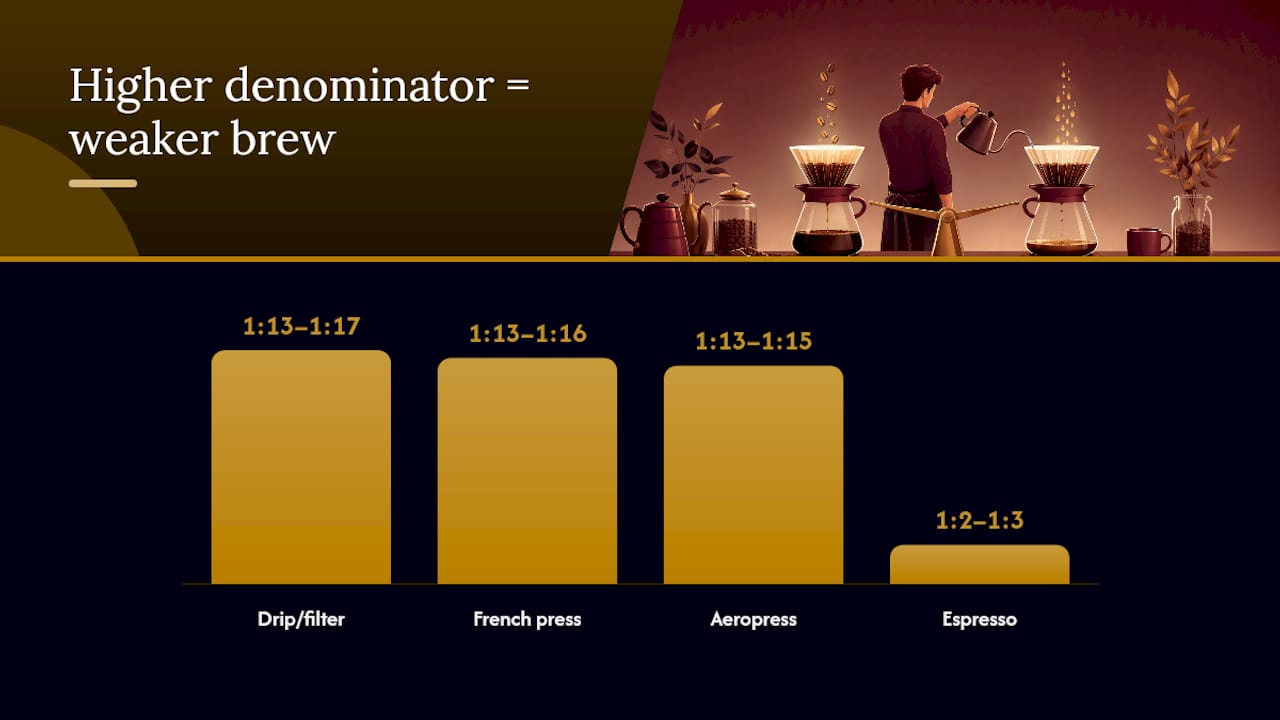
These ratios describe grams of coffee to grams of water, so a 1:15 pour-over means roughly 20 grams of coffee to 300 grams of water.
Pro Tip: Change one variable per brew. Adjust dose first since it’s the most reliable lever for perceived strength, then fine-tune grind or time only after you’ve locked in a ratio you like.
How Do You Test Your Own Ideal Coffee Strength?
This is the part most guides skip, and it’s the part that actually matters. Give yourself 30 to 45 minutes, one bag of coffee, and three cups.
- Brew three versions. Use the same beans and same grind setting, but hit three different ratios, weak (1:17), medium (1:15), and strong (1:13). Write down the exact grams for each so you can repeat it later.
- Taste in order, black first. Sip each one, starting with the weakest. Note acidity, body, and bitterness on a simple 1 to 5 scale. Then add a splash of milk to each and taste again, since milk mutes acidity and can flip your preference entirely.
- Pick a winner and confirm it. If black and milky preferences point to different cups, brew that top choice again the next day to confirm it wasn’t a fluke. Record the winning ratio, grind setting, and brew time somewhere you’ll actually find it again, a notes app, an index card taped to the coffee canister, wherever sticks.
Use a short checklist while tasting: acidity (bright or flat), body (thin or heavy), bitterness (clean or harsh), and overall preference. Isolating variables like this, same batch, same grind, same water, is what makes the test meaningful instead of just three random cups.
Pro Tip: Use the same mug for every cup and the same water source. Rinse your palate with plain water between sips so the third cup isn’t just tasting like fatigue.
Starter Recipes for Every Method and Strength Level
Once you know your target, here are copyable starting points across the major brew methods.
Roast pairing matters as much as the ratio. A light roast pour-over shows off fruit and floral notes when you drink it black, while a medium to dark roast French press carries milk without disappearing into it. If you’re building a rotation for a household that drinks both black and milky coffee, a medium roast covers the most ground without forcing anyone to compromise heavily.
If your starter recipe still tastes too weak, increase your dose by 2 grams before touching anything else. If it’s bitter or harsh, coarsen your grind slightly or shave 30 seconds off contact time. Small moves, one at a time, get you there faster than guessing.
Common Mistakes That Throw Off Your Strength
Three myths cause most of the frustration people run into. First: strong does not mean more caffeine, it means more concentrated flavor. Second: darker roast does not mean more caffeine either, since heat actually burns off caffeine as roast time increases. Third: grinding finer does not always mean stronger. Push grind too fine without adjusting time, and you’ll over-extract into bitterness instead.
Quick fixes:
- Too bitter → coarsen the grind or cut brew time.
- Too weak or watery → increase dose before anything else.
- Inconsistent results → measure by weight, not scoops.
- Flat, muddy taste → grind fresh right before brewing and check your water temperature.
Why Espritkaffe Roasts for Clarity, Not Just Caffeine
We built Espritkaffe around a simple idea: coffee should reward attention, not just deliver a jolt. Every roast is dialed to reveal flavor clearly rather than mask it under scorch and bitterness, which is exactly what makes strength testing meaningful. Our roast guide and tasting resources walk through the same fundamentals covered here. If you drink coffee black, start with our light roast. If milk is part of the routine, reach for medium or dark.
Find Your Match With Coffee With Mushrooms Medium Roast
If you ran the tasting test above and landed on “medium,” you need a bean that stays consistent bag after bag, not one that drifts toward bitter or sour depending on the batch. That consistency is the whole point of the testing protocol. A recipe only works if the coffee behind it doesn’t change on you.
Coffee with Mushrooms Medium Roast was roasted with exactly this kind of clarity in mind, a balanced body that holds up black and carries milk without disappearing. It’s a practical pick for anyone locking in the 1:15 ratio from the starter recipes above and wanting the same result every time they brew. Order a bag and run your own three cup test this weekend to confirm your ratio before you commit to a full rotation.
Sources
For roast theory, deeper caffeine and bitterness research, BBC Food’s roast breakdown is the clearest starting point. For brew ratios and step-by-step adjustments, Daily Home Coffee’s ratio guide covers the mechanics in more depth. For the technical distinction between strength and extraction, Blue Bottle’s brew theory explains the sweet spot concept well.
- 7 tips for choosing your perfect coffee - BBC Food
- Coffee Strength Meaning: Flavor vs Caffeine - Coffeenatics
- Beginner’s Guide to Coffee Strength: Ratios, Roast and Brew Time | Daily Home Coffee
- Coffee Extraction, Coffee Strength, and the Theory Behind Our Pour Over Brew Method — Blue Bottle Coffee Lab