

Keep whole beans in an opaque, airtight container on a cool, dark cabinet shelf, away from your stove and dishwasher, and only load that container with a few days’ to two weeks’ worth of coffee at a time. That’s the whole system. Everything else in this guide is just the reasoning behind it and the details that make it actually work in a real kitchen.
Three things to do right now, before you read another word:
- Transfer your beans. Move whole beans out of a torn or clipped bag and into a proper airtight canister the moment you notice the original bag has lost its seal.
- Pick a cabinet shelf, not the counter. A lower or interior shelf away from heat and steam beats anything sitting next to your espresso machine.
- Split your stash. Keep a small daily portion in your working canister and seal the rest separately so you’re not opening one big bag twenty times a week.
The National Coffee Association backs the core logic here: airtight and cool beats everything else, and light and moisture are the enemy. Roasters interviewed by Epicurious echo the same advice, particularly around resealable bags with one-way valves. And if you’re starting from beans that were roasted last month and shipped in a plain paper sack, no storage method will save you. Freshness starts at the roaster, which is part of why Espritkaffe prints roast dates on every bag it ships.
Key Takeaways
Whole bean freshness depends far more on airtight, opaque, cool storage and small daily portions than on any single fancy container.
| Point | Details |
|---|---|
| Container choice | Pick vacuum, airlock, or POP-style airtight containers over clear jars or loosely folded bags. |
| Cabinet placement | Use a lower or interior shelf away from ovens, dishwashers, sinks, and sunlight. |
| Portion size | Keep 1 to 2 weeks of beans in your daily canister and seal the rest separately. |
| Freezer rules | Vacuum-seal two-week portions and thaw sealed packs to room temperature before opening; never refreeze. |
| Start with fresh beans | Espritkaffe roasts to order and prints roast dates, so your storage clock starts as late as possible. |
Table of Contents
- How to Store Whole Beans in a Kitchen Cabinet for Maximum Freshness
- How to Choose the Right Container for Cabinet Storage
- Where to Keep Whole Beans in a Kitchen Cabinet
- How Much Coffee to Keep in Your Daily Canister
- Should You Freeze or Refrigerate Whole Coffee Beans?
- Setting Up a Cabinet Storage Workflow in a Small Kitchen
- Best Containers for Storing Whole Beans (What to Look For)
- How to Clean Your Canister and Avoid Grinder Storage Mistakes
- A Simple Daily Storage Routine That Actually Works
- Get Fresher Beans Before You Even Need to Worry About Storage
- Frequently Asked Questions
- Sources
How to Store Whole Beans in a Kitchen Cabinet for Maximum Freshness
Getting this right comes down to controlling four things: oxygen, light, heat, and moisture. Whole beans are full of trapped carbon dioxide and hundreds of volatile aromatic compounds. Every time they touch air, light, or a warm surface, that chemistry starts working against you instead of for you.
Oxidation is the biggest thief. Oxygen reacts with the oils inside the bean and breaks down the compounds responsible for flavor, turning bright, complex coffee into something flat and cardboard-like. Light does something similar through a slower process, degrading delicate aromatics even through a semi-clear bag. Heat speeds up both reactions, and moisture invites mold and stale, muddy flavors, especially in a humid kitchen near a stove or sink.
Then there’s degassing. Freshly roasted beans release carbon dioxide for days after roasting, which is why bags from quality roasters have a one-way valve that lets gas escape without letting air in. That process also explains why the “peak freshness” window is short.
“Good roasters often package coffee in resealable bags with one-way valves, and those can work fine for about a month if you keep them in a cool, dark place,” according to Epicurious, which draws on interviews with working roasters about post-roast handling.
That one-month figure assumes the bag stays sealed and unopened most of the time. Once you’re opening it daily to scoop beans, the clock moves faster. Industry groups like the International Coffee Organization increasingly point to roast-date transparency as a quality marker, not a marketing detail, because freshness genuinely does decline on a schedule you can track.
What actually happens as beans age:
- Aromatic compounds fade first, so your coffee starts smelling less vivid before it tastes noticeably worse.
- Oils on the bean surface oxidize and turn slightly rancid, giving stale coffee that flat, papery edge.
- Trapped CO2 escapes over the first one to two weeks, which affects how evenly the coffee brews and how much crema or bloom you get.
How to Choose the Right Container for Cabinet Storage
Not every airtight container solves the same problem, and picking one comes down to matching the sealing method to how you actually drink coffee.
Vacuum canisters use a hand pump or built in mechanism to pull air out of the container after you close it. They’re the gold standard for slowing oxidation because there’s simply less oxygen left inside to react with the beans. Testing from Serious Eats found vacuum-style canisters consistently protected flavor better than standard airtight jars over several weeks of home use, particularly opaque stainless steel models that also blocked light.
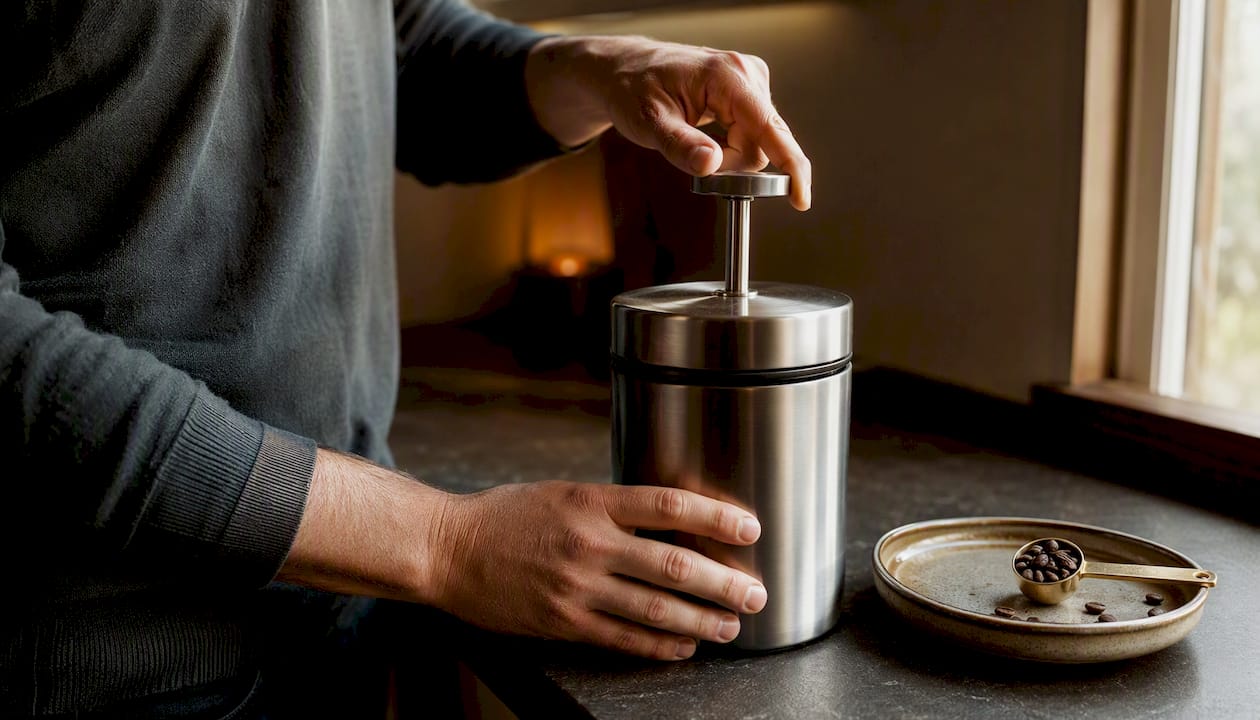
Displacement or airlock containers work differently. Instead of pumping air out, a push-down lid forces air through a one-way valve as it seals, so gas from degassing beans can escape without fresh oxygen rushing back in. These tend to be easier to use daily since there’s no pump step, though they don’t remove quite as much oxygen as a true vacuum design.
POP-style lids use a button-activated seal that locks in freshness with one press. They’re less aggressive about oxygen removal than vacuum or airlock designs, but they’re fast, which matters if you’re filling a canister every morning before your coffee’s even brewed.
Resealable bags with a one-way valve, meaning the roaster’s original packaging, are genuinely fine for short-term storage. If the seal still works and the bag is opaque, you don’t need to buy anything new for the first couple of weeks.
| Container type | Sealing method | Light protection | Best for |
|---|---|---|---|
| Vacuum canister | Pump removes air | Opaque steel blocks light | Weeks-long freshness, daily use |
| Displacement/airlock | Push-down valve releases gas | Varies by model | Easy daily refills |
| POP-style lid | Button-seal airtight | Often tinted, not opaque | Fast morning routine |
| Original roaster bag | One-way valve | Depends on bag material | First 2 to 4 weeks post-roast |
Pro Tip: If your container is clear glass, keep it inside the cabinet, not on the counter, even if the seal is excellent. Light degrades aroma compounds regardless of how airtight the lid is.
Where to Keep Whole Beans in a Kitchen Cabinet
Location matters almost as much as the container. A great vacuum canister sitting above your oven is fighting a losing battle against heat every time you bake.
Good spots inside your kitchen:
- A lower or middle cabinet shelf, especially one that doesn’t share wall space with your oven or range.
- An interior cabinet away from the dishwasher, since steam and heat vent out during cycles.
- A shaded pantry shelf if your kitchen has one, particularly if it stays a few degrees cooler than the rest of the room.
Spots to avoid, even though they’re common:
- Directly above or beside the stove and oven, where ambient heat spikes constantly.
- Next to or above the dishwasher, which pushes out warm, humid air.
- Any shelf beside a sink, where splashes and steam sneak in more than people expect.
- Near a sunny window or on an open shelf that gets direct light for part of the day.
- Right next to your espresso machine’s steam wand, which is a surprisingly common mistake in small kitchens.
For a studio apartment kitchen with limited cabinets, a single interior drawer near the counter often beats any open shelf, since drawers block light entirely. In a shared kitchen with an open-shelf setup, an opaque canister is doing double duty, hiding the beans from both light and curious housemates. Apartment Barista’s advice on small-kitchen storage lines up with this: a cool, dry, dark cabinet or drawer near your grinder setup is almost always your best option, regardless of square footage.
How Much Coffee to Keep in Your Daily Canister
Your daily container shouldn’t hold your entire supply. Think of it as a working reserve, not a warehouse.
A standard 1 pound bag of whole beans lasts roughly 1 to 2 weeks in a daily canister for a household that brews drip coffee once or twice a day. If you’re the only one drinking coffee and you brew a single cup, stretch that closer to 3 weeks, but expect a noticeable flavor dip by the final few days. Espresso drinkers who go through beans faster, sometimes two or three shots a day, will burn through that same bag in under 10 days.
Freshness generally peaks within the first one to three weeks after the roast date, based on roaster guidance reported by Epicurious, with lighter roasts often holding their brightness a bit longer than dark roasts, which tend to lose their punch faster once oils hit the surface.
Three quick examples:
A single-person drip drinker doing one pot a day should keep about half a pound in their daily canister and seal the rest. A two-person household running through coffee twice a day can comfortably keep a full pound in rotation, refilling from a sealed backup bag every one to two weeks. An occasional espresso drinker, someone pulling a shot every other day, is better off buying smaller bags more often rather than storing a large quantity slowly.
Pro Tip: Write the roast date on your daily canister with a piece of tape when you refill it. It takes five seconds and stops the “wait, how old is this” guessing game.
Should You Freeze or Refrigerate Whole Coffee Beans?
The refrigerator is not your friend here, despite how logical it sounds. Fridges are humid, full of competing odors from last night’s leftovers, and beans absorb both moisture and smell far more readily than most people realize. A cool cabinet shelf beats a fridge shelf almost every time for day-to-day storage.
The freezer is a different story, but only if you do it correctly.
Freezing makes sense when you’ve bought in bulk or want a backup stash that lasts longer than a few weeks. It becomes a problem when people freeze one big bag and repeatedly open it, letting warm, humid kitchen air rush in and condense on cold beans every single time. That moisture cycle is what ruins frozen coffee, not the cold itself.
Here’s the method that actually works, based on advice from roasters cited by Epicurious:
- Divide your bulk bag into small portions, roughly two weeks’ worth of coffee each.
- Vacuum-seal each portion individually so no single pack gets opened more than once.
- Freeze the sealed portions flat, and pull one out only when your daily canister is nearly empty.
- Let the sealed pack come fully to room temperature before opening it, which can take an hour or two.
- Once opened, treat it like any fresh bag: transfer to your daily canister and use it within one to two weeks.
Two rules that matter more than the rest of the steps combined:
- Never open a frozen pack while it’s still cold. Opening early lets condensation form directly on the beans.
- Never refreeze a portion once it’s been thawed and opened. The second freeze does real damage to flavor and texture.
Setting Up a Cabinet Storage Workflow in a Small Kitchen
Limited counter and cabinet space actually makes storage easier to get right, because there’s less room for beans to end up somewhere bad by accident.
A workable daily loop looks like this: your bulk bag or bulk freezer stash lives in the highest, most out-of-the-way cabinet you have. A sealed backup portion sits just below it, ready to refill your working canister. The daily canister itself lives on a lower shelf or in a drawer close to your grinder, so refilling takes ten seconds, not a trip across the kitchen. You top off the grinder hopper once each morning, using only what you’ll brew that day.
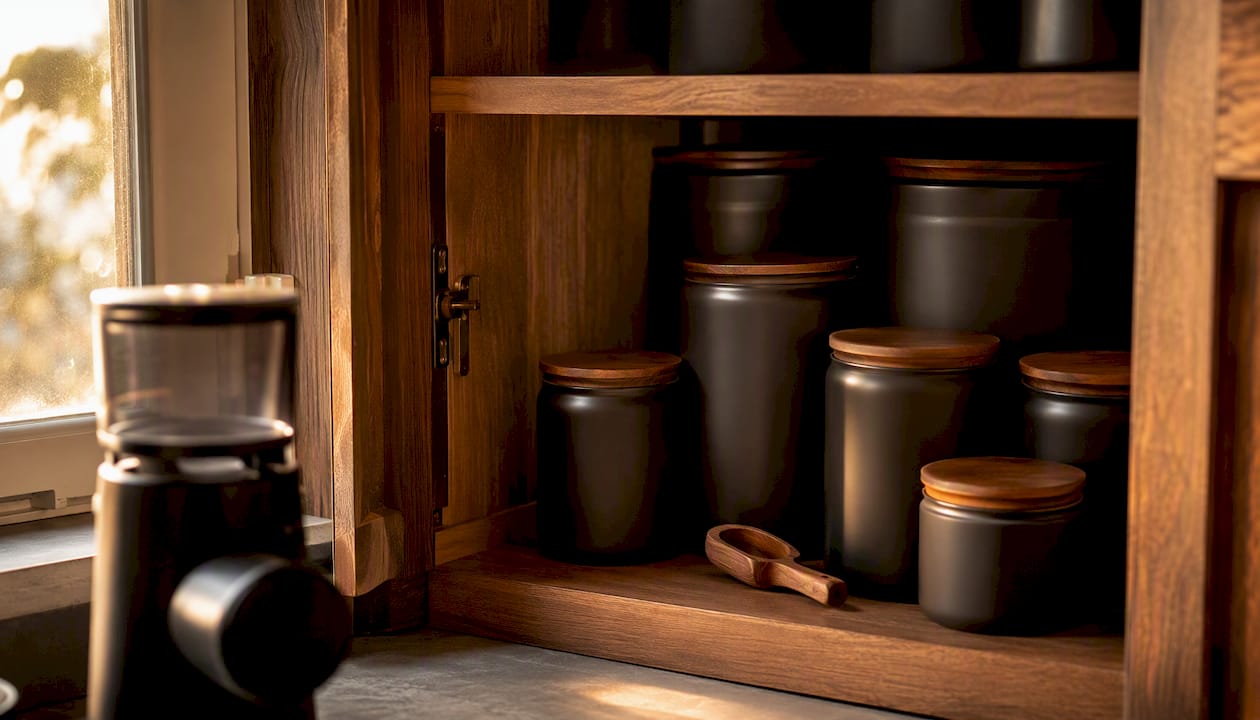
Two layouts that work well in tight kitchens:
Drawer-based hidden storage puts your daily canister in a shallow drawer near the counter edge, completely blocking light and keeping the beans out of sight and out of heat. Measure your drawer’s interior height before buying a canister. A container that’s an inch too tall will jam the drawer every single time you try to close it.
One-canister daily lane works for tiny kitchens with just one usable cabinet. Everything, backup bag included, lives in that single cabinet, organized front to back by how soon you’ll use it. Newest roast goes to the back, oldest comes forward.
Measure cabinet depth and height before you shop for containers. A tall vacuum canister that looks compact on a store shelf can be surprisingly awkward in a shallow cabinet.
Pro Tip: Label every backup bag with its roast date using a marker, right on the bag. When you’re rotating three roasts at once, “which one’s oldest” becomes an actual daily question, not a rhetorical one.
If you’re building out a proper coffee corner rather than squeezing storage into an existing cabinet, it’s worth looking at dedicated coffee bar furniture styles designed with built-in canister space.
Best Containers for Storing Whole Beans (What to Look For)
A handful of well-known products cover most of what home coffee drinkers actually need, and each one solves a slightly different problem.
Fellow Atmos uses a vacuum pump built into the lid, so a few twists pull air out after every use. It comes in opaque stainless steel, which blocks light completely, and testing from Serious Eats rated vacuum-style options like it among the best for weeks-long freshness. One caution straight from Fellow’s own product guidance: store whole beans only, since ground coffee can clog the vacuum valve over time.
MiiR Airlock Coffee Canister relies on a push-down lid that forces air out through a one-way seal rather than a pump. It’s a faster daily motion than a vacuum twist, which makes it a solid pick if you’re refilling a canister every morning before coffee’s even brewed.
OXO Steel POP Coffee Container uses OXO’s signature button-activated POP seal, airtight and quick, though it doesn’t remove air the way vacuum or airlock designs do. Its tinted or opaque body still blocks meaningful light, and the one-handed seal makes it genuinely convenient for a busy kitchen.
Tightpac / Coffeevac brings professional-grade vacuum sealing with a built-in degassing valve, letting trapped CO2 escape while limiting how much oxygen gets back in. That degassing valve design is standard practice in specialty coffee shops for exactly this reason.
Whichever you pick, size it to your actual bag size, not to whatever looks nicest on a shelf. A container built for 2 pounds is overkill and wastes airtight space if you’re only ever storing half a pound at a time.
How to Clean Your Canister and Avoid Grinder Storage Mistakes
Storing beans in your grinder’s hopper feels convenient, but it’s one of the most common freshness mistakes home brewers make. Hoppers are rarely airtight, and oils from the beans slowly coat the inside, going rancid and tainting every batch that follows. Tasting Table’s reporting notes that professional coffee shops empty and clean their hoppers every single night for exactly this reason.
A simple cleaning routine keeps both your canister and grinder working properly:
- Weekly: Hand wash your daily canister with warm water and mild soap, then dry it completely before refilling. Leftover moisture inside an airtight container defeats the entire purpose.
- Every few weeks: Check the lid gasket or seal on vacuum and airlock containers for oil buildup or cracking, since a compromised seal quietly stops doing its job.
- Nightly: Empty your grinder hopper if you keep more than a day’s worth of beans in it, wiping out visible oil residue with a dry brush or cloth.
- After deep cleaning: Let containers air dry fully before rotating fresh beans back in, since damp gaskets invite mold faster than you’d think.
Pro Tip: If your canister starts smelling faintly musty even when empty, it’s the gasket, not the beans. Replace or deep-clean the seal before blaming your coffee.
A Simple Daily Storage Routine That Actually Works
The best system is one boring enough that you’ll actually stick with it. My own routine is nothing fancy: a sealed backup bag lives in the cabinet above the fridge, a daily canister sits on the shelf right next to the grinder, and every few mornings I top off that canister straight from the backup bag before doing anything else.
The whole refill takes maybe fifteen seconds, and it means the backup bag gets opened only once every week or two instead of every single morning.
The freshness check I actually rely on isn’t complicated. Open the canister and smell it. Fresh beans smell sharp, a little sweet, occasionally chocolatey or fruity depending on the roast. Stale beans smell flat, sometimes faintly like cardboard or old nuts. If a whiff doesn’t tell the whole story, brew a small cup and pay attention to whether it tastes muted compared to what you remember from the same bag a week earlier. That dulling is usually the first real sign it’s time to finish the bag or start fresh.
Get Fresher Beans Before You Even Need to Worry About Storage
All the canisters and cabinet placement in the world can’t fix beans that were already stale by the time they reached your kitchen. The real advantage isn’t a better container, it’s starting with a shorter clock. Espritkaffe roasts to order and prints the roast date right on every bag, so you know exactly how many days you’re working with before you even open it.

That transparency changes how you shop for coffee. Instead of guessing whether a grocery store bag has been sitting on a shelf for two months, you can portion your storage plan around an actual date. Pair fresh beans with resealable, opaque packaging and the routines covered above, and you’re set up for the whole freshness window, not just the first few days. If you’re ready to put a real roast date on your next bag, browse the current coffee collection and pick a roast that matches how fast you actually drink it.
Frequently Asked Questions
Can I store whole beans in a kitchen cabinet without a special container? Yes, temporarily. If the original bag has a working resealable closure and a one-way valve, it’s fine for two to four weeks in a cool, dark cabinet. Once the seal weakens, transfer the beans to an airtight canister.
How long do whole beans stay fresh in normal cabinet storage? Most beans peak within one to three weeks of their roast date, then decline gradually over the following month. Lighter roasts tend to hold flavor slightly longer than dark roasts.
Is it better to store coffee beans whole or ground? Whole, always, if freshness is the goal. Grinding exposes far more surface area to oxygen, which speeds up flavor loss dramatically compared to whole beans in an airtight container.
Should I keep coffee beans in the fridge? No. Refrigerators are humid and full of competing odors that beans absorb easily. A cool cabinet shelf works better for daily storage than any fridge shelf.
What’s the biggest mistake people make storing beans in a kitchen cabinet? Storing them above the oven, next to the dishwasher, or in a clear jar on a sunlit counter. Heat and light quietly undo the benefit of even the best airtight container.
Sources
The National Coffee Association’s storage guidelines lay out the core airtight, cool, dark principle that the entire system in this article is built around.
Epicurious’s interviews with working roasters cover freezer portioning, one-way valve bags, and realistic freshness timelines in more depth than most consumer guides.
Serious Eats’s canister testing compares vacuum and airlock designs side by side if you want more detail before buying a container.
Apartment Barista’s small-kitchen storage advice is worth a look if you’re working with a single cabinet or a studio-sized kitchen.
For readers curious about how roast date and origin interact with storage speed, Espritkaffe’s guide on custom roast orders and its breakdown of black coffee bean flavor and origin both dig deeper into related decisions worth making before you even get to storage.
- Storage and shelf life - NCA
- Storing Coffee Beans for the Freshest Tasting Brews is Easier Than You Think | Epicurious
- The 3 Best Coffee Canisters of 2026, Tested & Reviewed
- How to Store Coffee Beans in a Small Kitchen | Apartment Barista