

Coffee tasting notes are the sensory descriptors, usually food or aroma comparisons like “blueberry” or “toasted almond,” that describe what a coffee smells and tastes like rather than what’s been added to it. No berries went into the bag; your nose and palate just recognize aromatic compounds that overlap with familiar foods. Learning to spot these notes turns coffee from background noise into something you actually taste.
TL;DR:
- The flavor wheel helps identify the most common coffee tasting notes, such as fruity, floral, nutty, and spicy, which vary by roast level and processing method.
- Your olfactory system plays a crucial role in tasting, as aroma molecules travel retronasally into your nose, shaping your perception of flavor beyond basic tastes.
- Consistent tasting protocols, like steeping, slurping, and tasting at multiple temperatures, improve your ability to detect subtle notes and distinguish between different coffees.
- Building tasting skills faster involves comparing different coffees side by side, testing blind, and using structured exercises to recognize specific flavor references.
- Accurate tasting notes should be straightforward, include the coffee’s origin and processing details, and focus on concrete flavors rather than marketing buzzwords.
Table of Contents
- What Coffee Tasting Notes Actually Mean
- Why Your Nose Does Most of the Work
- How to Taste Coffee Like a Pro (At Home)
- Reading the Flavor Wheel: Categories You’ll Actually Use
- Writing Tasting Notes People Can Actually Use
- Training Your Palate Faster Than Random Cups Will
- Tasting Notes Are for Curiosity, Not Bragging Rights
- Practice What You’re Tasting With a Curated Coffee Club
- Where to Learn More About Coffee Tasting
- Sources
What Coffee Tasting Notes Actually Mean
A tasting note is shorthand, not a recipe. When a bag says “notes of cherry and dark chocolate,” nobody dropped fruit or cocoa into the roaster. Coffee contains hundreds of aromatic compounds, and many happen to smell or taste like things you already know, so tasters borrow that vocabulary instead of describing raw chemistry.
The industry leans on shared reference tools to keep this language from turning into guesswork. The SCA flavour wheel organizes descriptors from broad categories, like fruity or nutty, down to specific terms, like raspberry or hazelnut, so two tasters have a common map instead of inventing their own private language.
Even with a shared wheel, notes stay subjective. A few things drive the differences you’ll notice between your impressions and someone else’s:
- Palate sensitivity varies person to person, the same way some people taste cilantro as soapy and others don’t.
- Roast level shifts which compounds dominate, muting fruit notes as roasts get darker.
- Freshness matters. Beans lose aromatic intensity within weeks of roasting.
- Personal food memory shapes which comparison jumps to mind first.
None of that makes tasting notes unreliable. It just means they’re a starting point for conversation, not a lab report.
Why Your Nose Does Most of the Work
Your tongue only detects five basic tastes: sweetness, acidity, bitterness, saltiness, and umami. That’s the entire vocabulary of taste buds. Everything more specific than “sweet” or “bitter” comes from your olfactory system, which can register a staggering range of aromatic compounds compared to taste’s short list.
Here’s the part most people miss: when you swallow or exhale through your nose while coffee is still in your mouth, aroma molecules travel up into your nasal cavity through what’s called retronasal olfaction. That’s the mechanism turning a simple bitter, acidic liquid into something your brain reads as “jasmine” or “ripe strawberry.” Acidity gives coffee its brightness, sweetness balances it, bitterness adds structure, and body determines how heavy or thin it feels on the tongue. Aroma layers the specific personality on top.
How to Taste Coffee Like a Pro (At Home)
You don’t need a lab to taste coffee properly. Professional cupping sessions follow a fixed cupping protocol: coffee brewed with a set coffee-to-water ratio, hot water, and timed steep before evaluation begins. Locking those variables down means you’re judging the coffee itself, not your brewing technique.
Here’s a simplified version you can run in your own kitchen:
- Grind coarse, just for this cup. A rough, medium-coarse grind, closer to sea salt than table salt, extracts evenly during the steep.
- Steep for four minutes, then break the crust. Push a spoon through the grounds floating on top and lean in immediately to smell what rises.
- Slurp, don’t sip. A hard slurp sprays the liquid across your whole tongue and forces aroma up into your nasal cavity at once, which is why cuppers sound so unglamorous doing it.
- Taste the coffee at multiple temperatures as it cools to reveal different flavors. Certain acids and aromatics only reveal themselves once the cup drops in temperature, and defects that hide in a hot cup tend to surface once it’s lukewarm.
- Write down the first word that comes to mind before overthinking it. Your gut reaction is usually more accurate than your second-guess.
Pro Tip: If every cup tastes flat or muddy, check your water temperature first. Water that’s too hot scorches delicate aromatics, while water that’s too cool under-extracts and leaves the cup tasting sour and thin instead of bright.
Struggling to pick up anything beyond “bitter”? That’s normal early on. Slow down, taste again once the cup cools, and resist the urge to judge the coffee on the first sip alone.
Reading the Flavor Wheel: Categories You’ll Actually Use
The flavor wheel works from the center outward. Broad families sit in the middle: fruity, floral, nutty, sweet, and roasted, and each branches into increasingly specific descriptors near the outer edge. You don’t need to memorize the whole wheel. You just need to recognize the handful of categories that show up most in specialty coffee:
- Fruity: berry (blueberry, raspberry), citrus (lemon, orange zest), stone fruit (peach, apricot)
- Floral: jasmine, rose, honeysuckle, common in washed Ethiopian coffees
- Nutty: almond, hazelnut, peanut, typical in medium-roasted Central American coffees
- Sweet: caramel, brown sugar, milk chocolate
- Spice and roasted: clove, cinnamon, tobacco, smoke, more common as roast level darkens
Roast level and processing method both push the needle. Light roasts and washed processing tend to preserve fruity and floral notes because less heat means less caramelization masking the origin character. Dark roasts push things toward chocolate, smoke, and spice as sugars caramelize and delicate aromatics burn off. A natural-processed coffee, dried with the fruit still on the bean, often leans into boozy, jammy fruit notes that a washed coffee from the same farm won’t show.
Writing Tasting Notes People Can Actually Use
A useful tasting note follows a simple structure: a headline description, a quick read on sweetness, acidity, and body, then one to three concrete flavor terms, and a note on the finish. Something like: “Bright and juicy. Medium body, crisp acidity. Notes of red apple and honey, with a clean, short finish.” That tells a reader far more than “smooth and delicious.”
A few habits separate a useful note from a vague one:
- Reach for foods you’ve actually tasted recently, not abstract adjectives like “complex” or “vibrant.”
- Skip marketing words like “premium” or “gourmet.” They describe nothing sensory.
- Note the finish separately from the initial flavor. Some coffees start sweet and finish bitter, or the reverse.
Roaster copy walks a line between sensory report and sales pitch. A note like “notes of blueberry and cocoa” backed by a stated variety and processing method is usually a genuine attempt to describe the cup. A note stacked with five unrelated fruits and zero information about origin is more often marketing dressed up as tasting notes. When in doubt, taste it yourself and see how many of those descriptors actually show up.
Training Your Palate Faster Than Random Cups Will
Drinking coffee randomly builds vocabulary slowly. Structured comparison builds it fast, because it forces your brain to notice differences instead of just enjoying the cup. A few exercises worth running:
Brew two coffees side by side, ideally from different origins or roast levels, and taste them back to back. The contrast makes subtle notes obvious in a way a single cup never will. Pair small food references, a slice of lemon for citric brightness, a bite of Granny Smith apple for malic acidity, a spoonful of blueberry jam for certain natural-processed coffees, so your brain locks a specific taste to a specific word. Try tasting blind occasionally, without seeing the bag or label first, since removing that visual cue stops your expectations from coloring what you actually perceive.
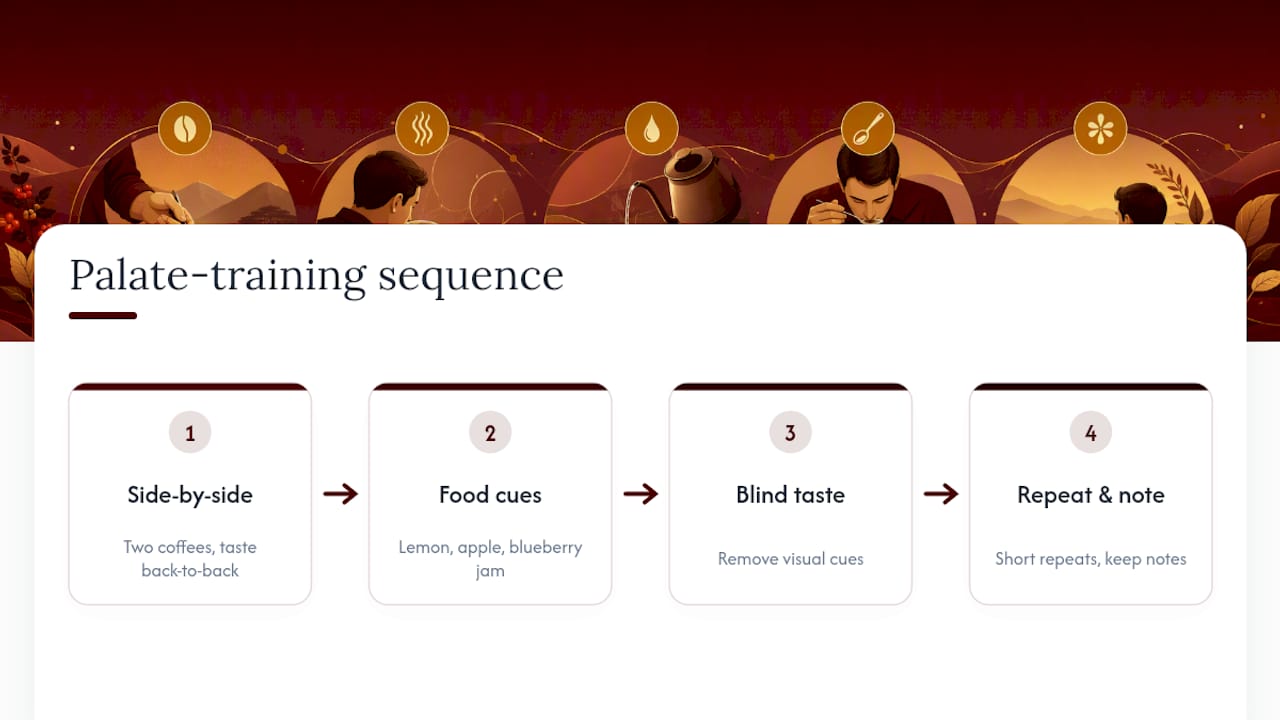
Running short, blind, side-by-side tastings of two or three coffees a couple of times a week for a few weeks, while keeping notes, builds discrimination faster than casual daily drinking ever will. A printable tasting sheet with an aroma map and flavor wheel gives you somewhere to actually record those observations instead of losing them, and Espritkaffe’s sensory tasting guide walks through more of these exercises if you want a deeper session plan.
Tasting Notes Are for Curiosity, Not Bragging Rights
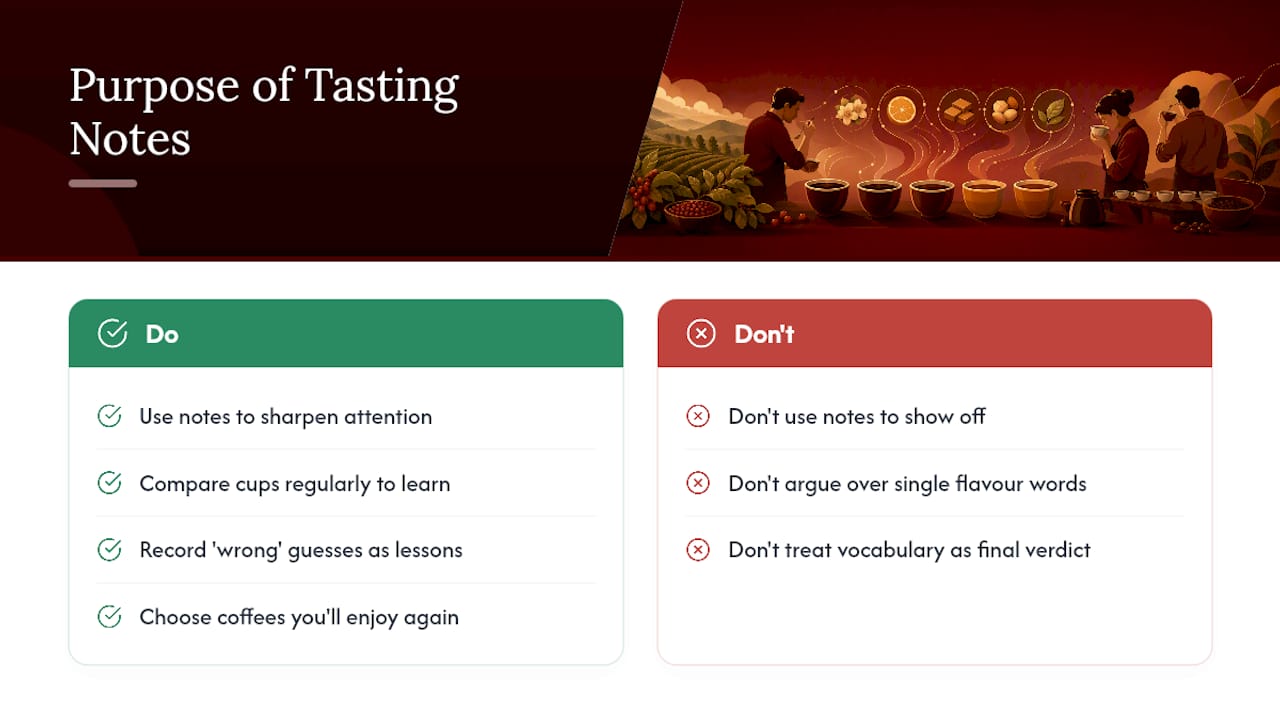
Tasting notes matter because they sharpen attention, not because they let you sound impressive at a coffee shop. The goal is noticing more in your cup, not winning an argument about whether it’s blackberry or blueberry.
Give it time. Your vocabulary grows with every comparative cup, and the “wrong” guesses teach you as much as the right ones. Use notes to find coffees you’ll actually enjoy again, not to perform expertise you don’t have yet.
— Jett
Practice What You’re Tasting With a Curated Coffee Club
Reading about tasting notes only gets you so far. You build the skill by comparing real coffees side by side, and that’s exactly what a rotating lineup makes easy. The Esprit Kaffe Members Club Subscription delivers a curated rotation of roasts with their own tasting notes attached, giving you fresh material for the comparison exercises above without hunting down new bags yourself every few weeks.

If you’d rather sample in smaller bites before committing to a rotation, single-serve options work well for quick back-to-back tastings. Espritkaffe’s 12-pack single-serve capsules let you run a blind comparison across a few cups in one sitting. Pick a rotation or a sampler pack, brew two side by side tonight, and see how many notes you can actually name.
Where to Learn More About Coffee Tasting
For deeper study, the World Coffee Research sensory lexicon explains the flavor wheel’s structure, the CoffeeStudies cupping guide covers full cupping protocol, and Q Grader certification info shows how professionals train their palates formally.
Sources
- Coffee cupping guide — CoffeeStudies
- World Coffee Research — sensory lexicon
- United Baristas — Coffee tasting guide