

Pesticide residues turn up in a meaningful share of coffee samples tested worldwide, but the risk assessments built on those samples generally land far below thresholds that would concern toxicologists. That gap between “detectable” and “dangerous” is the whole story. The practical move is to buy from roasters who can show batch testing, lean toward brewing methods that transfer less residue, and stop treating every trace finding as an emergency.
TL;DR:
- Pesticide residues are present in many coffee samples, but their levels remain well below health concern thresholds, with detection affected by testing methods and product format.
- Roasting and brewing methods, especially espresso or Turkish style, generally reduce pesticide residues, but no single approach completely eliminates them.
- Certified organic coffee and batch-specific testing provide more reliable assurance of lower pesticide residues than blending or general labeling.
- The legal use of certain pesticides varies by country, and export regulations often allow residues banned in consumer countries to remain in imported coffee.
- Consumer habits, such as asking for testing certification and choosing traceable, small-batch coffees, can help reduce pesticide exposure without needing to avoid coffee entirely.
Table of Contents
- How Common Are Coffee Pesticides, Really?
- Which Pesticides Show Up Most, and Should You Worry About Them?
- Does Roasting or Brewing Reduce Pesticide Residue?
- What Does a Real Health Risk Assessment Actually Show?
- Which Coffee Labels Actually Reduce Your Pesticide Exposure?
- A Practical Checklist for Lower-Pesticide Coffee Habits
- The Environmental Cost Behind Every Bag of Conventional Coffee
- How Different Countries Regulate Pesticide Residues in Coffee
- Farming Without Heavy Pesticide Use: What Actually Works
- Why This Data Should Change How You Shop, Not How Much You Worry
- What to Look for When You Choose Your Next Bag of Coffee
- Sources
How Common Are Coffee Pesticides, Really?
The honest answer depends entirely on what got tested and how. A large analysis of 881 coffee samples pulled from the Egyptian market found pesticide residues in a notable portion of green coffee, roasted coffee, and coffee capsule samples (https://www.sciencedirect.com/science/article/pii/S0308814625019223). That jump from green to capsule is the single most cited number in recent coffee-safety research, and it’s worth sitting with for a second: the same bean, processed differently, showed wildly different detection rates depending on the final product format.
Numbers like these vary by study because the studies themselves aren’t standardized. A monitoring program screening for 20 common actives will report different results than a targeted research project screening for 200. Sample origin matters too. A batch of green coffee straight off a farm in a region with heavy pesticide use will look different from a blend already screened by an importer.
A few caveats separate a headline number from a useful one:
- Lab sensitivity varies. A method with a lower limit of quantification (LOQ) will flag residues that a less sensitive test misses entirely, which alone can double a detection rate between two studies testing identical beans.
- The pesticide panel matters. Testing for 40 active ingredients versus 400 changes what counts as a “clean” sample, and most published studies don’t screen for the same list.
- Routine monitoring differs from targeted research. Government food-safety screening tends to check for compliance with legal limits; academic studies chasing publication often test more exhaustively and report lower thresholds as “detected.”
- Capsules are structurally different. Higher detection rates in pods may relate to the grinding, packaging, or plastic/aluminum contact points rather than the coffee itself carrying more residue at the farm level.
The detection methods behind these numbers rely primarily on LC-MS/MS and GC-MS/MS, laboratory techniques capable of identifying residue concentrations in the parts-per-billion range. That precision is exactly why comparing studies without checking their methodology section is a mistake. A “residue found” headline means very little without knowing what was found, at what concentration, and against what safety threshold.
Which Pesticides Show Up Most, and Should You Worry About Them?
The chemicals that turn up repeatedly across coffee-residue studies fall into a handful of well-known families: organophosphates like chlorpyrifos, neonicotinoids like imidacloprid, pyrethroids, and the herbicide glyphosate along with its breakdown product AMPA. A comprehensive review of pesticide usage in coffee documents this pattern across producing regions, tying it to how coffee is grown as a perennial crop vulnerable to specific pests and fungal pressure year after year.
Here’s where nuance actually matters:
- Chlorpyrifos is an organophosphate insecticide that’s been restricted or banned in several consuming countries due to neurodevelopmental concerns, yet it remains legal and in use in some producing countries.
- Imidacloprid and other neonicotinoids target coffee borer beetles and aphids; regulatory bodies in different regions disagree sharply on acceptable use, largely over pollinator impact rather than direct human toxicity.
- Glyphosate/AMPA shows up mostly from weed control between coffee rows rather than direct application to the plant, and its cancer classification remains one of the more contested toxicology debates in agricultural chemistry.
- Pyrethroids are generally considered lower in mammalian toxicity than organophosphates, which is part of why they’ve become more common as older chemicals get phased out.
A key number to hold onto: in the same large-sample Egyptian market study, the cumulative hazard index across detected pesticides landed far below 1, the threshold toxicologists use to flag meaningful risk. A hazard index under 1 means estimated exposure sits below the level expected to cause harm, even when residues are technically present.
The catch is that legal status and maximum residue limits (MRLs) vary between the country where coffee is grown and the country where it’s sold. A report from Coffee Watch and allied monitoring groups calls this a “double standard”: pesticides banned for use in consuming countries like the United States or across the European Union remain legal for farmers to apply in many producing countries, which means banned actives can still legally enter exported coffee under current trade rules.
Does Roasting or Brewing Reduce Pesticide Residue?
Processing changes residue levels, and the direction is almost always downward, though not uniformly. Roasting subjects beans to sustained heat above 400°F, which degrades many pesticide compounds through thermal breakdown. Researchers describe this reduction using “processing factors,” a ratio comparing residue concentration before and after a specific step like roasting, grinding, or brewing.
Brewing method adds another layer. The Egyptian market study found that espresso and Turkish coffee preparation methods reduced pesticide transfer more effectively than some filtration-based brewing methods. That’s a genuinely useful, underreported finding: the short contact time and high pressure of espresso, or the fine-grind, boiled approach of Turkish coffee, appear to leave more residue behind in the grounds rather than passing it into the liquid you drink.
A few things to keep in mind before you overhaul your brewing routine:
- No method eliminates residue completely. Processing factors reduce concentration; they don’t zero it out.
- Behavior differs by chemical. A compound that breaks down easily under heat may barely budge during a cold brew’s extended steep, while a water-soluble compound might transfer more readily during longer extraction methods.
- Capsules complicate the picture. Even though single-serve pods showed the highest detection rates in the same study, that’s a packaging and grinding effect, not necessarily a brewing effect. The extraction itself doesn’t inherently transfer more.
- Grinding size plays a role too. Finer grinds expose more surface area, which can work in either direction depending on whether that helps a compound bind to grounds or dissolve into the water.
Pro Tip: If minimizing residue transfer is genuinely a priority for you, brew espresso-style or use a Turkish preparation method rather than a long-steep filtration approach, and skip the capsule format when you have a choice.
What Does a Real Health Risk Assessment Actually Show?
Below an MRL doesn’t mean “zero residue.” It means the detected concentration falls under the legal ceiling regulators set with a substantial safety margin built in, typically calculated from animal studies with an extra 100-fold buffer added before the number becomes law. The German Federal Institute for Risk Assessment (BfR) makes this distinction explicit: detecting a pesticide is not the same statement as proving a health risk, and MRLs exist precisely so a positive lab result can still mean “safe under normal consumption.”
The more useful metric for actually gauging risk is the hazard index (HI), which sums estimated exposure across every detected pesticide and compares that total against a safety benchmark of 1. Studies modeling realistic coffee consumption have repeatedly found cumulative hazard index values far below 1 for the markets tested, which is the strongest evidence available that typical coffee drinking habits carry low estimated risk from pesticide exposure specifically.
That said, three real uncertainties remain on the table:
- Cumulative mixtures. Hazard index calculations combine known pesticides, but real-world exposure includes chemicals from dozens of other foods simultaneously, and interaction effects between compounds aren’t fully mapped.
- Chronic low-dose exposure. Most risk models are built around acute or moderate-term exposure scenarios, not decades of daily consumption, which is a genuinely open research question rather than a solved one.
- Vulnerable populations. Pregnant individuals, children, and people with existing liver or kidney conditions process chemical exposure differently, and standard hazard-index math doesn’t always capture that variance.
None of this overturns the low-risk finding. It does mean “far below 1” describes typical exposure under study conditions, not a guarantee that applies identically to every person drinking every cup.
Which Coffee Labels Actually Reduce Your Pesticide Exposure?
Not every label on a coffee bag means the same thing, and knowing the difference between marketing language and an actual testing standard is where health-conscious buyers can make real progress.
- Certified organic prohibits synthetic pesticide use at the farm level, which meaningfully cuts exposure at the source. It doesn’t guarantee zero residue in your final cup, though, because cross-contact during shared processing facilities, storage, or transport can still introduce trace amounts.
- Batch-level Certificates of Analysis (COAs) are lab reports showing exactly what a specific roasted batch tested for and at what concentration. This is a stronger assurance than any farming label alone, because it measures the actual product you’re about to drink rather than the farming method used to grow it.
- Single-origin sourcing with farm transparency lets you trace coffee back to a specific farm or cooperative, which matters because farms using agroecological methods (shade-grown systems, intercropping, natural pest predators) tend to rely far less on synthetic chemical inputs than large monoculture operations.
- Blends pool beans from multiple farms and sometimes multiple countries, which can average out quality but also makes tracing any single problematic batch back to its source much harder.
A few practical distinctions worth remembering:
- Organic certification is a farming-practice standard, not a laboratory guarantee for the bag in your hand.
- A COA is only as good as what it tests for; ask what pesticide panel was screened, not just whether “testing was done.”
- Shade-grown and agroecological farms often use fewer chemical inputs by necessity, since diverse plantings naturally suppress some pest pressure that monocultures don’t. Espritkaffe’s guide on how coffee is grown across different regions covers how cultivation method shapes what ends up needed at the pesticide stage.
- Single-origin coffee generally offers better traceability than blends, though it isn’t automatically lower in residue. Traceability is the advantage, not a chemical guarantee.
A Practical Checklist for Lower-Pesticide Coffee Habits
None of this requires overhauling your morning routine, especially when considering insights on caffeine and bone density that support balanced consumption. It requires a few specific, low-effort habit changes that compound over time.
- Ask your roaster for a COA. Any roaster serious about transparency should be able to produce batch testing results, or at minimum explain their sourcing and screening practices, without hesitation.
- Favor small-batch, traceable roasters over anonymous large blends. Espritkaffe’s ethical sourcing guide walks through what real farm-level transparency looks like in practice.
- Choose espresso or Turkish brewing when minimizing transfer matters to you, and treat single-serve capsules with a bit more caution given the higher detection rates reported in market studies.
- Store beans away from household chemicals, cleaning products, and anything with strong volatile compounds, since coffee is notably porous and absorbs surrounding odors and residues over time.
- Rotate your sourcing rather than sticking to one supply chain indefinitely. Diversifying where your coffee comes from spreads out any single farm’s or region’s chemical-use practices across your overall exposure.
- Moderate rather than eliminate. Given that hazard-index findings consistently land well under the risk threshold, the evidence doesn’t support cutting coffee out entirely. It supports buying smarter.
Pro Tip: Check roast date, not just “best by” date, when you buy. A bag roasted within the last two to three weeks tells you more about freshness and handling quality than any label on the front of the packaging. For more on what an old bag actually signals, Espritkaffe’s breakdown of stale coffee beans covers the safety and flavor tradeoffs in detail.
The Environmental Cost Behind Every Bag of Conventional Coffee
Pesticide use in coffee farming doesn’t stay contained to the plant. Runoff from treated coffee farms contaminates nearby waterways, and broad-spectrum insecticides kill beneficial insects, including the pollinators and natural pest predators that healthy coffee ecosystems depend on. Coffee is traditionally grown in tropical, biodiverse regions, which means intensive chemical farming there carries an outsized ecological cost compared to the same practice on a temperate monoculture crop.
Soil health takes a hit too. Repeated synthetic pesticide and herbicide application over years of cultivation degrades the microbial life that keeps soil fertile, which eventually pushes farmers toward heavier fertilizer use just to maintain yields. That’s a costly cycle once it starts.
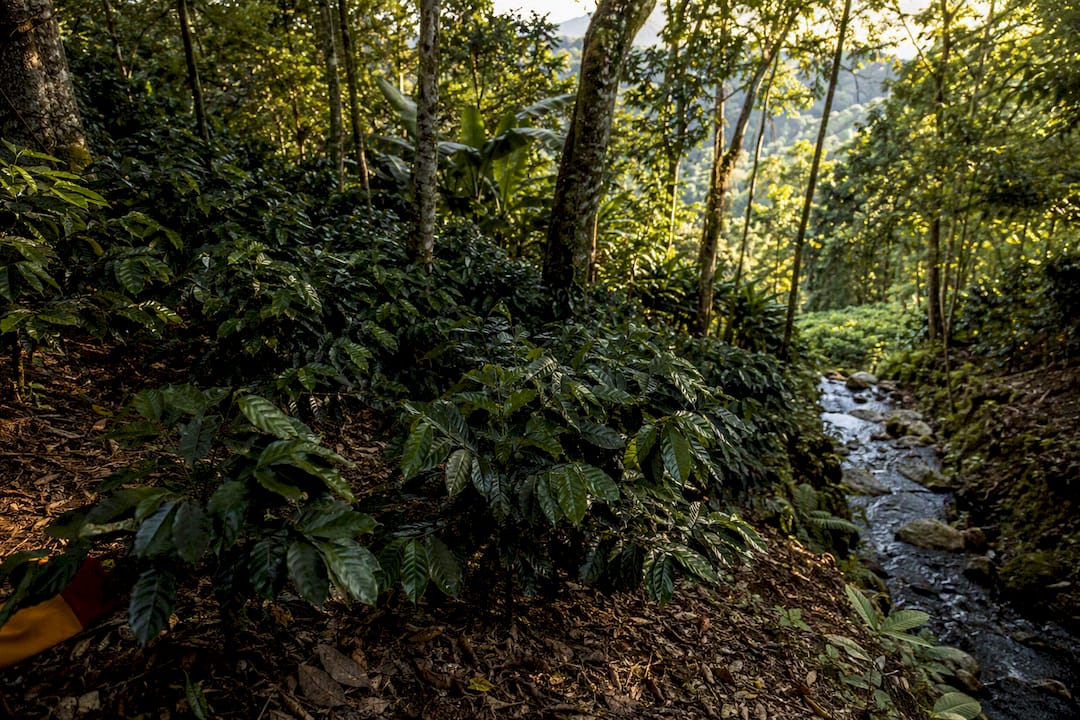
Shade-grown coffee systems, which mimic the plant’s natural forest-understory origin, tend to need far less chemical intervention because the ecosystem itself suppresses pest pressure. Sun-grown monoculture plantations, which dominate a large share of global commercial production because they yield more per acre, generally require heavier pesticide and fertilizer inputs to compensate for the biodiversity loss. The sustainability tradeoff is direct: higher yield per acre often correlates with a heavier chemical footprint per acre.
How Different Countries Regulate Pesticide Residues in Coffee
Regulatory frameworks for coffee pesticides differ sharply between producing and consuming nations, and that gap is the root of most confusion around “banned” chemicals showing up in imported coffee. The European Union and the United States both set maximum residue limits (MRLs) for imported food products, including coffee, and both restrict or ban a number of older organophosphate and organochlorine pesticides outright.
Producing countries, many in Latin America, Africa, and Southeast Asia, set their own domestic pesticide regulations, which frequently permit continued use of chemicals long since restricted elsewhere. A pesticide banned in Germany can remain fully legal for a farmer to apply in a coffee-growing region of another country, as long as the exported product still clears the importing country’s MRL at the border. That’s the mechanism behind the “double standard” that NGO monitoring groups have documented in recent reporting on global coffee supply chains.
Enforcement is where the real gap shows up. Border testing in consuming countries samples a fraction of imported shipments, not every batch, which means MRL compliance functions more as a statistical deterrent than a guarantee for any individual bag. Groups like the WHO and EFSA publish exposure guidance and monitoring frameworks that shape how individual countries interpret mycotoxin and pesticide risk, but actual enforcement authority stays entirely with each nation’s own food-safety agency.
Farming Without Heavy Pesticide Use: What Actually Works
Integrated pest management (IPM) is the term researchers use for combining multiple lower-chemical strategies instead of defaulting to broad-spectrum spraying. On a coffee farm, that typically means monitoring pest populations closely, introducing natural predators, using pheromone traps for the coffee berry borer, and only applying targeted chemical treatment when pest pressure crosses a specific threshold rather than on a fixed calendar schedule.
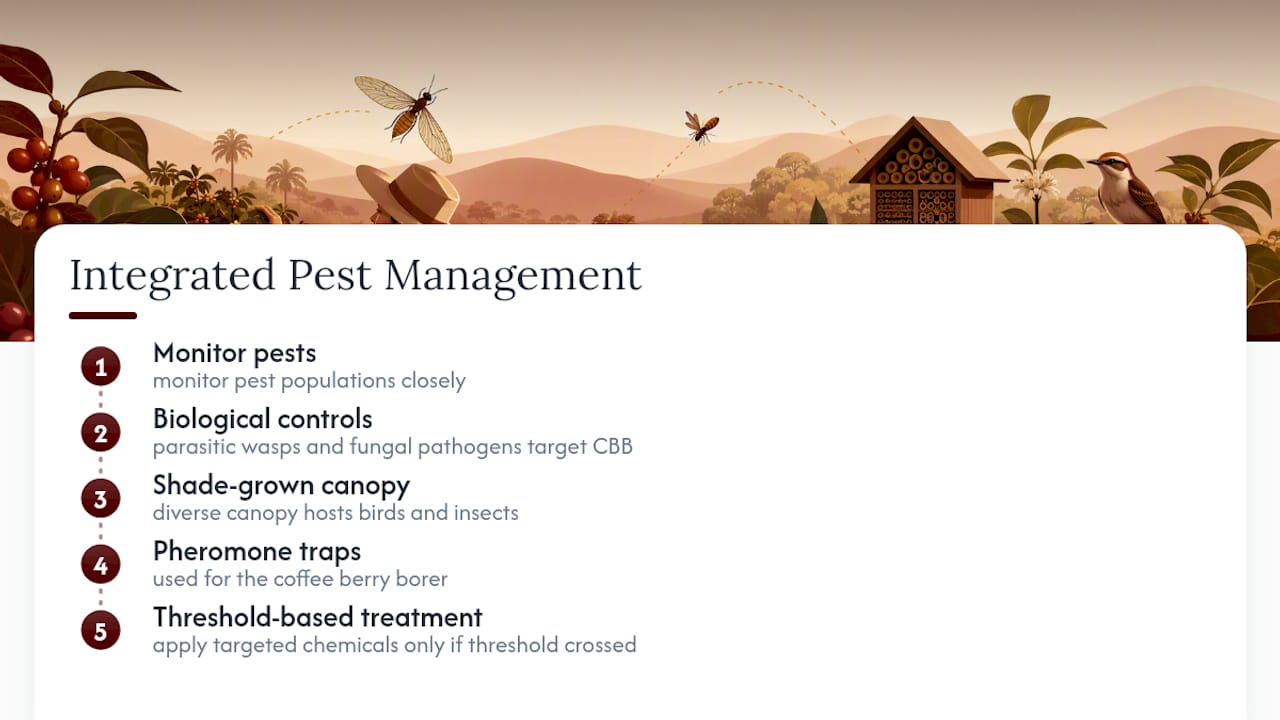
Biological controls take this further. Certain parasitic wasps and fungal pathogens specifically target the coffee berry borer, one of the crop’s most damaging pests, without the broader ecological collateral damage of a synthetic insecticide. Shade-grown cultivation, discussed earlier for its lower pesticide need, doubles as a biological control strategy on its own: a more diverse canopy naturally hosts more of the birds and insects that keep pest populations in check.
The same 2022 review that mapped common pesticide classes in coffee explicitly flags integrated pest management as one of the more promising mitigation paths going forward, alongside better residue monitoring infrastructure in producing regions. None of these approaches eliminate pest pressure entirely. They reduce reliance on the highest-hazard chemicals while keeping yields commercially viable, which is a far more achievable goal than a pesticide-free industry standard across every coffee-growing region simultaneously.
Why This Data Should Change How You Shop, Not How Much You Worry
Most consumer coverage of coffee pesticides swings between two bad extremes: outright dismissal (“it’s all fine, don’t think about it”) or alarmism dressed up as due diligence (“residues detected” treated as equivalent to “poisoned”). Neither serves you. The hazard-index math is the part that actually matters, and it consistently comes back low for typical consumption. That’s a real finding, not a corporate talking point.
What gets underreported is how much the format of your coffee, not just its origin, shapes your exposure. That’s a genuinely underexamined angle in most consumer coffee coverage, and it’s one every roaster, including us, should be transparent about rather than glossing over.
The double standard in global pesticide regulation is the uncomfortable part of this story worth sitting with. A chemical banned for health reasons in one country can legally end up in a product sold in another, and that’s a policy failure, not a reason to distrust coffee as a beverage category. The fix isn’t avoidance. It’s demanding traceability, asking roasters direct questions about testing, and treating a COA request as a completely normal thing to want answered before you buy a bag.
— Jett
What to Look for When You Choose Your Next Bag of Coffee
The criteria in this article aren’t abstract. They’re exactly what Espritkaffe builds sourcing decisions around: small-batch roasting, traceable origin, and a straightforward answer when you ask what’s actually in your cup. The sourcing approach addresses multiple contaminant categories beyond pesticide residue, reflecting a commitment to verifying claims rather than just making them.
If traceable, single-origin sourcing is what you’re after, the Single Origin collection gives you farm-specific beans instead of an anonymous blend. For readers who want the consistency of never running out while sticking with one transparent source, the Members Club Subscription delivers freshly roasted beans on your schedule, roasted in small batches rather than sitting in a warehouse for months. And if you’ve read the capsule caution above and still want the convenience format, the 12 Pack Single Serve Coffee Capsules give you that same sourcing standard in pod form.
Have a question about a specific batch or certification detail before you order? Reach out to customer service directly, or start with the Single Origin collection and see which farm’s story fits what you’re looking for.
Sources
The claims above rest on a mix of peer-reviewed lab research, NGO field monitoring, and regulatory guidance, not marketing copy from any single coffee brand.
- A review on the pesticides in coffee: Usage, health effects, detection, and mitigation
- Pesticide residues in Green, roasted, and capsule coffee from the Egyptian market: Occurrence, processing effects, and health risk assessment
- Poison in Your Coffee
- Pesticides in coffee: ‘Banned’ and ‘highly toxic’?
This article is general information, not a substitute for advice from a qualified doctor. Consult a qualified healthcare professional about your own circumstances before acting on anything here.