

A coffee bag valve is a one-way degassing valve that lets carbon dioxide escape while blocking oxygen from getting in. You need one whenever you seal coffee that’s still actively releasing gas, which usually means any bag over a small to moderate size packed within a short time after roasting. Skip that timing window or pack smaller, fully rested coffee, and a valve becomes optional rather than essential.
TL;DR:
- Most small to moderate coffee bags sealed within 24 to 72 hours after roasting require valves to prevent swelling or bag breakage due to active gas release.
- Larger bags and bulk shipments need higher-flow valves, especially if sealed soon after roasting, to manage increased gas volume without compromising seal integrity.
- Fully rested coffee, ground coffee, and instant coffee rarely need valves, as their gas release rates are significantly lower or negligible after a certain period.
- Valve sizing and pressure rating must be tested with actual fill weights and timing to avoid seal stress and swelling, with dual valves or pre-degassing steps as cost-effective alternatives.
- The valve’s placement, whether internal or external, should be above the settle line of the coffee, and proper sealing of the bag’s film and valve interface is essential for performance.
Table of Contents
- How Does a Coffee Bag Valve Work?
- When Do You Actually Need a Degassing Valve?
- How Do You Choose the Right Valve Size and Pressure Rating?
- Internal or External: Where Should the Valve Sit?
- What a Valve Can’t Do (and How to Store Coffee After Opening)
- Where Do You Source Valves and Pre-Fitted Bags?
- How Valve Choice Can Be Approached
- Where to Go for Specs and Datasheets
- Sources
- FAQ
How Does a Coffee Bag Valve Work?
Inside the fitting sits a small flexible disc, usually silicone or another elastomer, seated over a vented opening. As roasted coffee releases carbon dioxide, internal pressure builds until it reaches the valve’s opening threshold. The disc lifts, gas escapes, and it snaps shut the moment pressure drops. Oxygen and moisture from outside can’t push the disc open in reverse, so the mechanism only runs one way.
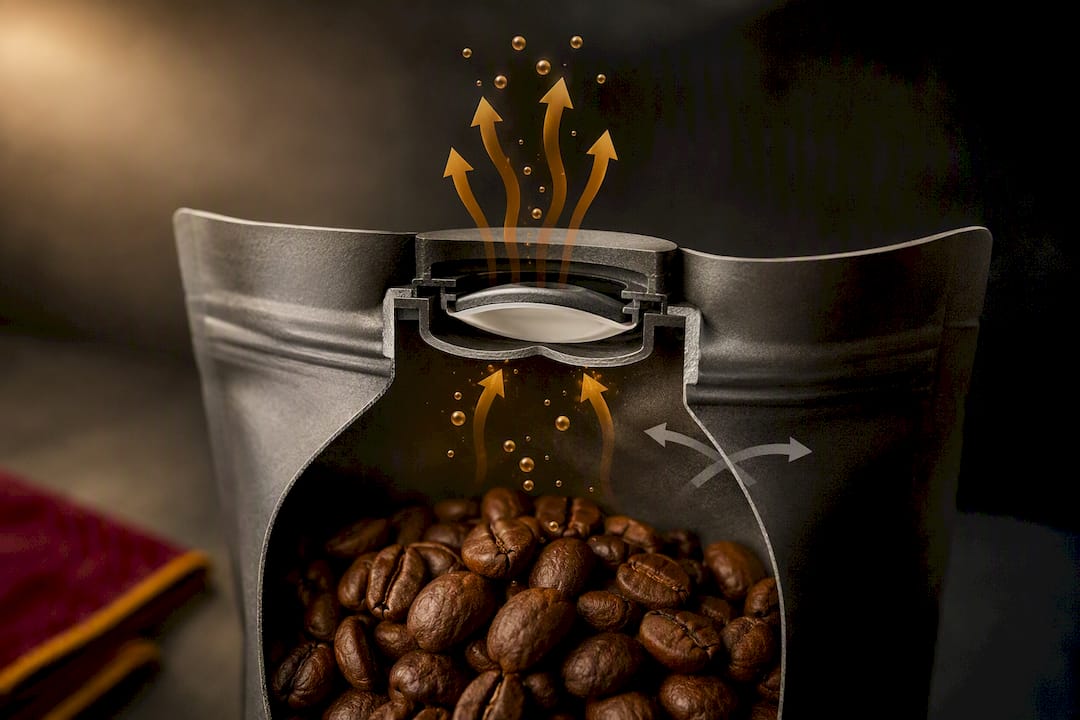
That one-way action explains why a bag can look completely flat and firm right up until you press it, then puff slightly with released gas. What actually escapes is mostly CO2, along with some aromatic volatiles. What stays out is the oxygen that would otherwise oxidize oils and dull flavor over weeks of storage, along with humidity that leads to clumping.
A valve is only half the system. Pair it with a low-barrier film and you’ve built an expensive way to let flavor escape anyway. Consider:
- Barrier film (usually a foil or metalized laminate) blocks oxygen transmission through the bag walls, not just at the valve.
- Heat-seal integrity around the valve and bag edges matters as much as the valve’s own spec sheet.
- A PLI-VALV style fitting only performs as advertised when the surrounding film and seal hold their end of the job.
When Do You Actually Need a Degassing Valve?
Most CO2 release happens in the first 24 to 72 hours after roasting, so the real question is how soon after roast you seal the bag and how much coffee sits inside it.
- Retail bags of moderate size sealed shortly after roast almost always need a valve, since a sealed bag that size can’t vent gas fast enough on its own and will swell or split.
- Bulk or wholesale bags of larger size shipped soon after roast need valves rated for higher flow, since more coffee means more trapped gas working against the seal.
- Ground coffee degasses roughly 50% faster than whole beans because grinding ruptures cell walls and releases gas immediately, so it needs a valve sized for a shorter, more intense degassing burst.
- Single-serve pods, fully rested coffee (10 or more days post-roast), and instant coffee rarely need valves, since there’s little or no active gas release left to manage.
If your production always ships same-day, timing itself, not valve spec, is often the cheapest thing to fix before you spend more on hardware.
How Do You Choose the Right Valve Size and Pressure Rating?
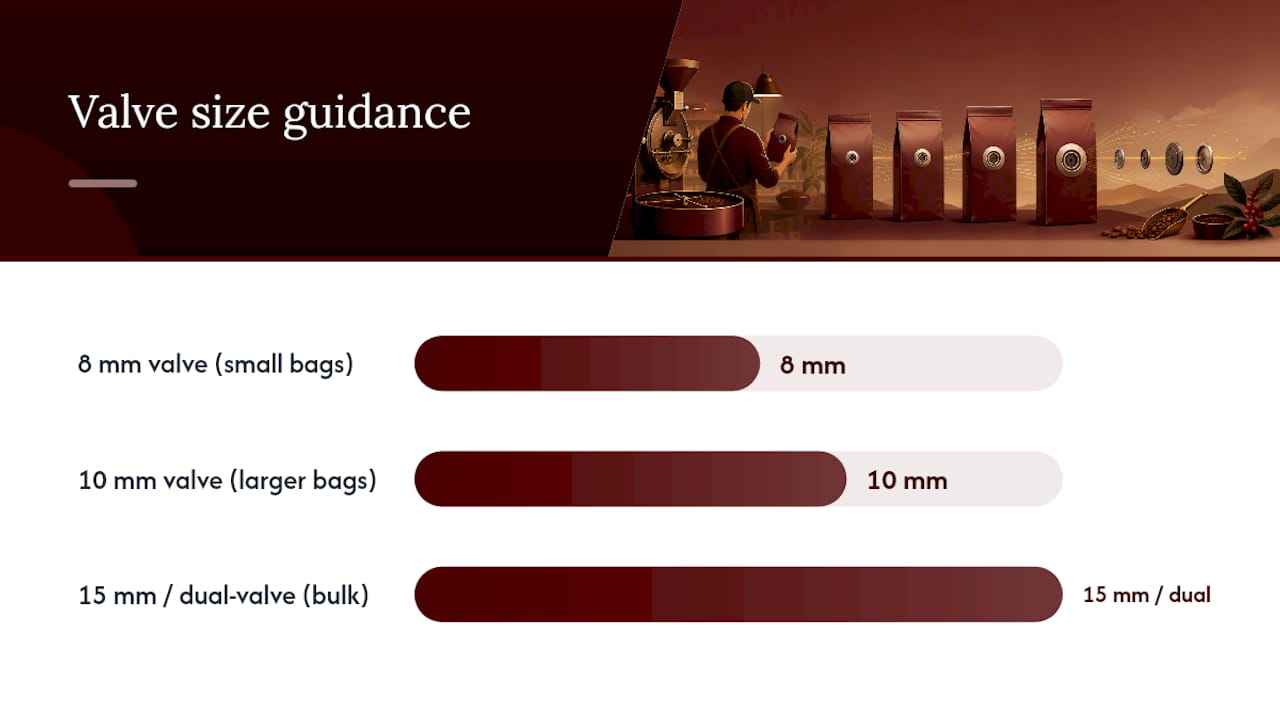
Valve sizing comes down to matching diameter and flow rating to your fill weight and how soon after roast you’re sealing. Supplier datasheets commonly list starting points like 8mm valves for small to moderate size bags, 10mm for larger bags, and 15mm or dual-valve setups for bulk bags, though these are guidelines to confirm through your own testing, not fixed rules.
Opening and closing pressure matters just as much as diameter. A low-pressure valve (roughly 0.5 to 1 psi opening threshold) vents gently and suits slower-degassing whole bean coffee. A higher-pressure threshold holds back more gas before releasing, which can help retain aroma volatiles longer but risks bag swelling if your fill weight or roast profile pushes out gas faster than the valve can clear it. Valve performance actually depends on six variables working together: roast profile, bean density, fill weight, sealing timeline, storage temperature, and target shelf life. Change one, and your valve spec needs a second look.
Before committing to a production run, test it:
- Seal a batch of sample bags at your normal fill weight and timeline.
- Weigh and inspect them at 24, 48, and 72 hours for weight loss and visual swelling.
- Flag any bag showing seal stress or ballooning; that’s your signal the valve is undersized for the load.
Pro Tip: If you’re packing within six hours of roast on a fast production line, don’t just upsize the valve. Look at dual-valve bags or a short holding/degassing step before sealing. It’s usually cheaper than the valve upgrade alone.
Internal or External: Where Should the Valve Sit?
Valves come in two mounting styles, and the choice affects both looks and manufacturing cost. Internal valves sit flush against the inside film layer for a cleaner retail appearance, while external valves attach to the bag’s outer surface and are generally simpler to apply after the bag is already made, which matters for smaller roasters retrofitting existing stock.
Placement relative to the fill line matters more than most roasters expect:
- Position the valve above where the coffee settles to prevent bean oils and fines from clogging the vent over time.
- On stand-up pouches, the upper back panel or a gusset seam works well and keeps the front graphic panel clean.
- On side-gusset bags, mount along the gusset itself rather than the flat face to avoid interfering with the fold.
- Attachment method matters too: heat-sealed valves bond more reliably across a wider range of films, while adhesive-backed valves apply faster but can fail under temperature swings if the film and adhesive aren’t matched.
What a Valve Can’t Do (and How to Store Coffee After Opening)
A valve’s job ends the moment you open the bag. Before that, it’s holding oxygen out and letting gas escape. After that first seal is broken, the valve has no way to remove the oxygen that rushes in every time you open the bag to scoop out coffee.
That’s on the consumer or café side to manage, not the packaging. Practical steps that actually help:
- Fold the bag tightly at the top and clip or reseal it after each use to limit air exchange.
- Transfer beans to a clean, airtight canister if you’re going through the bag slowly.
- Keep headspace to a minimum; more empty air in the bag means more oxygen contact with the beans.
- Store away from heat and direct light, both of which accelerate oxidation regardless of packaging.
Valves themselves have a functional lifespan. The elastomer disc can harden with temperature extremes over 12 to 24 months, so for any product with a planned shelf life beyond that window, validate valve performance over time rather than assuming day-one specs hold.
Pro Tip: Tell customers on the bag or in packaging copy exactly how to reseal it. Most people don’t know the valve stops working the moment air gets a straight path in.
Where Do You Source Valves and Pre-Fitted Bags?
Three supplier types cover most of the market. Valve manufacturers like Plitek, which makes the PLI-VALV line, sell loose valves and applicator systems for roasters who fit their own bags. Packaging houses including ePac, TricorBraun/Flex, and Fres-co supply pre-fitted valve bags with the film, seal, and valve already matched and tested as a system.
For most small-to-medium roasters, ordering pre-fitted bags is more cost-effective than buying loose valves plus applicator equipment, since applicators carry their own upfront cost that only pays off at higher volume.
A sound pilot workflow looks like this:
- Request sample valves or fitted bags at your actual fill weight and roast profile, not a generic sample size.
- Run temperature and pressure cycling on the samples to check for seal or adhesive failure under shipping-like conditions, since many real-world failures trace back to valves peeling from incompatible film adhesives.
- Check aroma retention after 30, 60, and 90 days against an unvalved control bag.
- Request datasheets covering flow rate, opening pressure, material composition, and shipping temperature tolerance before placing a production order.
Ask every vendor for food-safety compliance documentation on the elastomer and film materials, since those come into direct contact with roasted beans and their oils.
How Valve Choice Can Be Approached
Valve choice should be treated as a packaging decision tied to how coffee actually moves, not a spec pulled off a supplier’s default sheet. Small batches get tested at real fill weight and real gap between roast and seal, because a valve that works for a 12-ounce retail bag sealed the next morning won’t necessarily hold up on a bulk order shipped same-day.
If you want the freshness side of this from the roast angle, our posts on fresh roasted coffee and ground coffee shelf life go deeper into what happens to beans before and after they hit the bag.
If you’re vetting suppliers yourself, copy this short list: request at least a dozen sample bags at your real fill weight, run the 24/48/72 hour weight and pressure check, confirm food-safety documentation on valve and film materials, and push for a minimum 60 day shelf trial before you commit to a full production run.
— Jett
Where to Go for Specs and Datasheets
Start with the valve manufacturer directly if you’re buying loose valves and fitting your own bags: Plitek’s coffee valve page lays out PLI-VALV specifications and applicator options. For pre-fitted bags and pilot runs, ePac’s degassing valve explainer covers sample and testing workflows. For the timing science behind valve sizing, PackagingBest’s breakdown covers degassing rates by roast form. And for the consumer side of valve limitations, America’s Test Kitchen’s explainer is worth sharing with customers directly. If you’re also weighing film and adhesive choices, A3M’s guide to packaging print and construction covers the material side of that decision.
Sources
- What Is That Valve on My Coffee Bean Bag? - America’s Test Kitchen
- Degassing Valves for Coffee Packaging - Plitek
- Why Coffee Bags Have Vents: The Valve Truth Roasters Miss - PackagingBest
FAQ
What Is the Valve on a Coffee Bag For?
It lets carbon dioxide released by freshly roasted coffee escape the sealed bag without letting oxygen in, which prevents swelling and keeps the coffee from oxidizing while it’s still sealed.
Do Coffee Bags Need a Valve?
Only if you’re sealing coffee that’s still actively degassing, typically within a few days of roast in a bag over 8 to 12 ounces; fully rested coffee, single-serve pods, and instant coffee usually don’t need one.
Are Coffee Bag Valves One-Way?
Yes. The valve opens under internal gas pressure to vent CO2 and closes immediately after, so air and moisture from outside can’t pass back through it.
What Is a Coffee Valve in Packaging Called?
It’s most commonly called a one-way degassing valve, and you’ll also see it labeled a coffee bag valve or valve bag fitting on supplier datasheets from manufacturers like Plitek.