

The single quickest way to judge a bag of coffee is to check three things: the roast date, how transparent the roaster is about sourcing, and how specific the origin claim actually is. A bag stamped with a farm name, a two-week-old roast date, and a real processing method is telling you far more than one that just says “premium blend.” Everything else on the label exists to fill in that picture.
TL;DR:
- The roast date, origin details, and processing method provide the most reliable clues about coffee quality and flavor potential.
- Certifications like USDA Organic or Bird Friendly verify farming practices and environmental sustainability but do not guarantee taste.
- A label that specifies farm, cooperative, or region is a stronger indicator of traceability and flavor than vague country claims.
- Freshness peaks within seven to 21 days of roasting, making roast date the most critical piece of information for flavor.
- Tasting notes describe the roaster’s sensory perception and should be used as flavor direction, not exact promises.
Table of Contents
- What coffee label terms actually mean
- What coffee certification labels actually guarantee
- How to actually use a coffee label to pick a bag
- The 10-point label checklist to use right now
- How Jett and Esprit Kaffe actually read a bag
- Where to verify these claims yourself
- Why we print what we print
- The gap between what a coffee label promises and what it proves
- Sources
What coffee label terms actually mean
Every coffee bag is a small dossier. Read it right and you can predict flavor, freshness, and how the coffee was farmed before you ever break the seal. Read it wrong and you’re just trusting a bag of marketing copy.
Origin is the first and biggest clue. It comes in layers: country, then region, then farm or cooperative, then sometimes a specific microlot. A label that says “Colombia” tells you almost nothing useful. A label that says “Huila, Colombia, from the La Palma y El Tucán cooperative” tells you the growing conditions, likely processing traditions, and gives you a name you could actually look up. Farm-level or lot-level traceability is the highest-value information on the bag, and it’s the detail cheap commodity coffee almost never includes.
Single-origin vs. blend is a tradeoff, not a hierarchy. Single-origin coffee comes from one country, region, or farm, so you taste the character of that specific place, season, and soil. Blends combine beans from multiple origins to hit a consistent flavor profile year-round, which is exactly why your favorite grocery store blend tastes the same in January and July. Neither is objectively better. One chases distinctiveness, the other chases consistency.
Species and varietal matter more than most shoppers realize. Nearly all specialty coffee is Arabica, prized for its sweetness, acidity, and complexity. Robusta is higher in caffeine and more disease-resistant but tends toward a harsher, more bitter cup, which is why it shows up mostly in cheaper blends and instant coffee. Within Arabica, cultivar names like Bourbon, Typica, Geisha, or Caturra hint at flavor tendencies, Geisha in particular is known for floral, tea-like cups, but the growing conditions matter just as much as the genetics.
Roast level terms like light, medium, and dark sound precise. They aren’t. Roast level is a subjective description each roaster applies differently, not a regulated standard. Generally:
- Light roast preserves the coffee’s own acidity and origin character, often floral or fruity.
- Medium roast balances origin flavor with some roast-driven caramel sweetness.
- Dark roast pushes toward bittersweet, smoky, or chocolatey notes that come from the roast itself rather than the origin.
Roast date vs. best-by date is where most shoppers get fooled. A best-by date can sit a year or more out, which tells you almost nothing about freshness. The roast date is the number that matters, since coffee peaks in flavor within a few weeks of roasting and degrades slowly after that, losing aromatic compounds even if it never technically “spoils.”
Processing method shapes flavor as much as origin does. Washed coffee is fermented and rinsed before drying, producing a clean, bright cup that shows off acidity clearly. Natural (dry) processed coffee dries with the fruit still on the bean, which usually delivers a heavier body and fruitier, sometimes wine-like sweetness. Honey process falls in between, pulping off some fruit but leaving mucilage on the bean during drying, giving a cup that balances sweetness with moderate body. Anaerobic processing, a newer technique that ferments beans in sealed, oxygen-free tanks, tends to push flavors even further toward funky, boozy, or tropical fruit notes. If you want a deeper look at how the washed process actually works at the mill level, it’s worth a read before your next purchase.
Altitude or elevation, usually listed in meters above sea level, is a real quality signal because beans grown higher tend to mature slower, which concentrates sugars and acidity. As a rough guide, anything above 1,200 meters is considered high-grown and often correlates with more complex flavor, though altitude alone doesn’t guarantee a great cup.
Tasting notes like “blackberry, dark chocolate, orange peel” describe what the roaster tasted during cupping. They are not added flavors or ingredients. They’re a sensory guide, similar to how a wine label might say “notes of cherry and oak,” meant to set expectations rather than promise an exact experience.
Pro Tip: Don’t fixate on matching every tasting note exactly. Palates vary, and roast batches shift slightly. Use the notes to pick a general flavor direction, fruity versus nutty versus chocolatey, rather than expecting a literal blackberry taste.
What coffee certification labels actually guarantee
Certification logos get slapped on packaging constantly, but they don’t all promise the same thing, and none of them promise good flavor. Here’s what each one actually covers.
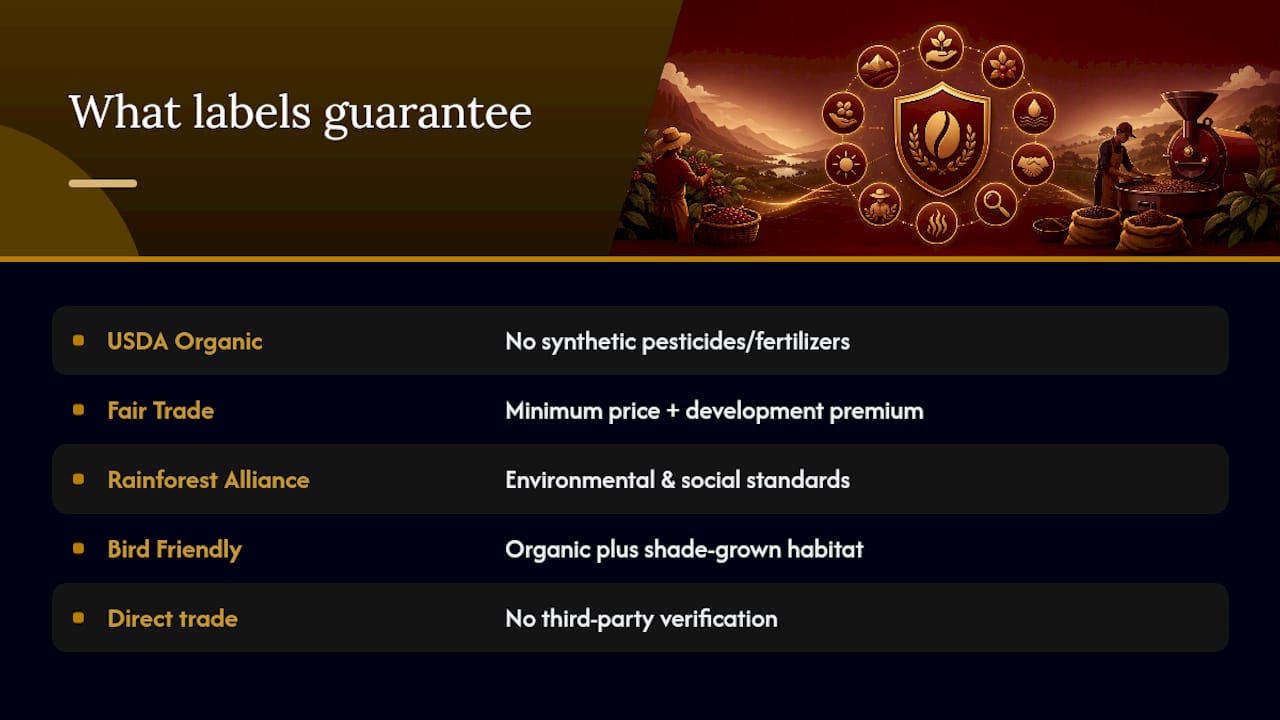
USDA Organic certifies that the coffee was grown without most synthetic pesticides or fertilizers, verified by an accredited agent. The USDA maintains a public list of organic certifying agents, so you can confirm a certifier is legitimate rather than a logo someone printed on a bag.
Fair Trade certification (often shown as Fairtrade) guarantees producers a minimum price and a community development premium on top of the market rate. It’s an economic protection, not a taste guarantee. Fairtrade’s own program materials are explicit that the certification focuses on price floors and producer welfare rather than cup score.
Rainforest Alliance sets environmental and social sustainability standards, covering things like water use, biodiversity, and worker conditions on certified farms. It’s broader in scope than organic certification and audits farming practices more holistically, but it isn’t a substitute for organic status since the two standards measure different things.
Bird Friendly, run by the Smithsonian, is arguably the strictest common certification. It requires both organic practices and genuine shade-grown cultivation under a diverse tree canopy, specifically because that structure preserves migratory bird habitat that monoculture sun-grown farms destroy.
“Direct trade” and similar phrases like “ethically sourced” or “farm direct” carry no legal definition and no third-party audit. Some roasters use the term honestly to describe real relationships with farms and above-market prices paid. Others use it purely as a marketing flourish. There’s no registry to check, so the term is only as good as the roaster’s actual track record on transparency.
A quick validity check for any logo: search the certifying body’s own website (usda.gov, fairtradecertified.org, rainforest-alliance.org, or the Smithsonian’s Bird Friendly page) and look up the roaster or farm by name. A real certification will show up in the certifier’s own database. If it doesn’t, treat the logo as decoration, not proof.
How to actually use a coffee label to pick a bag
Reading every field on a bag is one thing. Knowing which fields to weigh in the checkout line is another. Here’s the order that matters.
- Check the roast date first. Coffee tastes best within roughly seven to 21 days of roasting, and most of it has faded noticeably past 60 days. If a bag only shows a “best by” date a year out with no roast date printed anywhere, that’s a red flag, not a technicality.
- Check roaster transparency. Does the bag name a specific farm or cooperative? Is there an importer listed? Is there a published SCA cupping score? Roasters confident in their sourcing tend to print all of it. Roasters hiding behind “premium Arabica blend” usually have nothing specific to say.
- Match origin, process, and roast level to the flavor you want. Want bright and fruity? Look for a washed or natural Ethiopian or Kenyan single-origin at a lighter roast. Want something heavier and chocolatey? A darker roast Brazilian or Sumatran will usually deliver that. Treat tasting notes as directional cues, not contracts.
Watch for the marketing-only terms that mean nothing on their own: “artisanal,” “premium,” “gourmet,” and “small-batch” have no regulated definition in coffee labeling. A vague origin like just “South America” paired with a bag that only shows a best-by date is a near-certain sign you’re looking at commodity coffee dressed up in nicer packaging.
If your priority is ethics and farmer welfare, weight certifications like Fair Trade or Bird Friendly more heavily. If your priority is flavor, weight roast date, processing method, and tasting notes more heavily, since certifications say nothing about what’s in the cup.
The 10-point label checklist to use right now
Run any bag through this list before you buy:
- Roast date — confirms freshness; skip anything without one.
- Roast level — signals whether you’ll get bright acidity or roasty sweetness.
- Origin specificity — country alone is weak; region or farm is strong.
- Farm or cooperative name — the single best traceability signal on the bag.
- Processing method — predicts body and acidity before you brew a cup.
- Altitude — higher elevation often means denser, more complex beans.
- Tasting note specificity — vague notes suggest a vague roaster.
- Certifications — check for logos tied to your actual priority (organic, Fair Trade, Bird Friendly).
- SCA or Q-grader score — a published number is a verifiable quality claim.
- Importer or lot traceability — shows the roaster can account for where the coffee actually came from.
| Checklist item | Why it matters |
|---|---|
| Roast date | Determines flavor freshness window |
| Roast level | Signals acidity vs. roast-driven sweetness |
| Origin specificity | Farm/region beats generic country claims |
| Farm or cooperative | Highest-value traceability signal |
| Processing method | Predicts body, acidity, and sweetness |
| Altitude | Higher elevation often means denser, complex beans |
| Tasting note detail | Vague notes suggest vague sourcing |
| Certifications | Confirms ethical or environmental claims |
| SCA/Q-grader score | Verifiable, standardized quality claim |
| Importer/lot traceability | Shows the roaster can account for sourcing |
How Jett and Esprit Kaffe actually read a bag
Jett’s rule of thumb is simple: treat the roast date as a deadline, not a suggestion, favor any bag that names a farm or cooperative over one that just names a country, and use tasting notes as a compass rather than a promise.
A genuinely transparent specialty bag lists the roast date, the farm or cooperative, the process, the elevation, the tasting notes, and the importer. Miss two or three of those fields and you’re probably holding commodity coffee with a nicer label.
That field set isn’t arbitrary. It mirrors what specialty coffee guides recommend checking for exactly because those fields are the ones commodity roasters tend to skip. Esprit Kaffe prints roast date, origin, and process on every bag for that reason: it’s the same checklist we’d want to see if we were standing in the aisle ourselves.
Where to verify these claims yourself
- USDA organic certifying agents for organic verification
- Fairtrade Certified FAQ for Fair Trade guarantees
- Rainforest Alliance for environmental standards
- Perfect Daily Grind’s label breakdown for processing detail
- Pulled Journal’s field-by-field guide for a deeper walkthrough
- For a home-brewing angle on roast impact, see this light roast vs. dark roast guide
Why we print what we print
We stamp the roast date, origin, and process on every bag because that’s the exact information we’d want if we were the ones buying. It’s not a compliance checkbox. It’s how you know whether a coffee will actually taste the way you’re hoping when you’re picking a single-origin for a slow Sunday morning or something faster for a weekday grind.
If you ever want to know more about a specific lot, where it came from, who grew it, how it was processed, just ask us. We’d rather answer a sourcing question than have you guess. And if you want to start simple, our instant coffee carries the same roast transparency without the extra brewing steps.
The gap between what a coffee label promises and what it proves
Most coffee marketing wants you to believe every term on a bag is doing real work. It isn’t. “Artisanal” proves nothing. “Premium” proves nothing. Even a certification logo, real as it is, only proves one narrow thing, organic pesticide use, or a price floor, not that the coffee tastes good.
What I think gets underestimated is how much the roast date alone filters out bad coffee before you even get to origin or process. A bag with no roast date printed is telling you something by omission: the roaster either doesn’t track freshness closely or doesn’t want you comparing it to how stale the coffee might actually be. That’s a bigger tell than any missing certification.
The other thing worth saying plainly: certifications and flavor are separate questions, and treating them as the same thing leads to disappointment. I’ve seen shoppers buy a heavily certified bag expecting a spectacular cup, only to get a flat, over-roasted coffee that happens to check every ethical box. Certifications answer “was this grown and traded responsibly.” Roast date, process, and tasting notes answer “will I like drinking this.” You need both answers, but they come from different parts of the label, and conflating them is where a lot of buying decisions go wrong.
— Jett
Sources
- How to Understand The Label on Your Bag of Roasted Coffee - Perfect Daily Grind
- National Organic Program: Organic certifying agents - USDA AMS
- Fairtrade Certified - FAQ
- Rainforest Alliance
- How to Read a Coffee Bag Label: Origin, Roast Date, Process, Tasting Notes | Pulled Journal