

Adenosine is defined as the primary molecular mediator of sleep pressure, a neuromodulator that accumulates in your brain during every waking hour and signals when it is time to sleep. Understanding what adenosine and sleep pressure mean together explains why you feel progressively drowsier as the day goes on, why caffeine works the way it does, and why a full night of sleep resets your mental clarity. The homeostatic drive to sleep, known in sleep science as Process S, depends almost entirely on adenosine. It builds in the basal forebrain and binds to A1 and A2A receptors that either suppress wakefulness or activate sleep circuits. Your brain is literally counting the hours you stay awake through chemistry.
What is adenosine and sleep pressure, and how are they connected?
Adenosine is a byproduct of neuronal energy use. Every time a brain cell fires, it burns adenosine triphosphate (ATP) for fuel. That ATP breaks down through a chain reaction: ATP to ADP, ADP to AMP, and finally AMP to adenosine. The CD73 pathway drives this extracellular conversion, releasing adenosine into the fluid surrounding your neurons during active wakefulness. The longer you stay awake, the more adenosine accumulates.
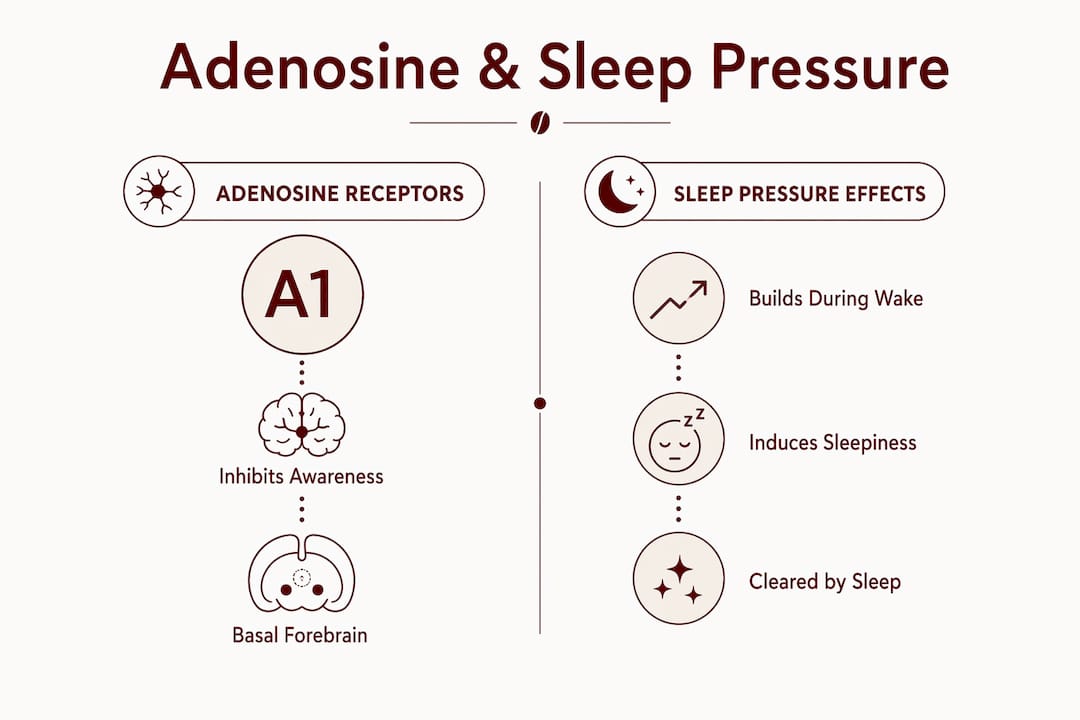
Sleep pressure is the increasing urge to sleep that builds with time awake. Scientists call this Process S, the homeostatic component of sleep regulation. Adenosine is the key molecular mediator of Process S, meaning it is the chemical that physically encodes how long you have been awake. This is not a metaphor. Your brain keeps a running biochemical tally of wakefulness through adenosine concentration.
The basal forebrain is the brain region most sensitive to this accumulation. Research describes it as an “active computational node” that converts the metabolic cost of staying awake into a sleep-promoting signal. That is an elegant design: the very act of thinking and moving generates the chemical that eventually forces you to rest.
How does adenosine accumulate during wakefulness?
The accumulation follows a predictable pattern tied to how hard your brain and body are working. Here is the sequence:
- Neurons fire and burn ATP. Every thought, movement, and sensory experience consumes energy stored as ATP.
- ATP breaks down extracellularly. Neurons and astrocytes release ATP, which the CD73 enzyme pathway converts into adenosine outside the cell.
- Adenosine concentrations rise. Extracellular adenosine doubles after approximately 6 hours of sustained wakefulness in the basal forebrain. That doubling is the molecular signature of significant sleep pressure.
- Sleep pressure intensifies. As adenosine binds to receptors, wake-promoting neurons slow down and sleep circuits activate.
- Sleep clears the slate. After roughly 3 hours of recovery sleep, adenosine levels return to baseline, resetting the pressure.
The accumulation is not uniform across the brain. Sleep deprivation selectively elevates adenosine in the basal forebrain, while other regions show minimal change. This localization explains why sleep deprivation hits cognitive function and emotional regulation hardest. Those are basal forebrain-dependent processes.
Pro Tip: Intense mental or physical activity increases local adenosine production faster than passive rest does. A demanding work session or a hard workout builds sleep pressure more quickly than a relaxed afternoon, which is why you feel more tired after a cognitively demanding day even if you barely moved.

How do adenosine receptors translate sleep pressure into sleepiness?
Adenosine does not cause sleepiness on its own. It needs receptors to act on. The two primary receptors are A1 and A2A, and they work through different pathways.
| Receptor | Location | Primary action | Effect on sleep |
|---|---|---|---|
| A1 | Basal forebrain, cortex | Inhibits wake-promoting neurons | Reduces arousal, increases sleep drive |
| A2A | Preoptic hypothalamus, striatum | Activates sleep-promoting circuits | Directly triggers sleepiness and sleep onset |
A1 receptors act like a brake on wakefulness. When adenosine binds to them, the neurons that keep you alert and focused slow their firing. A2A receptors take a more active role, switching on the circuits in the preoptic hypothalamus that initiate sleep. A1 receptors suppress wake neurons while A2A receptors stimulate sleep circuits, meaning both pathways converge on the same outcome through different mechanisms.
This receptor specificity matters clinically. Dysfunction in either pathway can produce sleep disorders that look similar on the surface but require different treatments. Therapeutic approaches to sleep disorders must consider the distinct roles of A1 and A2A receptors, not just total adenosine levels. A drug that targets only one receptor type may address one part of the problem while leaving the other intact.
Pro Tip: Receptor sensitivity varies between people due to genetics. Some people carry variants that make their A2A receptors less responsive to adenosine, which is one reason certain individuals genuinely feel less sleepy after a poor night’s sleep than others do.
How does adenosine interact with circadian rhythms and caffeine?
Sleep is regulated by two systems working in parallel. Process S is the homeostatic drive, the adenosine-based pressure that builds with wakefulness. Process C is the circadian rhythm, the internal 24-hour clock that promotes alertness during the day and sleep at night. These two systems interact constantly.
Caffeine enters this picture as a direct antagonist to adenosine. Here is what caffeine actually does and does not do:
- Caffeine blocks adenosine receptors. It fits into A1 and A2A receptor sites without activating them, preventing adenosine from binding. This is competitive antagonism.
- Caffeine does not clear adenosine. Caffeine blocks receptors but does not reduce adenosine levels. Adenosine keeps accumulating while caffeine is in your system.
- The crash is real and biochemical. When caffeine clears your system, all that accumulated adenosine floods the now-unblocked receptors at once. The tiredness you feel is not weakness. It is hours of unprocessed sleep pressure hitting simultaneously.
- Timing caffeine around adenosine dynamics matters. Consuming caffeine too late in the day means it is still blocking receptors when your circadian rhythm is trying to initiate sleep. The adenosine is there. The signal just cannot get through.
- Morning caffeine works with your biology. Cortisol peaks in the early morning naturally promote alertness. Delaying your first cup by 60–90 minutes lets cortisol do its job and saves caffeine’s effect for when adenosine pressure starts rising.
Understanding why caffeine timing affects focus is not just productivity advice. It is applied adenosine biology. Specialty beverages that balance caffeine content with other compounds can also influence how sharply this receptor competition plays out, which is why specialty beverage choices are worth thinking about beyond simple caffeine content.
How does sleep clear adenosine and restore brain function?
Sleep is not passive. It is an active clearing process, and adenosine is the primary thing being cleared.
- Astrocytes take over. These glial cells surrounding neurons absorb and break down extracellular adenosine during sleep. Astrocytes clear adenosine during sleep, and impaired astrocyte function disrupts this process even when sleep duration is adequate.
- Slow-wave sleep drives the deepest clearance. Slow-wave sleep coincides with low adenosine states and facilitates brain waste clearance. This is the deepest, most restorative stage of sleep, and it is when adenosine dissipation is most efficient.
- Fragmented sleep fails the clearance process. Waking repeatedly during the night interrupts astrocyte-mediated clearing. You may log eight hours in bed but still wake feeling unrefreshed if sleep fragmentation prevented adequate adenosine dissipation.
- Chronic impairment compounds. The recovery of sleep pressure requires astrocyte-mediated clearance. Impairments in these glial cells can contribute to chronic sleep quality issues independent of how many hours you sleep.
Pro Tip: Alcohol disrupts slow-wave sleep even though it helps you fall asleep faster. Less slow-wave sleep means less adenosine clearance, which is why drinking before bed often leaves you feeling groggy the next morning despite a full night’s rest.
One counterintuitive fact worth knowing: the blood-brain barrier blocks oral adenosine from reaching the brain, which is why adenosine supplements do not work as sleep aids. The only way to clear adenosine is to sleep.
Key Takeaways
Adenosine is the brain’s primary sleep timer, accumulating during wakefulness to drive sleep pressure and clearing during sleep to restore mental function.
| Point | Details |
|---|---|
| Adenosine drives sleep pressure | It accumulates from ATP breakdown during wakefulness and signals the brain to initiate sleep. |
| Basal forebrain is the key region | Adenosine doubles here after 6 hours awake and returns to baseline after recovery sleep. |
| Two receptors, two pathways | A1 receptors suppress wakefulness; A2A receptors activate sleep circuits in the hypothalamus. |
| Caffeine masks, not clears | Caffeine blocks adenosine receptors without reducing adenosine, causing a rebound crash when it wears off. |
| Sleep clears adenosine actively | Astrocytes remove adenosine during slow-wave sleep; fragmented sleep impairs this process. |
Why adenosine changed how I think about sleep and coffee
The science of adenosine rewired my intuition about tiredness. Most people treat sleepiness as a failure of willpower. The biology says otherwise. Sleepiness is a precise, accumulated chemical signal that your brain has been building since you woke up. You cannot outthink it indefinitely. You can only delay it.
The biggest misconception I see is the belief that caffeine “gives you energy.” It does not. Caffeine borrows alertness from your future self by blocking the signal that adenosine is sending. The energy was never created. The debt is always paid. Understanding this changes how you relate to that afternoon crash. It is not a character flaw. It is chemistry.
What this means practically is that sleep hygiene is not about discipline. It is about respecting a biological system that has been running for hundreds of millions of years. Protecting your slow-wave sleep, timing your caffeine to work with adenosine dynamics rather than against them, and giving your astrocytes the uninterrupted time they need to do their job: these are not wellness trends. They are the mechanics of a functioning brain.
The most underrated insight here is that intense mental work accelerates adenosine buildup locally. A hard thinking session is genuinely tiring in a measurable, molecular sense. Giving yourself permission to rest after demanding cognitive work is not laziness. It is accurate biology.
— Jett
Coffee that works with your biology, not against it
Adenosine accumulation is inevitable. How you manage the caffeine side of that equation is where you have real control.

Espritkaffe’s Coffee with Mushrooms Medium Roast is built for people who think carefully about what they put in their body and when. The blend pairs quality coffee with functional mushroom extracts, offering a measured caffeine experience that works with your adenosine curve rather than bulldozing it. For those who prefer a deeper roast, the Coffee with Mushrooms Dark Roast delivers the same intentional approach with a bolder profile. Espritkaffe is coffee roasted for sharp minds who want clarity without the crash.
FAQ
What is adenosine’s role in sleep?
Adenosine is a neuromodulator that accumulates in the brain during wakefulness and binds to receptors that suppress alertness and activate sleep circuits. It is the primary molecular driver of homeostatic sleep pressure, known as Process S.
How long does it take for adenosine to build up?
Extracellular adenosine in the basal forebrain doubles after approximately 6 hours of sustained wakefulness. Levels return to baseline after roughly 3 hours of recovery sleep.
Does caffeine reduce adenosine in the brain?
No. Caffeine blocks adenosine receptors competitively but does not reduce adenosine levels. Adenosine continues accumulating while caffeine is active, which causes a rebound crash when the caffeine clears.
Why does fragmented sleep leave you feeling unrested?
Adenosine clearance happens primarily during slow-wave sleep through astrocyte activity. Fragmented sleep interrupts this process, leaving residual adenosine even after a full night in bed.
Can you take adenosine as a sleep supplement?
No. The blood-brain barrier prevents oral adenosine from reaching the brain, making supplements ineffective. The only proven way to clear adenosine is through quality, uninterrupted sleep.