

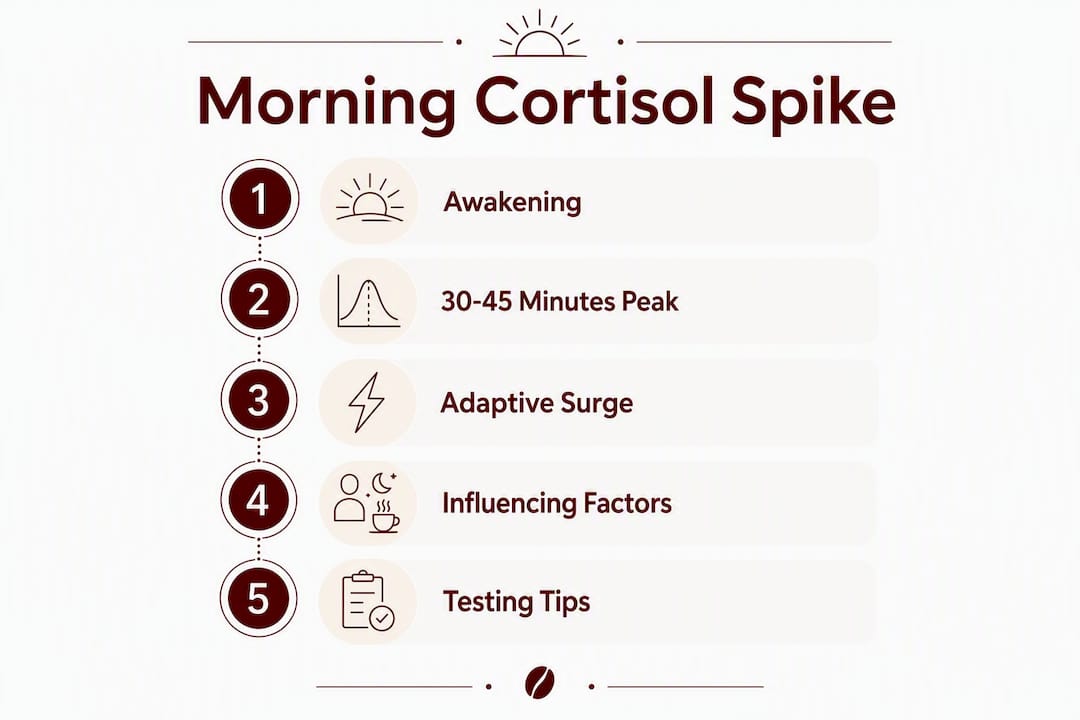
The morning cortisol spike is the cortisol awakening response (CAR), a normal, adaptive surge your body produces to mobilize energy and sharpen alertness as you transition from sleep to waking. It is not a stress alarm. It is your biology preparing you for the day.
TL;DR: A single morning spike is healthy and expected. The concern is sustained high cortisol throughout the day, which is what chronic stress and certain medications produce.
According to a widely cited review, the CAR produces a rapid cortisol increase of roughly 38–75% within 30–45 minutes of waking and is seen in about 77% of healthy people.
- Ignore it if you feel alert in the morning and your energy, mood, and sleep are stable.
- Track it if you notice persistent fatigue, mood swings, or disrupted sleep, especially after major life changes or new medications.
- See a clinician if you have progressive weight changes, muscle weakness, easy bruising, or symptoms that do not resolve with lifestyle adjustments.
Table of Contents
- What is cortisol and why does it rise every morning?
- What does a normal morning cortisol spike look like?
- When can a morning spike signal a problem?
- What changes your morning cortisol response?
- How do you test cortisol correctly?
- Practical steps to support a healthy cortisol rhythm
- What does recent research add about the CAR?
- When should you contact a clinician?
- Key Takeaways
- The morning ritual is the intervention
- Your morning ritual, made intentional
- Useful sources and further reading
What is cortisol and why does it rise every morning?
Cortisol is a steroid hormone produced by the adrenal glands, released in response to signals from the hypothalamic-pituitary-adrenal (HPA) axis. The HPA axis functions like a command chain: the hypothalamus signals the pituitary, the pituitary signals the adrenal glands, and cortisol enters the bloodstream. Cleveland Clinic notes that most people have their lowest cortisol levels in the evening and their peak levels just before and after waking, pointing to cortisol’s central role in circadian rhythm.
The CAR sits on top of that broader circadian rhythm as a distinct, sharper event. Where the circadian rise is gradual across the early morning hours, the CAR is a rapid burst triggered specifically around the moment of awakening. Its proposed functions span metabolism, immune regulation, and neurocognition, essentially priming the body’s systems before the demands of the day arrive.
“The cortisol awakening response is an adaptive burst of cortisol that prepares the organism for the day by mobilizing resources and supporting alertness — it is distinct but superimposed on the circadian rhythm.” Endocrine Society
Key roles the CAR serves:
- Mobilizes glucose for immediate energy
- Modulates immune function to prepare for physical and psychological demands
- Supports memory consolidation and cognitive readiness
- Regulates mood and motivational states in the first hours of the day
What does a normal morning cortisol spike look like?
Timing and magnitude matter here. The CAR begins at or just before the moment of awakening, peaks roughly 30–45 minutes later, then declines gradually across the rest of the day. Research published on PMC/NIH confirms that CAR may actually begin before physical awakening in some people, suggesting the brain anticipates waking rather than simply reacting to it.

The typical magnitude is a 38–75% increase over the waking baseline, seen in about 77% of healthy adults. That range is wide because individual variation is real and expected. Genetics, habitual wake time, sleep duration, and even what you expect the day to hold all shape how large your CAR is on any given morning. Twin studies show a substantial heritable component, and individuals tend to show stable CAR profiles across repeated measurements.
A typical CAR timeline:
- Pre-wake (half an hour to an hour before alarm): Cortisol begins rising gradually
- At waking: Baseline cortisol level, the starting point for measuring the CAR
- Approximately 30 minutes after waking: Peak cortisol, the highest point of the CAR
- Up to an hour after waking: Levels begin declining
- Midday onward: Steady fall continues
- Evening: Lowest levels of the day, supporting sleep onset
When can a morning spike signal a problem?
A single morning spike almost never signals a problem on its own. The distinction that matters clinically is between a normal CAR and two abnormal patterns: sustained high cortisol across the entire day, or a blunted CAR that barely rises at all.
Research from The Conversation makes the point clearly: a higher CAR helps you cope with the day’s mental and physical demands, while a blunted CAR is associated with worse health outcomes in observational studies. Neither extreme is ideal.
“The concern is sustained cortisol elevation across the day — chronic stress states and long-term corticosteroid use prevent the normal rise-and-fall pattern and are linked to adverse outcomes.” UNSW Newsroom
Warning signs that suggest an abnormal cortisol pattern:
- Persistent fatigue that does not improve with rest
- Unexplained weight gain, especially around the abdomen and face
- Muscle weakness or loss of muscle mass
- Easy bruising or slow wound healing
- Recurrent infections or a sense that your immune system is struggling
- Significant mood changes, anxiety, or depression that feel out of proportion
- Major sleep disruption, particularly waking in the early hours and being unable to return to sleep
Rare but important causes include Cushing’s syndrome (excess cortisol production from a tumor or long-term steroid use), pituitary disorders, and primary adrenal insufficiency. These are uncommon, but they are the reason a clinician’s evaluation matters when multiple warning signs appear together.
What changes your morning cortisol response?
Several lifestyle, medication, and environmental factors shift the CAR up, down, or sideways.
Lifestyle and sleep factors:
- Irregular sleep and wake times weaken the CAR’s circadian anchoring
- Short sleep duration or poor sleep quality blunts the response
- Night-shift work disrupts the entire cortisol rhythm, not just the morning peak
- Chronic psychological stress tends to elevate baseline cortisol and can distort the CAR pattern
- Major life events (job loss, bereavement, relationship stress) reliably alter CAR magnitude
Medications and substances:
- Long-term corticosteroid use (prednisone, for example) suppresses the HPA axis and flattens the natural rhythm entirely; this requires clinician management and cannot be self-corrected
- Some psychiatric medications affect HPA axis regulation, though effects vary by drug class and individual response
- Stimulants can raise cortisol acutely, though habitual morning caffeine in regular drinkers has limited effect on the CAR itself
Environment and behavior:
- Morning light exposure reinforces the circadian signal that supports a healthy CAR
- Anticipatory stress, meaning what you expect the day to bring, measurably influences CAR magnitude
- Habitual caffeine timing matters more later in the day than in the morning (more on this in the next section)
Pro Tip: The fastest modifiable levers are sleep schedule consistency, morning light exposure, and caffeine timing. Medication-related disruptions require a clinician’s review before you change anything.

How do you test cortisol correctly?
Testing cortisol accurately depends entirely on which question you are trying to answer. The CAR specifically requires salivary cortisol collected at two precise times: immediately on waking and again at exactly 30 minutes later. Some protocols add a third sample at 45–60 minutes. MedlinePlus notes that blood cortisol tests are typically ordered early in the morning for the same reason: cortisol varies significantly across the day, and timing determines what the result actually means.
| Sample type | When to use it | What it tells you |
|---|---|---|
| Salivary cortisol (waking + 30 min) | CAR measurement | Size and shape of the morning surge |
| Morning blood cortisol | General cortisol status, adrenal function | Circulating cortisol at peak time |
| 24-hour urine cortisol | Total daily cortisol exposure | Whether overall production is elevated |
| Dexamethasone suppression test | Suspected Cushing’s syndrome | Whether cortisol suppresses normally |
Common collection errors that produce misleading results include eating or brushing teeth before a saliva sample, failing to record the exact wake time, and collecting samples at the wrong interval. Compliance with timing is the single biggest source of false CAR results, which is why research protocols use electronic monitors to verify collection times.
Pro Tip: Before a saliva sample, do not eat, drink, or brush your teeth. Write down your exact wake time the moment you open your eyes. Even a 10-minute error in recording can distort the calculated CAR.
Practical steps to support a healthy cortisol rhythm
The goal is not to suppress the morning spike. It is to support the full daily arc: a healthy peak in the morning and low levels by evening.
Daily behavioral anchors:
- Fix your wake time, even on weekends. Consistency is the single strongest circadian signal.
- Get outside or near a bright window within 30 minutes of waking. Natural light reinforces the cortisol rhythm and helps the evening decline happen on schedule.
- Prioritize 7–9 hours of sleep. Duration and quality both shape CAR magnitude.
- Avoid heavy meals late at night, which can disrupt sleep architecture and blunt the morning response.
Caffeine timing: Morning coffee in habitual drinkers generally does not disturb the CAR. The timing that matters more is the afternoon. Caffeine consumed in the late afternoon or evening can elevate cortisol later in the day and delay the evening decline, which then disrupts sleep and weakens the next morning’s response. Understanding why caffeine timing affects focus and productivity helps you place your cups where they do the most good.
Stress management steps:
- Practice 4–7–8 breathing (inhale 4 counts, hold 7, exhale 8) for 3–5 minutes after waking to moderate the anticipatory stress that amplifies the CAR.
- Schedule a brief 5–10 minute walk or gentle movement in the first hour. Physical activity supports healthy HPA axis regulation without spiking cortisol further when kept moderate.
- Defer high-stakes decision-making and worry to a scheduled time later in the morning. Anticipatory cognitive load is a documented CAR amplifier.
Pro Tip: An intentional morning ritual, quiet light, a few minutes of movement, and a mindful first cup of coffee, creates a low-threat environment that lets the CAR do its job without amplification from anxiety. The ritual itself is the intervention.
If you are looking for caffeine-free energy options to complement your morning routine, particularly on days when you want to reduce stimulant load, natural alternatives can support alertness without adding to cortisol burden.
What does recent research add about the CAR?
The most significant shift in how researchers understand the CAR is the move from a reactive to an anticipatory model. Forcing someone awake in the middle of the night does not produce the same CAR as natural awakening, which strongly supports the idea that the brain prepares for waking rather than simply responding to it. The hippocampus, amygdala, and prefrontal cortex all contribute to a dual-control system that integrates circadian timing with cognitive and emotional context.
The Endocrine Society frames CAR as an adaptive anticipatory tool for resource mobilization, a framing that reframes variability as meaningful signal rather than noise. A larger CAR on a high-stakes morning is not a malfunction.
“Emerging models view the CAR as an adaptive, anticipatory tool for resource mobilization and counterregulation — shifting how researchers interpret variability and health associations.” Endocrine Society
What remains unresolved: why CAR magnitude varies so widely between individuals even after controlling for sleep and stress, and exactly how much anticipatory cognition (versus pure circadian timing) drives the response. These are active research questions, not settled science.
When should you contact a clinician?
Most people reading this article do not need a cortisol test. But some patterns warrant a conversation with a doctor.
Red flags that should prompt evaluation:
- Progressive, unexplained weight gain around the face, neck, or abdomen
- New or worsening muscle weakness
- Easy bruising without obvious cause
- Persistent fatigue that does not respond to improved sleep
- Significant mood changes, anxiety, or depression alongside physical symptoms
- Recurrent infections or slow healing
What clinicians typically do:
- Review your full medication list, particularly any corticosteroids, even topical or inhaled ones.
- Order a morning blood cortisol or 24-hour urine cortisol depending on the clinical picture.
- Consider a dexamethasone suppression test if Cushing’s syndrome is suspected.
- Refer to endocrinology when results are ambiguous or when a pituitary or adrenal cause is possible.
Before your appointment, note:
- When symptoms started and whether they are getting worse
- Every medication and supplement you take, including dose and duration
- Your typical sleep and wake times
- Any major stressors or life changes in the past 6–12 months
This article is general health information, not medical advice. Confirm any clinical concerns with a qualified healthcare provider.
Key Takeaways
The morning cortisol spike is the cortisol awakening response, a normal adaptive surge seen in about 77% of healthy people that peaks 30–45 minutes after waking and supports alertness, metabolism, and immune readiness.
| Point | Details |
|---|---|
| CAR is normal and adaptive | A 38–75% cortisol rise within 30–45 minutes of waking occurs in about 77% of healthy people. |
| Sustained elevation is the concern | Chronic high cortisol across the full day, not the morning peak, is linked to adverse health outcomes. |
| Sleep and light are the top levers | Consistent wake time and morning light exposure are the most effective routine-level supports for a healthy CAR. |
| Test timing is everything | Salivary cortisol at waking and exactly 30 minutes later is the correct protocol for measuring the CAR. |
| Espritkaffe fits the ritual | An intentional morning coffee from Espritkaffe supports the calm, low-threat environment that lets the CAR work as designed. |
The morning ritual is the intervention
Most cortisol content focuses on fear: how to lower it, suppress it, or avoid it. That framing misses the point entirely. The morning spike is not the enemy. It is the mechanism. Your body is doing something purposeful and well-designed, and the smartest thing you can do is create conditions where it can do that job cleanly.
What strikes me about the research on anticipatory stress and the CAR is how much the quality of your first waking moments matters. A chaotic, alarm-blaring, phone-grabbing start amplifies the CAR through cognitive threat signals. A calm, light-filled, intentional start lets the same biological process run without amplification. Same hormone. Very different experience.
The practical implication is that a morning ritual is not a luxury. It is a physiological tool. Light, gentle movement, and a mindful first cup of coffee are not wellness theater. They are the conditions under which your cortisol rhythm does exactly what it is supposed to do.
Your morning ritual, made intentional

Espritkaffe is built for exactly this kind of morning. Every roast is certified free of mycotoxins, heavy metals, mold, and yeast, so the first thing you put in your body supports clarity rather than adding a burden to it. The Instant Coffee is the simplest way to make your morning ritual consistent: no grinder, no fuss, just a clean cup ready in the time it takes to let the light in. For something with a little more depth, the Coffee with Mushrooms Medium Roast pairs a smooth, balanced roast with functional mushroom extracts for a grounded start to the day.
This is a lifestyle choice, not a medical treatment. For clinical concerns about cortisol, speak with your healthcare provider. For the ritual itself, Espritkaffe is a good place to start.
Useful sources and further reading
“The cortisol awakening response produces a rapid increase of roughly 38–75% within 30–45 minutes of waking and is observed in approximately 77% of healthy people.” Cortisol awakening response — Wikipedia
- Cortisol awakening response — Wikipedia: Quick-reference overview with timing, magnitude, and sampling methodology.
- The cortisol awakening response: Fact or fiction? — PMC/NIH: Peer-reviewed open-access review examining the evidence base for CAR as a distinct biological phenomenon.
- The Cortisol Awakening Response — Endocrine Society: Clinical review from the leading endocrine authority; covers mechanisms, health associations, and research gaps.
- Cortisol spikes are normal, so when is cortisol a real problem? — The Conversation: Plain-language summary for general readers; addresses caffeine, chronic stress, and when to seek help.
- Cortisol spikes are normal, so when is cortisol a real problem? — UNSW Newsroom: Research-backed explainer on the difference between normal spikes and chronic elevation.
- Cortisol: What It Is, Function, Symptoms & Levels — Cleveland Clinic: Patient-friendly clinical reference covering cortisol function, normal ranges, and when to see a doctor.
- Cortisol blood test — MedlinePlus: Government health encyclopedia entry on cortisol blood testing, timing, and interpretation.
- The cortisol awakening response (review) — ScienceDirect: Academic review of the dual-control (circadian + cognitive) model of CAR regulation.