

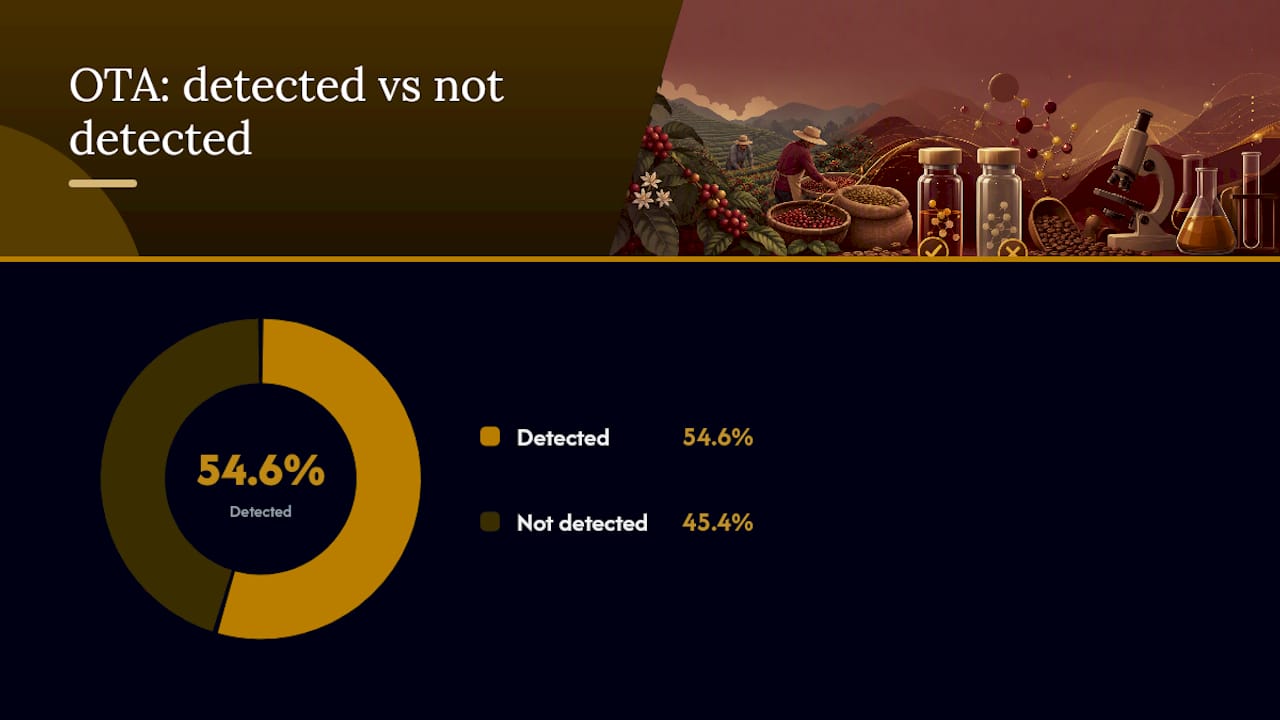
Typical coffee drinking carries low ochratoxin A (OTA) risk, but OTA is a monitored toxin, so prevention through supplier quality and storage is the actual control that matters. A 2024 worldwide systematic review covering 3,256 coffee samples found OTA in 54.6% of them, yet estimated daily intake still landed below the safety thresholds set by JECFA and EFSA. The International Agency for Research on Cancer classifies OTA as a Group 2B possible human carcinogen, which is why regulators and coffee producers track it closely rather than ignore it.
Here’s what to do with that information right now:
- Buy from roasters who document post harvest handling, not just ones who print “certified” on a bag.
- Store beans sealed, dry, and away from humidity swings.
- Skip any beans with visible mold, musty smell, or a green coffee origin you can’t trace.
Quick stat: Only a small fraction of the samples in that 2024 review exceeded EU regulatory limits, and calculated hazard quotients generally stayed below 1 for the general population, meaning modeled health risk from coffee-based OTA exposure was low under typical consumption patterns.
Key Takeaways
Coffee’s ochratoxin A risk is low for typical drinkers, but managing it well requires upstream supplier controls, not downstream fixes like roast level or occasional lab certificates.
| Point | Details |
|---|---|
| Detection isn’t danger | More than half of tested samples showed measurable OTA, but exposure still stayed below JECFA and EFSA safety thresholds. |
| Kidneys are the target organ | OTA’s nephrotoxicity, not acute poisoning, is why regulators track chronic low-dose exposure over time. |
| Drying is the highest-risk stage | Moisture control during drying and storage prevents most contamination before it starts. |
| Roasting helps but isn’t a guarantee | Reduction ranges from 12% to over 90% depending on conditions, so it can’t replace clean sourcing. |
| Espritkaffe’s standard is process-based | Beans are certified mycotoxin, heavy metal, mold, and yeast free, reflecting ongoing quality controls over single-point testing. |
Table of Contents
- What Ochratoxin A Is and How It Affects Health
- How Common Is OTA in Coffee, and Does It Exceed Safe Intake Levels?
- Regulation and Industry Guidance: Who Sets the Limits
- How OTA Forms in the Coffee Supply Chain
- Does Roasting Remove Ochratoxin A From Coffee?
- How to Reduce Your Ochratoxin A Exposure From Coffee
- How Espritkaffe Approaches Supply Chain Quality and OTA Prevention
- What the Research Actually Tells Us to Prioritize
- Get Coffee Sourced the Way This Article Describes
- Sources
What Ochratoxin A Is and How It Affects Health
OTA is not something added to coffee. It’s a byproduct of mold. Specifically, it’s a secondary metabolite produced by certain Aspergillus and Penicillium fungi that colonize coffee cherries and beans when conditions get too warm, too wet, or too slow to dry.
Once ingested, OTA doesn’t pass through the body quickly. Its nephrotoxic profile, meaning it targets the kidneys, comes from how slowly it’s cleared through the kidneys and bile, which is also why the IARC lists it as a Group 2B possible human carcinogen rather than a confirmed one. That classification sits in the same tier as substances where evidence is suggestive but not conclusive in humans, which is a meaningfully different statement than “known carcinogen.”
There’s no medical detox for OTA. No supplement, cleanse, or juice flush accelerates its clearance. The body handles it on its own timeline, which is exactly why public health guidance focuses entirely on reducing intake rather than treating exposure after the fact.
A few distinctions matter here for how you think about risk:
- Acute exposure (a single contaminated batch) is rare and generally not the concern driving regulation.
- Chronic low-level exposure across years of coffee drinking is the actual variable researchers study.
- Molecular weight and stability (OTA is a fairly stable compound at 403.813 Da) mean it survives some processing steps, which is why prevention upstream matters more than any single downstream fix.
Key figure: The EC caps roasted coffee at 3 µg/kg and soluble coffee at 5 µg/kg, thresholds set specifically because chronic low-dose kidney exposure, not acute poisoning, is the toxicological concern regulators are managing.
How Common Is OTA in Coffee, and Does It Exceed Safe Intake Levels?
Coffee testing finds ochratoxin A more often than most drinkers assume, but that’s not the same as finding dangerous levels of it. The 2024 systematic review analyzing three decades of global data (1997 to 2024) detected OTA in 1,778 of 3,256 samples, a 54.6% detection rate. Detection, though, just means the compound showed up above the lab’s threshold. Most of those samples still measured well under regulatory limits.
The review’s exposure modeling is the part that actually answers the safety question. Estimated daily intake (EDI) from coffee consumption came in below both the JECFA provisional tolerable daily intake (14 ng/kg body weight per day) and the stricter EFSA figure (17 ng/kg body weight per day). Resulting hazard quotients, the ratio of actual exposure to the safety threshold, stayed under 1 for most populations studied, which is the number toxicologists watch as the line between acceptable and concerning exposure.
If those acronyms sound like alphabet soup, here’s the plain-language version:
“Detected” and “unsafe” are different words for a reason. A coffee sample can register a trace of OTA on a sensitive lab instrument and still contribute a fraction of what your body could tolerate daily without measurable harm. The review’s own numbers make that gap explicit: over half the samples tested positive, yet modeled daily exposure stayed under the safety ceiling for nearly every population group examined.
| Metric | What it measures | Finding from the 2024 review |
|---|---|---|
| Detection rate | Share of samples with any measurable OTA | More than half of 3,256 samples |
| EDI vs. JECFA PTDI | Daily intake compared to the international safety ceiling | Below 14 ng/kg bw/day threshold |
| EDI vs. EFSA PTDI | Daily intake compared to the stricter European ceiling | Below 17 ng/kg bw/day threshold |
| Hazard quotient (HQ) | Ratio of exposure to tolerable limit | Generally below 1 across studied populations |
Only a small number of the studies included in that review reported coffee levels above EU maximum limits, and those outliers tended to trace back to identifiable failures, like poor drying or prolonged wet storage, rather than being representative of the coffee supply broadly. That distinction is worth sitting with: the data doesn’t say coffee is risky. It says a minority of poorly handled batches drag the detection statistics up while barely moving the actual exposure math.
Regulation and Industry Guidance: Who Sets the Limits
Coffee’s OTA rules look completely different depending on which side of the Atlantic you’re standing on. The European Commission sets maximum levels at 3 µg/kg for roasted coffee and 5 µg/kg for soluble (instant) coffee. Both figures came from risk assessments tied to the kidney toxicity data discussed earlier.
The US FDA, by contrast, has not established a coffee-specific OTA limit. That’s not the same as saying US coffee goes unmonitored. Importers and roasters selling into the US still operate under general food safety law and often follow the same international codes European buyers require, but there’s no single numeric backstop the way the EU has one.
That’s where the FAO/ICO Code of Practice (CAC/RCP 69-2009) fills the gap. It’s a cross-industry standard, not a law, but it’s the reference document most serious buyers use to write supplier contracts. Its core recommendations:
- Keep bean moisture content under 12.5% before storage or shipment.
- Limit how long cherries or parchment sit on drying patios, since extended drying time under humid conditions is when fungal colonization accelerates.
- Control transport conditions to prevent condensation inside shipping containers, which can rewet beans that were dried correctly.
Recent industry guidance from March 2026 reinforces the same point: OTA management works best as a continuous control running from tree to finished product, not a single inspection gate. Under a proper HACCP framework, OTA typically gets treated as an ongoing control point rather than a one-time critical checkpoint, meaning it’s monitored at multiple stages instead of checked once and forgotten.
Pro Tip: A single certificate of analysis tells you about the exact bag that was tested, on the day it was tested. It tells you nothing about the next shipment. If a supplier can’t describe their moisture targets or drying timelines, that absence is more informative than the certificate they hand you.
How OTA Forms in the Coffee Supply Chain
Every stage between the coffee tree and your kitchen cabinet is a moment where fungal growth either gets controlled or doesn’t. Understanding the sequence explains why prevention has to start long before a bean ever gets roasted.
- Pre-harvest damage. Insect activity and overripe, fallen cherries create entry points for fungal spores while the coffee is still on the tree. Cherries left too long before picking are measurably more vulnerable.
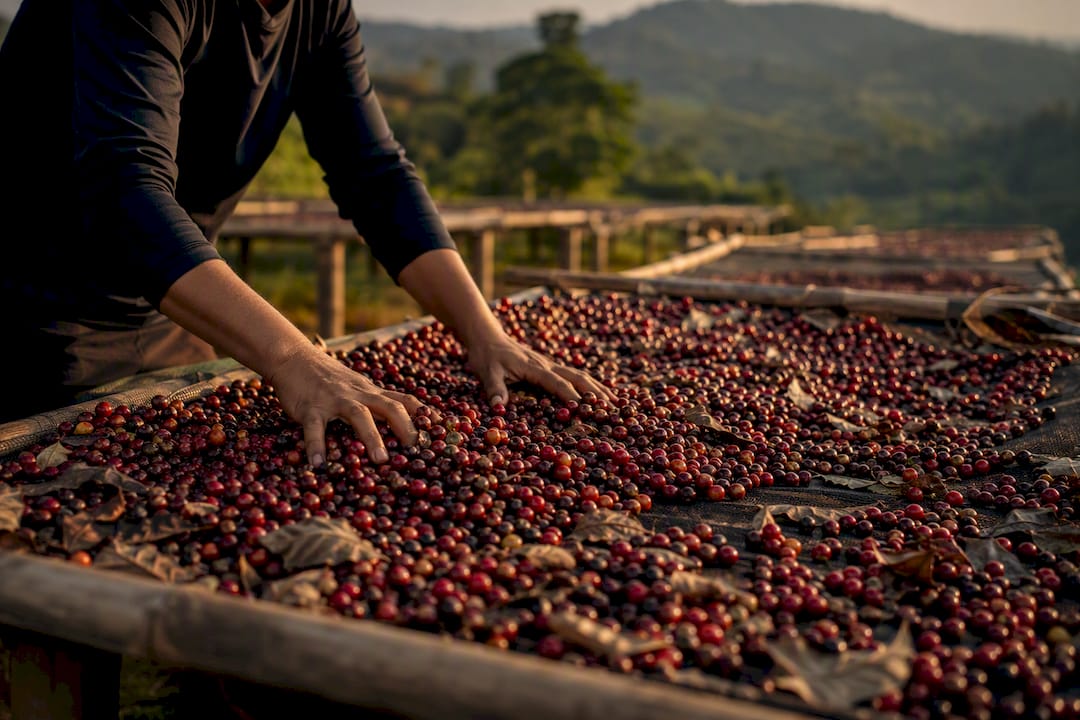
- Drying. This is the highest-risk window. Ochratoxigenic fungi thrive in a specific moisture and water-activity range, and beans sitting on drying patios too long in humid conditions hit that range repeatedly. Industry guidance recommends minimizing drying-yard time and hitting that 12.5% moisture target as fast as conditions allow.
- Storage. Beans that were dried correctly can still develop OTA later if warehouse humidity climbs or bags get stacked against damp walls or floors.
- Transport. Shipping containers moving through temperature swings generate internal condensation, which can rewet beans that were dry when loaded. This single failure point accounts for a meaningful share of contamination that traces back to shipments, not farms.
Notable finding: According to reviewed prevention literature, the Aspergillus fungal sections Circumdati and Nigri are identified as the main OTA producers across coffee supply chains, and their growth is directly tied to the moisture windows created at drying and storage, not something inherent to any particular origin or variety.
The practical takeaway is that OTA contamination usually signals a process failure somewhere along this chain rather than an unavoidable feature of coffee itself, a point echoed in independent research on OTA formation. Good drying and dry storage prevent the overwhelming majority of cases before they start.
Does Roasting Remove Ochratoxin A From Coffee?
Roasting helps, but it’s not a reliable safety net, and you shouldn’t treat it as one. Published reduction ranges are wide: reviewed literature reports OTA reductions from as low as 12% to over 90%, depending on roast temperature, duration, and how much OTA was present before roasting even started. Recent 2026 industry guidance points to 70 to 90% reduction specifically at high roasting temperatures, but that’s a range, not a guarantee.
Here’s why that range is so wide, and why it matters for what you buy:
- A dark roast run at high heat for longer duration tends to degrade more OTA than a quick light roast.
- But a dark roast starting from a heavily contaminated green bean can still end up with more residual OTA than a light roast made from clean beans.
- Roast degree alone tells you nothing reliable about the starting contamination level, which means you can’t shop by roast color and assume you’re managing risk.
- Instant and soluble coffee can show different measured concentrations than roasted whole bean, partly because concentration steps in processing can shift the numbers, which is part of why EU limits are set differently for each (3 µg/kg roasted versus 5 µg/kg soluble).
The number that matters more: upstream prevention, not roasting, is the primary control. Roasting is a helpful secondary reduction step layered on top of good sourcing, never a substitute for it.
How to Reduce Your Ochratoxin A Exposure From Coffee
You don’t need a lab to manage this risk. You need to know what to look for and what questions actually reveal something useful.
- Buy from suppliers who talk about process, not just certifications. A roaster who can describe moisture targets, drying timelines, or wet milling standards is signaling real quality control. One who only shows you a lab certificate is showing you a single data point.
- Prefer whole bean over pre-ground when you have the choice, and check for a recent roast date rather than a vague “best by” window. Freshness correlates with tighter supply chain oversight in most specialty operations.
- Understand what labeling claims actually mean. “Mycotoxin-free” or “tested” claims are meaningful QA signals, but they describe a tested batch, not an ironclad guarantee for every future bag, since ongoing supplier controls matter more than any single test result.
- Store beans sealed, cool, and dry at home. Humidity swings in a kitchen can undo good upstream handling. An airtight container in a stable cabinet away from the stove or sink does more for you than any specialty gadget.
- Inspect before you brew. Visible mold, a musty or moldy smell, or discoloration on beans means discard, no exceptions. This applies whether the bag cost $8 or $28.
- Be more cautious with unknown-origin bulk green coffee. If you’re roasting at home from green beans bought without any traceability information, you’re taking on the exact supply chain risk this whole article describes, without any of the oversight a commercial roaster provides.
- Don’t treat a single certificate of analysis as the whole story. As covered earlier, a documented HACCP program beats a one-time test, because OTA can develop after that test was run.
Pro Tip: If you’re ever unsure whether a supplier’s quality claims are substantive, ask one specific question: “What’s your green coffee moisture spec at intake?” A supplier with real controls answers instantly. One without them changes the subject.
For readers curious how cherries become the beans on your shelf, the harvest-to-bean process shows exactly where these control points sit in practice, and selecting reputable sourcing walks through what to check before you buy.
How Espritkaffe Approaches Supply Chain Quality and OTA Prevention
Espritkaffe’s coffee is certified mycotoxin, heavy metal, mold, and yeast free, a standard built directly around the prevention principles covered throughout this article rather than a single point-in-time test. That distinction matters because, as the FAO’s own code of practice makes clear, ongoing controls beat one certificate every time.
A few things worth knowing about how that plays out in practice:
- Espritkaffe publishes educational resources on sourcing and processing rather than treating that information as proprietary.
- Beans are roasted by origin, roast level, and blend, giving buyers visibility into the specific sourcing decisions behind each bag rather than a generic blend with untraceable origins.
- “Certified mycotoxin-free” is a meaningful QA signal, though it works best alongside the storage and handling habits covered above. No labeling claim replaces good habits once the bag is in your kitchen.
Readers interested in sourcing standards specifically can look at how domestic-grown options fit into a traceable supply chain conversation.
What the Research Actually Tells Us to Prioritize
The conventional coffee safety advice out there fixates on the wrong variable. Consumers get told to chase dark roasts because “roasting destroys toxins,” or to treat a certificate of analysis as a permanent guarantee. Neither holds up against what the actual data shows. Roast degree explains almost nothing about starting contamination, and a COA describes one bag on one day, not the bag you’re about to buy next month.
What the systematic review data actually supports is more boring and more useful: OTA in coffee is overwhelmingly a drying and storage problem, not a roasting or brewing problem. The FAO’s own code of practice says as much directly, and the 2024 exposure data backs it up by showing that hazard quotients stay low even with over half of tested samples registering some detectable OTA.
If you take one thing from this, let it be this: stop asking whether your coffee was tested once, and start asking how it was dried, stored, and shipped. That question tells you more than any certificate ever will.
— Jett
Get Coffee Sourced the Way This Article Describes
Everything covered here points to the same conclusion: prevention beats testing, and process transparency beats a single certificate. Espritkaffe roasts beans by origin, roast, and blend, and every batch is certified mycotoxin, heavy metal, mold, and yeast free, built around the ongoing quality controls this article recommends rather than a one-time check.
If you’ve read this far because you actually care about what’s in your cup, the next step is straightforward: browse the coffee collection and pick a roast based on origin and freshness rather than guesswork about roast color. Whether you’re restocking your everyday bag or trying a new origin for the first time, you’re ordering beans backed by documented handling standards, not just a label. Place an order today and taste the difference that real supply chain accountability makes.
This article is general information, not a substitute for advice from a qualified doctor. Consult a qualified healthcare professional about your own circumstances before acting on anything here.
Sources
The claims in this article draw on peer-reviewed and regulatory sources rather than general industry chatter. For further reading:
- PubMed record reporting IARC classification and OTA properties
- A worldwide systematic review of ochratoxin A in various coffee products - human exposure and health risk assessment (2024)
- Reduction in Ochratoxin A Occurrence in Coffee: From Good Practices to Biocontrol Agents (2024)
- Code of practice for the prevention and reduction of ochratoxin A contamination in coffee (CAC/RCP 69-2009)
- Guidelines for the prevention of OTA occurrence in coffee (ECF, March 2026)
Testing itself relies on standardized methods like HPLC with immunoaffinity cleanup (EN 14132) and ELISA screening, which is worth knowing because different methods can report different detection thresholds on the same sample.