

A coffee bean is the seed inside a coffee cherry. That transformation is what this article walks through, start to finish.
Here is the roadmap:
- Anatomy: what each layer of the cherry is and why it matters
- Harvest: ripeness, picking methods, and the clock that starts ticking immediately
- Processing methods: dry (natural), wet (washed), and honey (semi-dry)
- Core steps: pulping, fermentation, washing
- Drying, hulling, and sorting: hitting the moisture target and grading green beans
- Fermentation risks and best practices: what goes wrong and how producers prevent it
A freshly harvested cherry carries about 65% moisture; the finished green bean needs to land at 10–12% before it is stable enough to store, ship, or roast.
Key Takeaways
The coffee cherry becomes a stable green bean only when each stage — harvest, processing, drying, hulling, and sorting — is executed with speed, cleanliness, and precise moisture control.
| Point | Details |
|---|---|
| Anatomy matters | Five layers surround the seed; mucilage thickness directly affects fermentation time and flavor. |
| Processing method sets flavor | Dry (natural) yields fruit-forward cups; washed produces clean brightness; honey sits between them. |
| Moisture target: 10–12% | Fresh cherries start at ~65% moisture; green beans must reach 10–12% to be stable for storage and roasting. |
| Speed prevents spoilage | Cherries should reach the mill within hours of harvest; delay invites mold and off-flavors. |
| Sorting ensures roast consistency | Size and density grading after hulling prevent uneven roasting and reduce defect rates. |
Table of Contents
- What is inside a coffee cherry?
- How and when are coffee cherries harvested?
- What are the three main ways to process coffee cherries?
- How do pulping, fermentation, and washing actually work?
- How are green beans dried, hulled, and sorted?
- What are the fermentation risks and how do producers manage them?
- Why speed and control define quality at every stage
- What specialty roasters look for in green beans
- Sources
What is inside a coffee cherry?
The coffee cherry looks like a small, firm grape. Bite into one and you will find five distinct layers wrapped around the two seeds that become your morning cup.
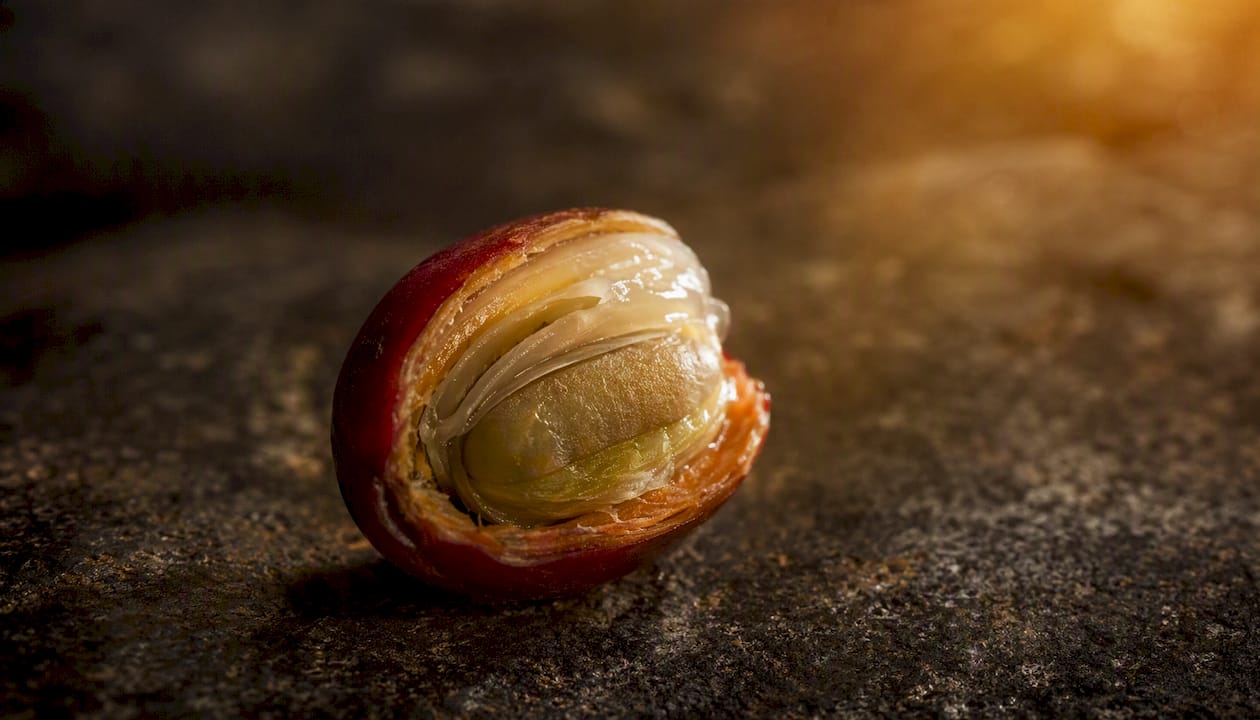
Exocarp (skin): The outermost layer. It starts green, ripens to red, yellow, or even purple depending on the variety, and signals harvest readiness by color and firmness.
Mesocarp (pulp): A thin, sweet fruit layer just beneath the skin. It is edible and mildly sweet, similar to a grape or lychee. Producers remove it mechanically during pulping.
Mucilage: A sticky, sugar-rich gel that clings to the parchment. This layer is central to fermentation because its sugars feed the microbes that loosen it from the parchment. Mucilage thickness varies by variety and growing region, which directly affects how long fermentation takes.
Parchment (endocarp): A papery shell that protects the seed through processing and drying. It is removed during hulling, the final mechanical step before export.
Silver skin (spermoderm): A thin membrane wrapped tightly around the seed. Most of it burns off during roasting; the residue is the chaff you see in your roaster.
Seed (endosperm): The bean itself. It stores the sugars, lipids, proteins, and chlorogenic acids that roasting transforms into flavor and aroma.
Most cherries contain two seeds, each with a flat side pressed against the other. When only one seed develops, it grows round instead of flat — that is a peaberry, and it roasts differently because of its shape.
Pro Tip: If you are evaluating green beans from different origins, ask about mucilage thickness and fermentation duration together. A thick-mucilage variety fermented for 12 hours will taste very different from the same variety given 36 hours, even under identical roast conditions.
How and when are coffee cherries harvested?
Coffee trees flower once or twice a year, and the cherries take roughly 6–11 months to ripen after flowering, depending on altitude, variety, and climate. Harvest timing is not a fixed calendar date — it is a judgment call made by reading the fruit.
Ripe cherries shift from green to deep red (or yellow, depending on the cultivar), feel firm but slightly yielding under pressure, and carry a measurably higher sugar concentration than under-ripe fruit. Picking too early locks in grassy, astringent flavors. Picking too late risks over-fermented, mushy fruit that contaminates the batch.
Selective (hand) picking targets only ripe cherries. Pickers move through the same tree multiple times across several weeks, choosing fruit at peak ripeness on each pass. The result is a more uniform raw material that is easier to process consistently. It is labor-intensive and more expensive, which is why it correlates strongly with specialty-grade coffee.
Strip picking removes all cherries from a branch in one pass, ripe or not. Mechanical harvesters do the same thing at scale. The speed advantage is real, but the quality tradeoff is significant: a mix of ripe, under-ripe, and overripe cherries in the same batch creates uneven fermentation and inconsistent cup quality.
Once picked, the clock starts. Cherries must reach the mill within hours of harvest because the fruit’s sugars make it a fast target for yeast and mold. Producers who run processing facilities close to their fields have a structural quality advantage over those who transport cherries long distances before milling. You can read more about how harvest timing connects to freshness in Espritkaffe’s guide to coffee crop seasons.
- Cherries ripen 6–11 months after flowering
- Color, firmness, and sugar concentration signal peak ripeness
- Selective picking yields more uniform batches than strip picking
- Processing should begin within hours of harvest to prevent spoilage
What are the three main ways to process coffee cherries?
Processing is where the coffee cherry becomes a bean in the practical sense: the fruit is removed, the seed is stabilized, and the flavor profile is largely set. Three primary methods dominate production worldwide, each leaving a distinct fingerprint on the cup.
Dry (natural) process
The oldest and simplest method. Whole cherries are spread on raised beds or patios and dried in the sun for 3–6 weeks, fruit and all. As the cherry dries, the sugars in the pulp and mucilage slowly migrate into the seed, producing fruit-forward, wine-like, full-bodied cups. Ethiopia’s natural Yirgacheffes are a textbook example of what this method can do at its best.
The tradeoff is attention. Cherries must be raked and turned constantly to prevent mold, and any rain during drying can ruin a batch. Natural processing is common in water-scarce regions like Yemen and parts of Brazil precisely because it requires no water.
Wet (washed) process
Pulping machines strip the skin and pulp immediately after harvest. The parchment-covered seeds then ferment in tanks — typically 12–48 hours — to loosen the mucilage, which is washed away with clean water. What dries is the parchment bean, not the whole fruit.
The result is a cleaner, brighter cup with more pronounced acidity and terroir clarity. Washed coffees from Colombia and Kenya are known for this profile. The method demands significant water and careful fermentation monitoring, but it gives producers more control over the final flavor.
Honey (semi-dry) process
Honey processing removes the skin but leaves some or all of the mucilage on the parchment during drying. The amount left determines the “honey” level: yellow honey (less mucilage) through red and black honey (more mucilage, longer drying). The retained sugars caramelize during drying, producing cups that sit between natural and washed — sweet and textured, but cleaner than a full natural.
Costa Rica popularized this method as a way to reduce water use while preserving sweetness. The flavor outcomes depend heavily on how much mucilage is left and how carefully drying is managed.
Specialty innovations
Anaerobic fermentation and carbonic maceration are newer techniques that give producers precise control over flavor by limiting oxygen during fermentation. Sealed tanks, controlled temperatures, and pressure monitoring allow repeatable, intense aromatic profiles that conventional methods cannot easily replicate. These approaches demand lab-like discipline but are increasingly common in competition-grade lots.
| Method | Key steps | Typical flavor profile |
|---|---|---|
| Dry (natural) | Whole-cherry sun drying | Fruity, wine-like, full body |
| Wet (washed) | Pulp → ferment → wash → dry parchment | Clean, bright, high acidity |
| Honey (semi-dry) | Pulp skin → dry with mucilage intact | Sweet, medium body, balanced |
| Anaerobic | Sealed fermentation → any drying method | Intense, aromatic, complex |
How do pulping, fermentation, and washing actually work?
These three steps are the mechanical and biological core of wet and honey processing. Each one has a narrow window for error.
Pulping uses a pulping machine to strip the skin and most of the pulp from the cherry within hours of harvest. The exposed parchment bean, still coated in mucilage, is immediately vulnerable to microbial activity. Speed and cleanliness at this stage are non-negotiable. Any delay between harvest and pulping accelerates unwanted fermentation before the controlled process even begins.
Fermentation loosens the remaining mucilage so it can be washed away. Two approaches exist:
- Dry fermentation: beans sit in tanks without added water; ambient microbes break down the mucilage
- Submerged fermentation: beans are covered with water, which slows microbial activity and gives producers more control
Timing ranges from 12 to 48 hours depending on ambient temperature, mucilage thickness, and the producer’s target flavor profile. Warmer temperatures accelerate microbial activity; cooler temperatures slow it. Producers monitor fermentation by touch (the mucilage feels rough and gritty when it has fully loosened) and by smell, combined with time and temperature logs.
Washing channels serve two purposes: they rinse the fermented mucilage from the parchment, and they use water flow and density to sort beans. Ripe, dense beans sink; under-ripe or defective ones float. Flotation sorting at this stage removes a significant portion of defects before drying even begins.
Equipment used at this stage includes drum pulpers, disc pulpers, fermentation tanks, demucilagers (mechanical mucilage removers), and washing channels. Demucilagers can replace biological fermentation entirely by using friction and water pressure to strip mucilage mechanically, which is faster but produces a different flavor outcome.
Pro Tip: Clean your pulping and fermentation equipment between batches. Residual mucilage harbors bacteria that carry over into the next lot and introduce off-flavors that no amount of careful drying will fix.
How are green beans dried, hulled, and sorted?
Drying is where the bean transitions from a biologically active, moisture-heavy seed to a stable commodity ready for storage and roasting. Get it wrong in either direction and the damage is permanent.
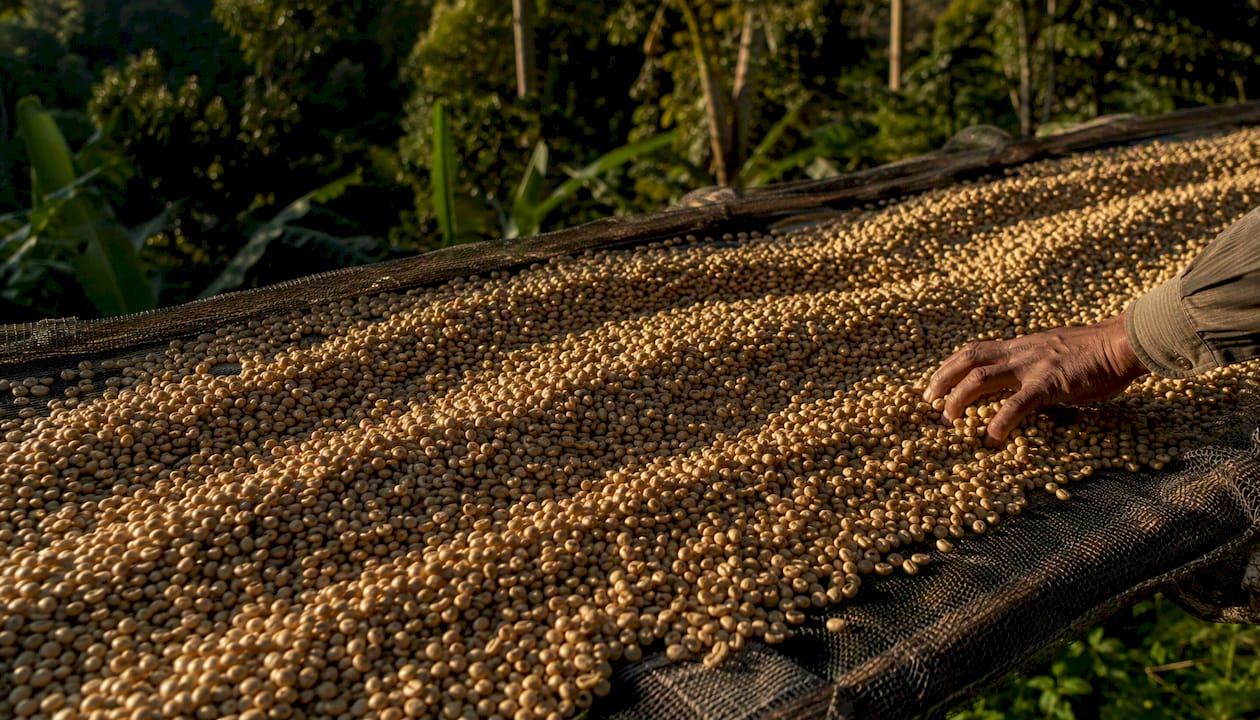
A freshly pulped parchment bean still carries substantial moisture. The target for export-grade green coffee is 10–12% moisture content. Too wet and the bean molds in storage; too dry and the parchment cracks during hulling, fragmenting the seed and creating roast defects.
Drying methods
Raised drying beds (African beds) allow airflow above and below the bean layer, which speeds drying and reduces mold risk compared to flat patios. Beans are spread in thin layers and turned regularly.
Patio drying is common in large-scale operations. Concrete or brick patios hold heat well, but airflow is limited to the top surface, requiring more frequent turning.
Mechanical dryers use heated air to finish drying when sun-drying has reduced moisture to a safe intermediate level. A sun-plus-mechanical hybrid is common: sun-drying handles the bulk of moisture removal, and the mechanical dryer brings the bean to the precise target. Drying must be staged — rapid initial drying removes surface water, then a slower final stage reduces internal moisture gradually. Rushing either phase risks cracking; stalling risks mold.
Hulling, polishing, and sorting
Once dried, the parchment bean goes to a hulling machine that strips the parchment and silver skin. Polishing (an optional step) buffs the bean surface for a cleaner appearance, though it has minimal flavor impact.
Sorting and grading follow. Mills use rotating drums and sieves to separate beans by screen size (measured in 64ths of an inch), and gravity tables to sort by density. Consistent size and density matter enormously for roasting: a batch with mixed sizes will have small beans over-roasted and large beans under-roasted by the time the roast cycle ends.
Green bean quality checklist before roasting:
- Moisture: 10–12% (measured with a calibrated moisture meter)
- Absence of off-odors (ferment, mold, musty)
- Low defect count (primary defects: blacks, sours, insect damage)
- Consistent screen size and density
- Clean, even color (no yellowing or discoloration from improper drying)
What are the fermentation risks and how do producers manage them?
Fermentation is a controlled biological process, but the word “controlled” carries real weight. Left unmonitored, it becomes the fastest route to a ruined lot.
The purpose of fermentation is to break down the pectin-rich mucilage so it releases from the parchment. The microbes doing that work — primarily yeasts and lactic acid bacteria — also produce flavor compounds that end up in the cup. That is the upside. The downside is that the same conditions that support beneficial microbes also support harmful ones.
Main risks:
- Runaway fermentation: beans left too long develop acetic acid (vinegar) and butyric acid (rancid) notes that are impossible to remove downstream
- Mold growth: high humidity, inadequate airflow, or wet beans sitting too long before drying create conditions for mold, which can produce mycotoxins
- Uneven fermentation: overfilled tanks or inconsistent mucilage thickness lead to some beans over-fermenting while others are still intact
Practical mitigation:
- Process cherries within hours of harvest, not days
- Keep fermentation tanks clean and sized appropriately for the batch
- Monitor temperature throughout fermentation; warmer ambient conditions require shorter fermentation windows
- Use clean, fresh water for submerged fermentation and washing
- Begin drying immediately after washing; never leave wet parchment beans sitting overnight
Pro Tip: Track fermentation with a simple log: start time, water temperature, ambient temperature, and a touch-and-smell check every 6–8 hours. That log becomes your quality record and your guide for the next harvest.
Why speed and control define quality at every stage
The underlying reason all of these best practices converge on speed and cleanliness is simple: coffee cherries are sugar-rich fruit, and sugar-rich fruit is a microbial target from the moment it is picked. Every hour between harvest and processing is an hour in which the wrong organisms can gain a foothold.
Producers who process cherries within hours of harvest consistently produce cleaner, more consistent lots than those who delay. That is not a specialty-coffee preference — it is basic food science.
An actionable checklist for producers and small-mill operators:
- Selective picking only — sort at the tree, not at the mill
- Transport to mill within 6–8 hours of harvest
- Float-sort on arrival to remove defective cherries before pulping
- Pulp immediately and begin fermentation in clean, appropriately sized tanks
- Log fermentation every 6–8 hours (time, temperature, sensory check)
- Wash thoroughly and move to drying beds the same day
- Dry in stages — sun-dry to an intermediate moisture level, then finish mechanically
- Measure moisture with a calibrated meter before hulling; target 10–12%
- Hull and sort by size and density; remove defects before packing
- Store in grain-pro or jute bags in a cool, dry, well-ventilated space
Espritkaffe applies strict processing oversight and rapid-handling standards as a baseline for every lot it sources, treating these steps not as optional quality upgrades but as the minimum threshold for a bean worth roasting. For readers interested in what those standards look like in practice, the specialty coffee guide covers quality benchmarks in more detail.
What specialty roasters look for in green beans
When a bag of green coffee arrives at a roastery, the evaluation happens fast and covers a short list of non-negotiables.
Moisture and density come first. Density matters because denser beans — typically grown at higher altitudes — require more heat energy to develop fully and reward longer, more controlled roast profiles.
The fermentation and washing profile is the second checkpoint. A clean washed coffee should smell faintly sweet and grassy, never sour or vinegary. A natural should smell fruity and complex, not musty or fermented in the wrong direction. Off-odors at the green stage do not disappear in the roaster; they intensify.
Storage defects are the third concern. Beans that have been stored improperly — high humidity, temperature swings, proximity to other strong-smelling goods — develop a faded, papery quality called “past-crop” character. The color shifts from blue-green to yellow or gray, and the cup loses vibrancy regardless of roast skill.
Processing method also shapes roast strategy. Natural coffees often need a gentler, longer development phase to coax out fruit notes without tipping into fermented or smoky territory. Washed coffees tend to be more forgiving and respond well to a wider range of roast profiles. Honey coffees sit between the two and reward careful attention to first crack timing.
Sorting and grading consistency before export is what makes the roaster’s job possible. A well-graded lot roasts predictably. A poorly graded one requires constant adjustment and still produces an uneven result.

Every step from cherry to green bean shapes what ends up in your cup. Espritkaffe sources beans that have cleared every stage of that process with care — freshly roasted to your chosen profile, certified free of mycotoxins, heavy metals, mold, and yeast. Browse the full selection of freshly roasted coffees and find the roast and origin that fits your morning.
Sources
These are the primary references used throughout this article, each worth bookmarking if you want to go deeper on any stage of the process.
- Coffee Processing: How Do You Get from Cherry to Bean?
- Processes - NCA - About Coffee
- Coffee Wet Mill Processing Guide
- Coffee production - Britannica
- Coffee Cherry: Anatomy, Ripening, Processing & By-Products