

Choose a sideboard for dining rooms, a mobile bar cart for small apartments, and a tall cabinet or hutch when vertical storage is the priority. That single decision, made before you buy anything else, determines whether your coffee station actually works or just looks good in photos. Selon la National Coffee Association, 83 % des personnes ayant bu du café la veille l’ont préparé à la maison en 2024, soit une augmentation de 4 % depuis 2020. The home coffee bar is no longer a nice-to-have. Interior designer Lindy Lowney, featured in Architectural Digest, puts it plainly: even a small counter becomes a functional station when the furniture is chosen for workflow first.
Two things to lock in before you shop:
- Workflow: Confirm outlet placement, water proximity, and enough surface depth for your appliances. Plan for vibration from heavy machines and clearance for steam wands and grinder hoppers.
- Aesthetic alignment: Match your furniture’s scale and finish to your machine. A matte black espresso machine on a raw pine cart reads as an accident. A brass-accented machine on a dark walnut sideboard reads as a decision.
Espritkaffe’s single-origin collections and branded merchandise complete the display once the furniture is right.
Table of Contents
- What furniture type fits your room?
- Which style direction fits your coffee bar?
- How do you make the furniture actually work?
- What measurements do you actually need?
- Which materials hold up to daily coffee use?
- Where should you buy and what should you spend?
- Key Takeaways
- The ritual is the point
- Pair your furniture with Espritkaffe beans
- Useful sources and further reading
What furniture type fits your room?
Room function is the fastest filter in any coffee bar furniture styles guide. Get this right and every other decision gets easier.
- Dining room: A sideboard or buffet is the natural fit. The surface area handles a full espresso setup, and the drawers and doors hide bean bags, filters, and merchandise without cluttering the room.
- Small apartment or renter’s space: A bar cart wins on mobility. Park it against any wall with an outlet, style the shelves, and roll it out of the way when you need the floor. A sleek gold cart next to a bouclé chair achieves a minimalist look; a timber trolley reads coastal.
- Pantry or alcove: Tall cabinets and hutches use vertical space that sideboards ignore. Keep daily items on the lower shelves and close the doors when you’re done.
- Home office or small commercial counter: Prioritize easy-clean surfaces, integrated power strips, and enough depth for a commercial-grade machine. Durability matters more than aesthetics here.
Pro Tip: Before you buy, stand at the proposed location with your largest appliance in hand. Check for an outlet within cord reach, water access for rinsing, and at least 18 inches of clearance above the counter. Fixing these after the furniture arrives costs real money.
Which style direction fits your coffee bar?
Picking a single vibe first keeps furniture, materials, and accessories from reading like a yard sale. Three directions work especially well for premium home setups.
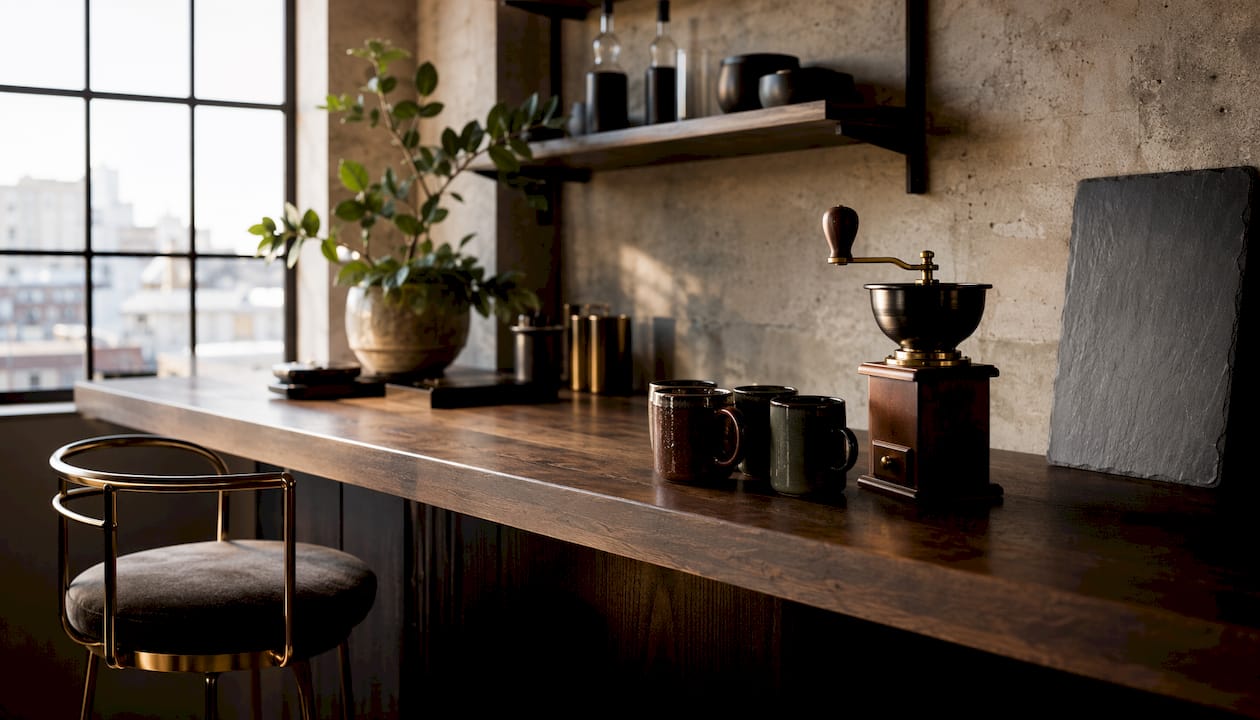
Moody espresso bar
Dark, deliberate, specialty-shop energy. The furniture backbone is a dark-stained sideboard or floating walnut shelves against a deep green or charcoal wall. Brass hardware, warm Edison bulbs, and jewel-toned mugs carry the finish. Seating, if space allows, is a low leather stool or a single upholstered chair.
- Core piece: dark walnut sideboard or floating shelves
- Finishing moves: brass cabinet pulls, warm pendant light, matte black machine
- Espritkaffe picks: dark roast single-origin bags displayed on a tray, branded mugs front and center
Clean Scandi
Warm minimalism. Two objects on the counter, everything else hidden. White oak or light ash cabinetry, a light stone or Corian countertop, brushed nickel hardware. Under-cabinet lighting does more work here than any decorative accessory. Seating is a simple bentwood stool.
- Core piece: white oak console or slim cabinet with closed storage
- Finishing moves: under-cabinet LED strip, one ceramic canister, a single plant
- Espritkaffe picks: light or medium roast beans in clean packaging, one branded mug visible
Cottagecore
Floral, layered, lived-in. A vintage dresser or painted hutch is the backbone. Natural wood, vintage brass, and tactile fabrics like linen or checked cotton create the warmth. Designers emphasize that natural wood and vintage brass fixtures age into a space rather than dating it. Dried lavender, a small botanical print above the station, and mismatched ceramic mugs complete the look.
- Core piece: painted hutch or vintage dresser
- Finishing moves: dried botanicals, linen hand towel, layered tray with cake stand
- Espritkaffe picks: flavored or single-origin beans in warm-toned packaging, a mix of branded and vintage mugs
Pro Tip: Match hardware finish to machine accents across all three styles. Brass machine details with brass cabinet pulls, matte black equipment with matte black or dark iron hardware. The Barista Life guide notes this finish consistency is what separates a curated station from a random collection of appliances.
How do you make the furniture actually work?
A beautiful sideboard that can’t fit your grinder next to your machine is just a buffet. Architectural Digest recommends layering with trays, cake stands, and cutting boards to keep frequently used items accessible while closed storage handles the visual clutter.
What the furniture must accommodate:
- Espresso machine (footprint varies; measure yours)
- Grinder (place it directly left or right of the machine, not behind it)
- Scale, tamper, and milk tools within arm’s reach
- Pour-over station or filter storage in a dedicated drawer
- Espritkaffe bean bags in an airtight canister or on a display tray
- Waste bin or puck drawer below or beside the machine
Workflow order on the counter, left to right: beans and grinder, machine, cup station, milk tools. Waste goes at the far right or in a pull-out below.
Storage specifics:
- Use airtight canisters for beans. Open shelving looks great but exposes beans to light and air.
- Pull-out trays or dedicated drawers for filters, pods, and accessories keep the counter clear.
- Open shelving above the machine works for mugs and display; closed cabinetry below handles supplies.
Clearance minimums: 18 inches above the counter for steam wand operation, 6 inches on each side of the grinder for hopper access, and enough door clearance in front for the portafilter swing.
Pro Tip: A dedicated coffee corner improves both workflow and the enjoyment of the ritual. Treat it as a zone, not just a surface.
What measurements do you actually need?
| Dimension | Minimum | Recommended |
|---|---|---|
| Counter depth | 18 inches | — |
| Clearance above counter | 18 inches | — |
| Counter height | — | Match to standing comfort |
These figures come from practical espresso-bar ergonomics. Heavy machines need a stable, substantial surface; high-end espresso machines on flimsy tops vibrate enough to affect extraction.
Setup checklist:
- Measure the proposed space: width, depth, and height to the ceiling or cabinet above.
- Locate the nearest outlet and measure the cord distance.
- Test clearance above with your tallest appliance in place.
- Choose finish and hardware to match your machine.
- Plan storage: one drawer minimum for accessories, one closed cabinet for supplies.
Which materials hold up to daily coffee use?
Surface choice is where premium buyers often cut corners and regret it within a year.
- Quartz or granite: Heat and stain resistant, no sealing required. The most durable option for heavy daily use.
- Sealed hardwood: Warm, beautiful, and workable, but needs monthly sealing and immediate spill cleanup.
- Stainless steel: Ideal for commercial counters and Scandi setups. Resists everything; shows fingerprints.
- Corian/solid surface: Repairable if scratched, seamless, and easy to clean. Works well in Cottagecore and Scandi styles.
- Raw or unsealed wood: Avoid it for a primary brewing surface. It stains within weeks.
Hardware: Brass and antique metal age well and suit Moody and Cottagecore styles. Matte black hardware fits Scandi and modern setups. Match to machine finish.
Maintenance schedule:
- Daily: wipe surfaces with a damp cloth after brewing.
- Weekly: clean under appliances and inside drip trays.
- Monthly: re-seal wood surfaces, inspect hardware for loosening.
Pro Tip: For renter-friendly storage that doesn’t require drilling or permanent installation, compact drawer organizers and cart-based setups protect surfaces and move with you.
Where should you buy and what should you spend?
Price ranges by furniture type give you a realistic starting point. Bar carts run from roughly $80 to $400 depending on material and finish. Sideboards span a wide range, from $300 for flat-pack options to $2,000 or more for solid hardwood. Custom built-ins start around $1,500 and climb quickly with integrated power and premium finishes.
When to go custom: unique room footprints, built-in power outlets or water lines, or premium finishes that off-the-shelf pieces don’t offer. When to buy vintage: Cottagecore and Moody styles benefit from aged patina that new furniture can’t replicate. Check joinery at corners and test drawer slides before buying any secondhand piece.
Buying checklist:
- Measure twice before ordering anything.
- Inspect surface stability: press down on corners and listen for flex.
- Test drawers and doors in person when possible.
- Confirm outlet and power planning before delivery.
- Estimate shipping and installation costs upfront.
A compact drawer organizer designed for coffee pods and accessories solves the small-space storage problem without adding furniture footprint.
Key Takeaways
The most effective coffee bar furniture choice pairs room function to furniture type first, then builds workflow, materials, and style around that single decision.
| Point | Details |
|---|---|
| Match furniture to room | Sideboard for dining rooms, bar cart for small spaces, tall cabinet for vertical storage. |
| Workflow before aesthetics | Confirm outlet placement, clearance, and appliance fit before choosing any piece. |
| Use durable surfaces | Quartz, sealed hardwood, or Corian outlast raw wood and resist daily coffee spills. |
| Pick one style direction | Moody Espresso Bar, Clean Scandi, or Cottagecore keeps furniture and accessories cohesive. |
| Espritkaffe completes the bar | Single-origin beans and branded merchandise display best on a planned, stable surface. |
The ritual is the point
Most coffee bar guides treat furniture as decoration. The better frame is that furniture is infrastructure. A wobbly cart under a $1,200 espresso machine is a problem waiting to happen. A sideboard with no outlet nearby means you’re running an extension cord across the floor every morning. These aren’t aesthetic failures; they’re friction in the ritual.
What actually changes the experience is the combination of a stable, well-sized surface, a finish that ages rather than dates, and beans worth displaying. A single-origin bag from Espritkaffe on a tray next to a brass-accented machine isn’t just styling. It signals that the whole setup was chosen with intention, not assembled from whatever was available. That’s the difference between a coffee corner and a coffee bar.
Pair your furniture with Espritkaffe beans
Once the furniture is right, the beans are what make the bar worth returning to every morning. Espritkaffe roasts to order, certified free of mycotoxins, heavy metals, mold, and yeast, so what you display on that sideboard or cart is genuinely worth showing off.

The single-origin collection is the natural starting point for a styled coffee bar. The packaging holds its own on an open shelf, and the roast profiles span light through dark to match any style direction. For a Moody Espresso Bar setup, the medium roast mushroom blend pairs well with the warm, layered aesthetic. Browse the full range at Espritkaffe and order the roast that fits your bar.
Useful sources and further reading
- National Coffee Association: Source for the 2024 home-brewing statistic (83% of past-day drinkers brew at home).
- Architectural Digest: Designer-sourced coffee bar ideas including Lindy Lowney’s functionality-first advice and styling with trays and layers.
- Barista Life: Practical sizing data: counter depths, widths, clearances, and machine stability guidance.
- The Coffee Chef: Style curation framework covering Moody Espresso Bar, Clean Scandi, and Cottagecore directions.
- SCA Coffee Design: Material and finish recommendations from specialty coffee design professionals.
- Espritkaffe: Single-origin beans, roast profiles, and branded merchandise to complete any home coffee bar setup.