

A structured morning routine is the single most reliable way to protect your focus, set a clear work-life boundary, and keep your mood stable when your home is also your office. If you want to start today, here are four micro-actions that take under ten minutes total:
- Set one fixed wake time and commit to it tomorrow, even on weekends.
- Drink a full glass of water before you touch your phone.
- Step outside or sit near a bright window for five minutes right after waking.
- Write down your top three tasks for the day before you open your inbox.
Those four steps address the three core mechanisms behind why morning routines work for remote workers: circadian alignment (light and consistent timing), decision-fatigue reduction (pre-set priorities), and transition ritual (replacing the psychological function a commute used to serve).
Key Takeaways
A consistent morning routine is the most reliable tool remote workers have for protecting focus, maintaining work-life boundaries, and keeping mood stable throughout the day.
| Point | Details |
|---|---|
| Consistent wake time first | Pick one wake time and hold it seven days a week before adding any other habit. |
| Light within 30 minutes | Morning light suppresses melatonin and anchors your circadian clock; outdoors or a full-spectrum lamp both work. |
| Screen delay protects focus | Waiting 20–30 minutes before checking email keeps your morning agenda yours, not the inbox’s. |
| Start small, stack slowly | A four-week micro-plan, one new habit per week, builds automaticity without the crash-and-abandon cycle. |
| Espritkaffe as ritual anchor | Brewing a clean, intentional cup before screens turn on is a practical, sensory commute replacement for remote workers. |
Table of Contents
- Why morning routines matter so much for remote work
- Evidence-backed morning habits and when to do each one
- How to build a morning routine that actually sticks
- Copy-paste routine templates for four remote-worker types
- Common mistakes that derail morning routines (and quick fixes)
- What the science actually says about mornings and performance
- The one small change that made the biggest difference
- The ritual that anchors everything else
- Sources
Why morning routines matter so much for remote work
When you commute, the drive or train ride acts as an involuntary buffer. It signals your brain that work is starting, separates home-self from work-self, and burns off a little cortisol before you sit down. Remote work strips that buffer out entirely. Without a deliberate replacement, the boundary between personal time and work time blurs, and your brain never fully shifts into a focused state.
The benefits of rebuilding that buffer are concrete, not abstract.
Improved focus. A predictable morning sequence reduces the number of micro-decisions you face before your first real task. Habit automaticity means your brain runs the sequence on low cognitive load, preserving mental energy for the work that actually matters.
Clearer work-life boundaries. A defined startup ritual tells your nervous system when the workday begins. Without it, remote workers often report a slow, anxious drift into work mode that never fully resolves, making it equally hard to switch off at the end of the day.
Lower decision fatigue. Every choice you make in the morning, from what to eat to whether to exercise, draws from the same finite pool of cognitive resources. Pre-deciding those choices the night before, or automating them through a routine, keeps that pool full for high-stakes decisions later.
Reduced stress and more stable energy. Rushing through the morning raises cortisol and sets a reactive tone for the whole day. Small, intentional actions, even something as simple as making your bed, trigger a small dopamine release and create a sense of control before the workday’s demands arrive.
Consider three common remote-worker profiles. A parent with a school-age child needs a routine that front-loads the highest-value work habits into a narrow window before the household wakes up. A deep-focus contributor, someone writing, coding, or designing, benefits most from a screen-delay rule that protects the first 30–60 minutes of cognitive freshness. An asynchronous team member whose colleagues are in a different time zone can use a slightly later routine without guilt, as long as it is consistent.
Cleveland Clinic guidance specifically recommends structured routines, workspace boundaries, and protected focus blocks as the foundation of remote-work mental well-being, not a nice-to-have.
Evidence-backed morning habits and when to do each one
You do not need all of these. Pick three or four that fit your life and do them in the same order every day. The sequence matters as much as the individual habits.
Consistent wake time. This is the highest-leverage habit in the list. Consistent wake times strengthen circadian entrainment, reducing the “social jet lag” that impairs cognition and mood when your sleep schedule drifts between weekdays and weekends. Pick a time you can hit seven days a week, not just Monday through Friday.
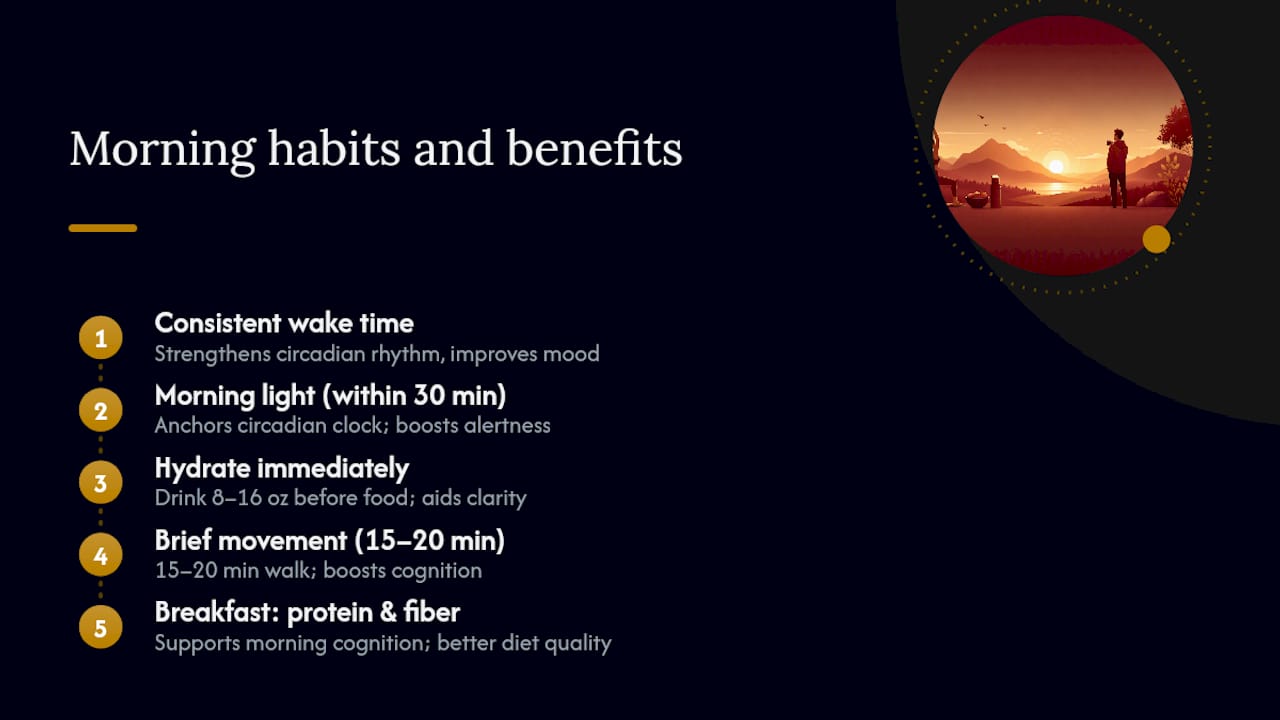
Morning light exposure within 30 minutes of waking. Bright light suppresses melatonin and anchors your circadian clock. ScienceFocus’ review of the literature confirms that morning light stabilizes circadian phase and supports alertness and mood regulation. If outdoor light isn’t available, a full-spectrum lamp placed within arm’s reach works as a partial substitute. Five to ten minutes is enough to produce a measurable signal.
Hydration immediately upon waking. Your body loses water overnight. Drinking 8–16 oz before coffee or food is one of the fastest, lowest-effort habits you can add, and it supports cognitive clarity before caffeine even enters the picture.
Brief movement (15–20 minutes). Even a short walk increases prefrontal blood flow and supports early-day cognitive performance. Timing it consistently also reinforces the circadian signal you just sent with light exposure. You don’t need a gym session; a brisk walk around the block counts.

Pro Tip: If you can only do one physical habit, make it the walk outside. You get light exposure, movement, and a commute-replacement transition all in one shot.
Breakfast with protein and fiber. Regular breakfast consumption associates with better diet quality and may support morning cognition. You don’t need an elaborate meal. Eggs, Greek yogurt with fruit, or oatmeal with nuts all deliver protein and fiber without requiring much prep time.
Brief mindfulness or breathing (5 minutes). Short meditation and breathing exercises improve attentional control and emotional regulation, particularly after poor sleep. Apps like Headspace or Calm work fine, but so does four cycles of box breathing (inhale 4 counts, hold 4, exhale 4, hold 4) before you get up.
Three-task priority setting before checking email. Write your three most important tasks for the day before you open any inbox or Slack channel. Checking email or social media immediately after waking shifts your attention to other people’s priorities and reduces your capacity for high-value work. The three-task list is your agenda; the inbox is everyone else’s.
Statistic: Breakfast typically accounts for 20–35% of daily energy intake, and observational evidence links regular breakfast with higher fiber and micronutrient intake and better overall diet quality.
Screen delay (minimum 20–30 minutes after waking). This is the habit most remote workers resist and most benefit from. Your phone is a decision engine. Every notification is a micro-decision. Delaying screen exposure keeps your morning sequence in your control, not the algorithm’s.
How to build a morning routine that actually sticks
Most routines fail in week two, not because the habits are wrong but because the plan asks too much too fast. A four-week micro-plan fixes that.
Week 1: Anchor plus one habit. Pick your fixed wake time and add exactly one habit, whichever feels easiest. Do not add more. The goal is to make the sequence feel automatic, not impressive.
Week 2: Add one more habit. Stack it immediately after the habit you already have. Implementation intentions work here: “When I finish my glass of water, I will put on my shoes for a walk.” The “when-then” format removes the decision moment entirely.
Week 3: Stabilize. Resist the urge to add anything new. This week is about making the two-habit sequence feel effortless. If you miss a day, return the next morning without adjusting the routine.
Week 4: Refine. Swap out anything that felt forced. Add one optional habit if the sequence feels genuinely easy. Keep the total routine under 60 minutes; longer than that and adherence drops sharply.
Chronotype adjustments matter. Sleep Foundation’s chronotype guidance is clear: biological differences between larks (early risers), owls (late risers), and intermediates affect the optimal timing for alertness, exercise, and cognitive work. An owl who forces a 5:30 AM wake time will spend weeks fighting their biology instead of building habits. If you are a night owl, a 7:30–8:00 AM routine is more sustainable than a 5:00 AM one, and the habits still work.
For parents and caregivers with constrained mornings, the priority order is: consistent wake time first, light exposure second, and everything else as time permits. A 20-minute routine done consistently beats a 90-minute routine done twice a week.
- Set your wake time tonight in your phone alarm.
- Place a glass of water on your nightstand.
- Write tomorrow’s top three tasks before you go to sleep.
- Put your shoes by the door if you plan to walk.
Pro Tip: Start with a 2-minute win, something so small it feels almost silly. Making your bed, drinking water, or stepping outside for 60 seconds. Then protect a 25–60 minute focus block at the start of your actual workday. The tiny win builds momentum; the focus block is where the productivity payoff lives.
Copy-paste routine templates for four remote-worker types
These are starting points. Swap elements freely between templates if your schedule is hybrid.
Early riser (5:00–5:30 AM wake)
| Time | Activity |
|---|---|
| 5:00 AM | Wake, water, 5 min bright light or window |
| 5:10 AM | 20-min walk or light exercise |
| 5:35 AM | Shower, breakfast |
| 6:00 AM | 5-min mindfulness or breathing |
| 6:15 AM | Write top 3 tasks, then start focus block |
| 7:00 AM | First email check |
Standard schedule (7:00–7:30 AM wake)
| Time | Activity |
|---|---|
| 7:00 AM | Wake, water, open blinds or step outside |
| 7:10 AM | 15-min walk or stretching |
| 7:30 AM | Breakfast, coffee ritual |
| 7:30 AM | 5-min breathing or journaling |
| 8:00 AM | Write top 3 tasks |
| 8:15 AM | Start focus block; no email until 9:00 AM |
Shifted schedule / night owl (8:30–9:00 AM wake)
| Time | Activity |
|---|---|
| 8:30 AM | Wake, water, bright lamp if overcast |
| 8:30 AM | 15-min movement indoors or short walk |
| 9:00 AM | Breakfast, coffee |
| 9:20 AM | Write top 3 tasks |
| 9:30 AM | Focus block begins; screens off until then |
Parent or caregiver (variable wake, often 6:00–6:30 AM)
| Time | Activity |
|---|---|
| 6:00 AM | Wake before household, water, 5 min light |
| 6:10 AM | 10-min walk or stretching while quiet |
| 6:25 AM | Write top 3 tasks for the day |
| 6:35 AM | Household startup (kids, breakfast, school prep) |
| 8:30 AM | First focus block after drop-off or school start |
Substitution rules:
- Can’t get outside? Use a 10,000-lux full-spectrum lamp for 10 minutes at your desk.
- No time for a full breakfast? A protein shake or Greek yogurt takes 90 seconds.
- Pressed for time? Cut mindfulness before cutting light exposure or priority setting.
- No quiet window for focus? Use noise-canceling headphones and a “Do Not Disturb” status in Slack.
Common mistakes that derail morning routines (and quick fixes)
Inconsistent wake times. This is the most damaging habit, not a bad morning routine but no consistent morning at all. The fix is boring: pick one wake time and use it seven days a week for two weeks before you adjust anything else.
Doomscrolling first thing. Reaching for your phone before you are fully awake hands your attention to the most algorithmically engaging content available, which is rarely what you need to start a focused workday. Put your phone charger across the room. Buy a cheap alarm clock. The physical barrier works better than willpower.
Overlong rituals. A 90-minute morning routine sounds aspirational in theory. In practice, one late night or an early meeting destroys it, and then you skip the whole thing. Keep the non-negotiable core under 30 minutes and treat everything else as optional.
Ignoring your chronotype. Forcing an early-morning routine onto a biological night owl produces chronic sleep deprivation, not productivity. If you consistently feel groggy for the first two hours after waking regardless of bedtime, your routine may be starting too early.
Caffeine too early. Cortisol peaks naturally in the first 30–60 minutes after waking. Drinking coffee during that window can blunt caffeine’s effectiveness and contribute to an afternoon energy crash. Waiting 60–90 minutes after waking before your first cup tends to produce more sustained alertness. Pairing caffeine timing with your remote meeting calendar is a practical way to get the most from each cup.
Red-flag note: If you experience persistent fatigue, difficulty falling asleep, or waking unrefreshed despite a consistent routine, those are signals worth discussing with a sleep specialist rather than adjusting your morning habits further.
What the science actually says about mornings and performance
The research on morning routines converges on a few durable findings, and they are more specific than “mornings are good for you.”
Circadian alignment is the foundation. Your body runs on a roughly 24-hour biological clock governed by light, temperature, and meal timing. When your wake time drifts, that clock drifts with it, producing a state researchers call social jet lag. ScienceFocus’ synthesis shows that stabilizing wake times and getting morning light exposure reduces that misalignment, with downstream improvements in alertness, mood, and sleep quality.
Morning light is the strongest circadian signal available. Bright light in the first 30 minutes after waking suppresses melatonin and advances the circadian phase, making it easier to feel alert earlier and fall asleep at a consistent time at night. This is not a marginal effect.
Brief exercise supports cognition the same morning. Even 15–20 minutes of walking increases prefrontal blood flow, which is the region most involved in planning, focus, and emotional regulation. The effect is acute, meaning it shows up that morning, not just over weeks of training.
Mindfulness has a measurable attentional effect. Short breathing or meditation practices change neural systems involved in stress regulation and improve morning affect, particularly on days following poor sleep.
| Habit | Mechanism | Evidence strength |
|---|---|---|
| Consistent wake time | Circadian entrainment, reduces social jet lag | Strong (observational + clinical) |
| Morning light exposure | Melatonin suppression, phase alignment | Strong (clinical + field studies) |
| Brief movement (15–20 min) | Prefrontal blood flow, circadian reinforcement | Moderate-strong (multiple studies) |
| Hydration | Cognitive clarity, reduces fatigue | Moderate (observational) |
| Breakfast with protein/fiber | Energy stability, diet quality | Moderate (observational) |
| Brief mindfulness (5 min) | Attentional control, stress regulation | Moderate (systematic reviews) |
| Screen delay (20–30 min) | Preserves proactive attention | Moderate (behavioral studies) |
The News-Medical synthesis of clinical and observational studies confirms that circadian-aligned routines combining light, movement, consistent timing, hydration, and mindful practice support both cognitive performance and mood regulation across the day.
Statistic: Regular breakfast consumption is associated with higher fiber and micronutrient intake and better overall diet quality, with breakfast typically accounting for 20–35% of daily energy intake.
The one small change that made the biggest difference
For a long time, the first thing that happened every morning was the phone. Not intentionally. Just habit. The alarm went off, and the hand moved to the screen before the eyes were fully open. By the time the coffee was ready, the inbox had already set the agenda for the next three hours.
The change was almost embarrassingly small: the phone charger moved to the bathroom. That’s it. The alarm still went off at the same time. But getting up to silence it meant being vertical, which made it easier to drink the water already on the nightstand, which made the walk feel like the obvious next step.
Within a week, the first 30 minutes of the morning belonged to the morning, not to other people’s notifications. The focus block that followed felt qualitatively different, less reactive, more deliberate.
The takeaway is not “move your charger.” It’s that the smallest environmental change can break a reactive pattern that willpower alone never could. Pick one physical barrier or one environmental cue you can set up tonight, and let the behavior follow.
The ritual that anchors everything else
The morning habits in this article work best when they are attached to something sensory and repeatable. That’s where coffee earns its place, not as a productivity hack, but as a ritual anchor.

The act of brewing a cup, the smell, the warmth, the deliberate pause before the screen turns on, is one of the most effective commute-replacement transitions available to remote workers. It takes three minutes and signals, physically and psychologically, that the workday is about to begin on your terms.
Espritkaffe’s Coffee with Mushrooms Medium Roast is built for exactly this moment. Certified free of mycotoxins, heavy metals, mold, and yeast, it’s a clean, intentional cup you can trust as the first thing you put in your body. Brew it while you write your top three tasks. Drink it before you open Slack. For caffeine timing that supports sustained focus, waiting 60–90 minutes after waking before your first cup tends to produce more stable energy across the morning. Order directly at espritkaffe.com and have your next ritual anchor delivered to your door.

Sources
- This is the optimal morning routine, according to science | BBC Science Focus Magazine
- How Morning Routines Influence Cognitive Performance, Mood, and Circadian Rhythm
- A morning routine can set you on the path to a better day | AP News
- Chronotypes | Sleep Foundation
- How to work from home and still be productive | Cleveland Clinic Health Essentials
- 20 morning habits of successful people backed by research | Quartz