

Most specialty coffee drinkers could name five Colombian farms before they’d name one American producer. That gap is closing fast. US grown coffee beans account for less than 1% of domestic consumption, making them genuinely rare in a market saturated with imports. But rarity alone doesn’t explain the surge in demand. What’s drawing serious coffee drinkers toward domestically produced specialty coffee, also called American origin coffee in the trade, is a combination of traceable sourcing, distinct terroir, and farming practices that prioritize quality at every step. Here’s what you need to know before you buy.
Table of Contents
- Key Takeaways
- 1. What makes US grown coffee beans worth evaluating
- 2. Top US coffee growing regions and the producers defining them
- 3. The top US coffee bean varietals and what sets them apart
- 4. Comparing major US coffee producers at a glance
- 5. How to buy authentic American coffee beans without getting burned
- My take on the future of American grown coffee
- Explore specialty roasts built for intentional coffee drinkers
- FAQ
Key Takeaways
| Point | Details |
|---|---|
| Domestic production is extremely limited | US coffee farming is confined to Hawaii, California, and Puerto Rico, making these beans inherently rare. |
| Terroir drives flavor differences | Each American growing region produces distinct cup profiles, from Kona’s buttery sweetness to California’s fruit-forward brightness. |
| Premium pricing reflects true cost | American grown beans can cost around $10 per ounce, roughly seven times the price of average specialty coffee. |
| Sustainability is a core selling point | 70% of specialty coffee consumers actively seek eco-friendly sourcing, and US farms often deliver on this directly. |
| Direct purchase guarantees authenticity | Buying from farm-linked sellers or verified direct trade roasters is the most reliable way to get genuine US origin coffee. |
1. What makes US grown coffee beans worth evaluating
Before you spend serious money on American origin coffee, you need a clear framework for what separates a genuinely exceptional domestic bean from a premium-priced curiosity.
Terroir and growing region. The term terroir, borrowed from wine, describes how geography, climate, and soil shape flavor. In US coffee, three regions matter. Hawaii sits in a classic tropical belt with volcanic soil, reliable trade winds, and well-defined wet and dry seasons. California’s southern coastal microclimates mimic equatorial conditions through marine fog, warm daytime temps, and cool nights. Puerto Rico’s mountainous interior regions produce coffee at elevation with significant rainfall. Each environment creates fundamentally different cup characteristics.
Bean varietals. Not all varietals thrive in US conditions. You’ll find Geisha, Caturra, Bourbon, Typica, Catuai, and the lower-caffeine Laurina growing across these regions. Varietal identity matters because it tells you about genetic potential, flavor ceiling, and how the farmer likely approaches cultivation.
Farming practices. The most compelling American grown coffee beans come from farms that prioritize shade growing, minimal chemical input, and direct relationships with buyers. Many US producers use certified organic practices or are working toward certification. Documented traceability at the lot level is your best assurance of authenticity.
- Look for lot number and farm name on packaging, not just region
- Confirm harvest date to assess freshness
- Prioritize farms with third-party sustainability certifications where available
- Check whether the roaster has a direct farm relationship or sources through a broker
Pro Tip: When a US coffee label only lists the state and not the specific farm or micro-region, treat it with skepticism. Authentic domestic producers are proud of their exact location and name it prominently.
2. Top US coffee growing regions and the producers defining them
The single origin segment now accounts for 15 to 20% of US specialty coffee retail sales, growing steadily each year. American origins are a small but increasingly recognized piece of that picture. Here’s where the most noteworthy production happens.
Hawaii: Kona and Ka’u. Kona is the most recognized American coffee origin globally. Grown on the slopes of Mauna Loa on the Big Island, Kona coffee benefits from rich volcanic soil, consistent rainfall, and a long tradition of careful processing. Ka’u, located in a more remote southern district, has emerged as a quieter but arguably more exciting origin, producing beans with more acidity and complexity than classic Kona. Both regions have strict grade designations, and 100% Kona labeling laws protect against blended imitations.
California: FRINJ and the Southern Coast farms. California’s coffee industry is young and ambitious. At least 65 to 70 farms cultivate coffee under the FRINJ network, with over 100,000 trees planted across Los Angeles, San Diego, Santa Barbara, Ventura, and San Luis Obispo counties. FRINJ’s approach focuses on a coordinated systems model covering genetics, farming equipment, and market development. The results have caught global attention.
Puerto Rico: Yauco and Jayuya. Puerto Rico’s coffee history predates any US mainland production by centuries. The Yauco and Jayuya regions produce coffee at altitude with a flavor profile that tends toward mild sweetness and clean finish. Production volumes are small and supply is inconsistent, but the quality potential is real.
- Kona: buttery body, low acidity, chocolate and nut notes
- Ka’u: brighter, more fruit-forward, excellent complexity
- California: floral, sweet, sometimes tropical fruit driven
- Puerto Rico: mild, clean, gentle sweetness with caramel tones
3. The top US coffee bean varietals and what sets them apart
Understanding the varietal in your cup gives you a direct line into the farm’s decisions and the flavor you can expect. These are the most significant varieties you’ll encounter in American origin coffee.
Geisha. Geisha (also spelled Gesha) is the headline act of specialty coffee globally, and California’s version has made serious noise. FRINJ’s Geisha coffee sold at auction for $256 per kilogram in Dubai, placing American-grown Geisha on the same stage as Panama’s famous Hacienda La Esmeralda lots. Expect jasmine florals, stone fruit, and bergamot tea-like clarity in the cup.
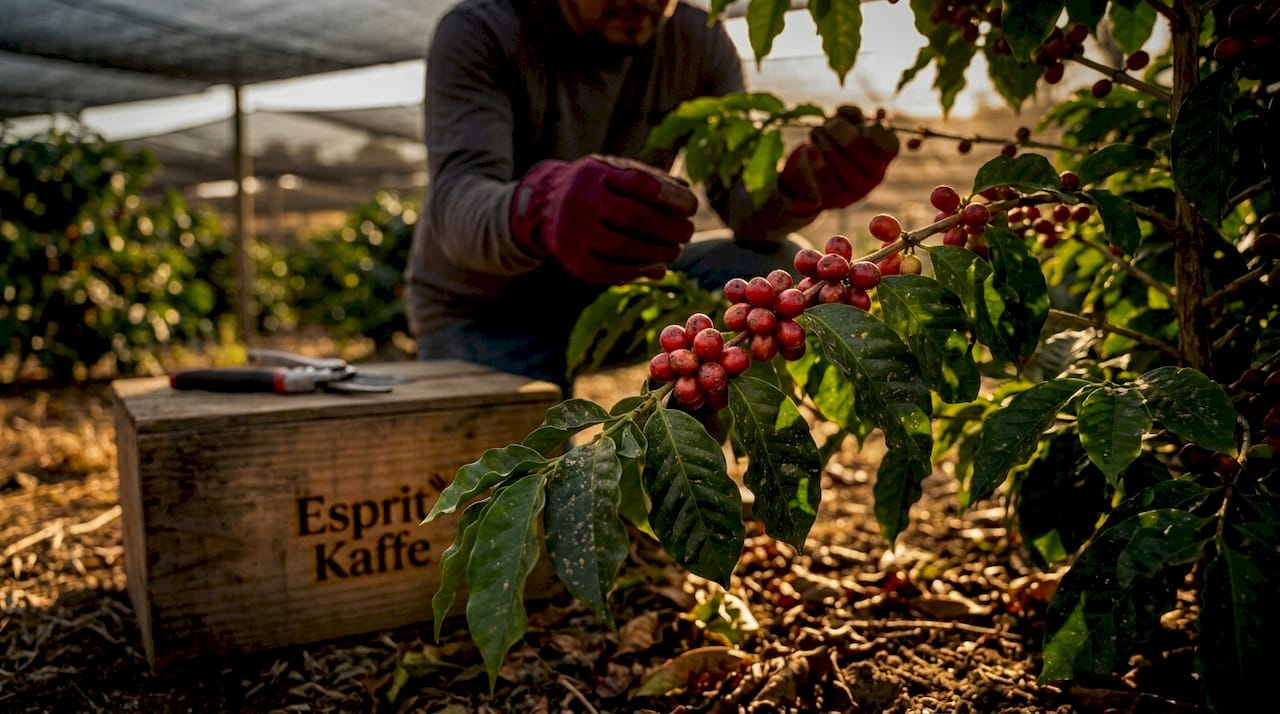
Caturra and Catuai. These two varietals are workhorses in US production. Caturra is a natural mutation of Bourbon with compact growth that suits smaller farms. Catuai is a hybrid of Mundo Novo and Caturra, offering disease resistance and consistent yields. Neither carries Geisha’s glamour, but both produce reliably clean, sweet cups when grown with care. You’ll find them widely in Kona and Hawaii’s other districts.
Bourbon and Typica. These are the heritage varietals. Bourbon produces a cup with sweetness, soft fruit, and fine balance. Typica, one of the oldest cultivated varietals, tends toward delicacy and clean brightness. Both require careful farming because they’re susceptible to coffee leaf rust, but the flavor reward is genuine. Some of Puerto Rico’s finest historic lots were Typica-based.
Laurina. Laurina, sometimes called “Bourbon Pointu,” is a low-caffeine mutation worth knowing. It’s difficult to grow and susceptible to disease, but the cup profile, featuring light body, high sweetness, and citrus-driven acidity, is distinctive. A handful of specialty US producers are experimenting with Laurina, and when done right, it’s unlike anything else from an American origin.
- Geisha: $$$, floral and fruit-forward, limited availability
- Caturra/Catuai: $$, balanced and clean, moderate supply
- Bourbon: $$, sweet and round, heritage profile
- Typica: $$, delicate and bright, historically significant
- Laurina: $$$, low caffeine, exceptionally sweet cup
Pro Tip: If you’re new to American origin coffees, start with a Caturra or Catuai from a Kona producer. They’re more available, more forgiving in brewing, and give you a reliable baseline before spending on Geisha or Laurina lots.
4. Comparing major US coffee producers at a glance
| Producer/Region | Varietals | Cup Profile | Sustainability | Price Range |
|---|---|---|---|---|
| Kona (Hawaii) | Caturra, Catuai, Typica | Buttery, chocolate, low acid | Many farms organic-certified | $$ to $$$ |
| Ka’u (Hawaii) | Caturra, Bourbon, Typica | Bright, fruit-forward, complex | Small farm, direct trade common | $$$ |
| FRINJ Network (California) | Geisha, Caturra, Catuai | Floral, tropical fruit, sweet | Regenerative and shade-grown focus | $$$$ |
| Yauco (Puerto Rico) | Bourbon, Typica | Mild, clean, caramel sweetness | Small batch, limited certifications | $$ |
| Jayuya (Puerto Rico) | Typica, local hybrids | Sweet, smooth, gentle acidity | Traditional small-farm methods | $$ |
These price tiers reflect real-world scarcity. American grown beans are unlikely to become mass-market commodities given climate and scale constraints. You’re paying for limited production, exceptional terroir, and a sourcing story you can actually verify.
5. How to buy authentic American coffee beans without getting burned
The single biggest pitfall when you try to buy US coffee beans is mislabeling. “Kona blend” products, for example, are legally allowed to contain as little as 10% actual Kona coffee. The same risk exists across all American origins. Here’s how to protect your purchase.
-
Buy directly from the farm or a farm-verified roaster. Direct-to-consumer models allow fresher batches and stronger origin stories to reach you without intermediary dilution. Many US farms sell through their own websites or through specialty roasters with named farm partnerships.
-
Read the label for lot-level data. Authentic locally sourced coffee will name the farm, the lot number, the harvest year, and the processing method. Vague labels like “Hawaiian blend” or “California coffee” without specifics are a red flag.
-
Look for credible certifications. USDA Organic, Rainforest Alliance, and direct trade verification are meaningful. No single certification covers everything, but multiple credible markers together indicate a serious producer. Quality control in US sourcing requires lot segregation data and verified traceability.
-
Account for seasonality. US coffee harvests are seasonal and supply is genuinely limited. If a seller claims year-round unlimited stock of a specific Hawaii or California lot, ask how. Genuine small-batch American coffee often sells out. Flexibility with harvest years and varietal substitutions is normal with honest producers.
-
Explore curated single origin collections from specialty roasters who have done the sourcing work for you. A roaster with direct farm relationships removes much of the guesswork and gives you access to beans that aren’t available on mass-market platforms.
Pro Tip: Ask your roaster for the green coffee invoice or import documentation for any US origin coffee you’re considering. Legitimate specialty sourcing operations have this on file and will share it. If they hesitate, that tells you something.
My take on the future of American grown coffee
I’ve been watching the California coffee scene develop for several years now, and I’ll say plainly what most commentary dances around: this is not hype. The infrastructure being built by networks like FRINJ, involving genetics work, precision farming, and coordinated market access, is the kind of long game that takes decades to pay off. The farms that are doing it seriously are doing it correctly.
What I find most compelling is the terroir argument. When I talk to producers in Southern California, they describe something genuinely rare. Coastal fog, volcanic-adjacent soils in some plots, and a community of growers who are obsessed with quality from the ground up. These aren’t hobbyists. They’re building something that could define a new origin category the way Nicaragua did fifteen years ago.
My honest view is that American coffee beans won’t replace your daily drinker. They’re not priced for that, and they shouldn’t be. But if you’re someone who already buys single origin lots from Ethiopia or Colombia, you have every reason to run a comparative tasting with a domestic lot. The experience is genuinely different, and the story behind it is one you can trace to a farm an hour’s drive from a major US city.
The sustainability angle is real too. When 70% of specialty coffee drinkers say eco-friendly sourcing matters to them, US-grown coffee is one of the few origins where that claim comes with full transparency. Support these farms now while they’re still small enough to know your name.
— Jett
Explore specialty roasts built for intentional coffee drinkers
If the quality and traceability behind American origin coffee resonates with you, Espritkaffe is where that standard meets the cup. Every selection in Espritkaffe’s catalog is chosen for people who want to know exactly what they’re drinking and why it matters.
For drinkers who want to push their palate further, Espritkaffe’s specialty dark roast blends the depth of a serious roast profile with functional ingredients that sharp-minded coffee drinkers have been reaching for. It’s built for clarity, not just caffeine. If you’re ready to move beyond the predictable and try something that rewards attention, start with Espritkaffe’s medium roast option as a reference point for how good a roasted-to-order coffee can actually be.
FAQ
Where is coffee grown in the USA?
Coffee grown in the USA is commercially produced in Hawaii, California, and Puerto Rico. Hawaii’s Kona and Ka’u districts are the most established, while California’s southern coast farms form an emerging specialty network.
Why are US grown coffee beans so expensive?
American grown beans cost significantly more because domestic production is extremely limited and farming costs in the US are far higher than in traditional coffee-producing countries. Small batch sizes and premium quality further drive prices up.
How can I tell if a Kona coffee is authentic?
Look for “100% Kona” on the label with a specific farm name, lot number, and harvest date. Products labeled “Kona blend” may contain as little as 10% actual Kona coffee and should be avoided if authenticity matters to you.
What are the best US coffee varieties to try first?
Start with a Caturra or Catuai from a Hawaiian producer for an approachable introduction. Once you have a baseline, move to a California Geisha or Ka’u Bourbon lot for a more complex, premium American coffee experience.
Is organic US coffee widely available?
Certified organic American coffee beans exist but supply is limited. Many US producers use organic practices without full certification due to cost. Buying directly from the farm or a verified roaster gives you the clearest picture of actual farming methods.