

Grown coffee is defined as coffee produced from cultivated plants of the species Coffea arabica or Coffea robusta, grown under specific tropical conditions that directly shape flavor, yield, and quality. Coffee cultivation, the recognized industry term, spans dozens of countries along the equatorial belt and supports one of the most traded agricultural commodities on earth. The global coffee industry is valued at $495.50 billion as of 2023. That figure reflects how deeply coffee is woven into daily life across every continent. Brazil alone accounts for 31% of worldwide production, making it the single largest source of cultivated coffee beans on the planet.
What are the ideal growing conditions for grown coffee?
Coffee plants are not forgiving. They require a narrow set of conditions to produce quality beans, and even small deviations in temperature or rainfall can reduce a harvest significantly.
Temperature is the most critical variable. Arabica thrives between 15–24°C, while Robusta performs best in hotter, more humid conditions between 24–30°C. Arabica’s sensitivity to heat is why it grows at higher altitudes, where cooler air slows cherry development and concentrates flavor compounds. Robusta’s heat tolerance makes it well suited to lowland farms in Vietnam and parts of West Africa.
Rainfall requirements are equally specific. Coffee plants need 1,500–3,000 mm of rain annually, ideally distributed across distinct wet and dry seasons. The dry season triggers flowering, and the wet season supports cherry development. Farms that rely solely on irrigation rarely match the flavor complexity of rain-fed crops.
Soil quality determines how well a plant absorbs nutrients. Volcanic soils are the gold standard in coffee cultivation because they drain well, retain moisture at depth, and carry high concentrations of minerals. Soil preparation typically involves digging holes 60 cm deep and layering nutrient-rich topsoil, with phosphorus, potassium, calcium, and magnesium prioritized over nitrogen. Excess nitrogen produces lush foliage but weak fruit.
- Altitude: Arabica grows best at 600–2,200 meters above sea level. Higher elevations slow maturation and build acidity and complexity.
- Latitude: Most coffee farms sit between the Tropics of Cancer and Capricorn, a band known as the Coffee Belt.
- Shade: Natural tree canopy reduces temperature swings and protects soil moisture.
- Drainage: Waterlogged roots cause root rot and kill plants within weeks.
Pro Tip: If you want to pick coffee beans by flavor and trace that flavor back to origin, start with altitude. Beans grown above 1,800 meters almost always show brighter acidity and more complex fruit notes than lowland varieties.
How is coffee cultivated and processed from planting to harvest?
Coffee cultivation is a long game. Most growers wait years before seeing a single harvestable cherry, and the decisions made during that wait shape everything about the final cup.
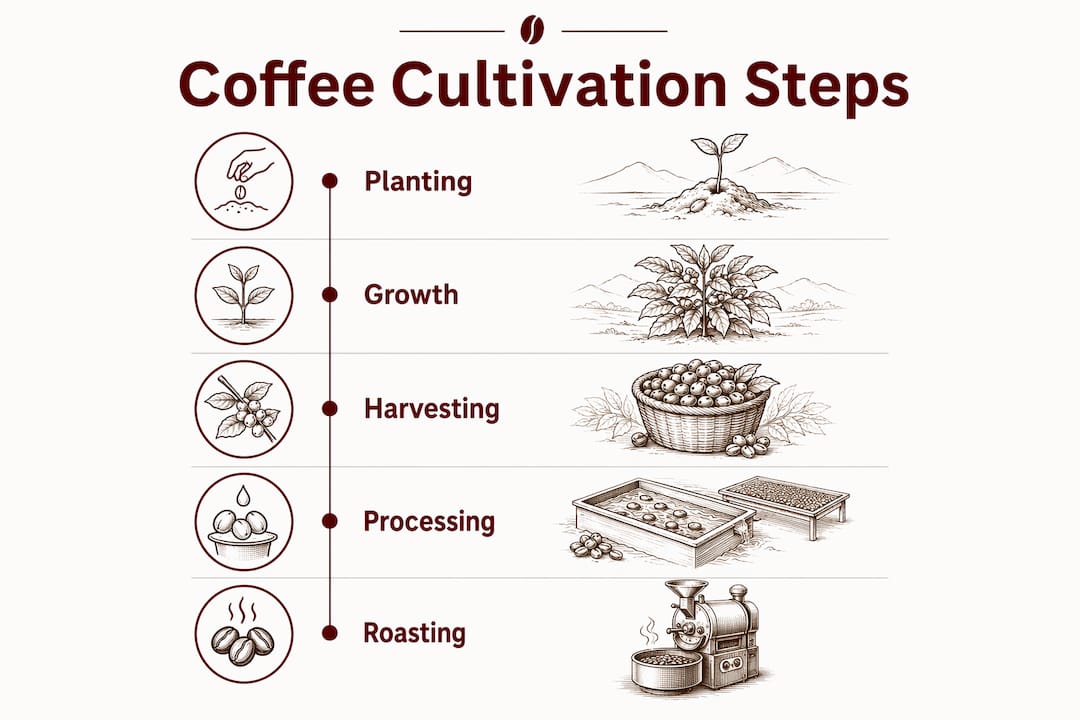
Planting and early growth
Seeds are germinated in shaded nurseries and transferred to the field after 6–12 months. Coffee seedlings take 3–4 years to mature and begin fruiting. A full tree can take a decade to fully establish. That timeline demands patience and consistent maintenance, which is why smallholder farmers often intercrop coffee with faster-yielding plants to generate income during the wait.
The cultivation cycle
- Nursery preparation: Seeds are planted in shaded beds with well-drained, phosphorus-rich soil. Seedlings are watered daily and protected from direct sun.
- Field transplanting: After 6–12 months, seedlings move to prepared field holes. Spacing between plants affects airflow, sunlight, and long-term yield.
- Pruning and maintenance: Regular pruning removes dead wood, controls plant height for easier harvesting, and directs energy toward fruit production rather than foliage.
- Cherry development: Arabica cherries mature in 7–9 months after flowering. Robusta takes up to 11 months. Ripe cherries turn deep red, which is the visual cue for harvest readiness.
- Harvesting: Selective picking, where only ripe red cherries are hand-picked, produces the highest quality beans. Strip harvesting, where all cherries are removed at once, is faster but includes unripe fruit.
Post-harvest processing
Processing separates the green bean from the cherry and defines much of the cup’s flavor profile. The three dominant methods are washed, natural, and honey processing. Washed processing removes the fruit before drying, producing clean, bright flavors. Natural processing dries the whole cherry, allowing sugars to ferment into the bean and creating fruity, wine-like notes. Honey processing sits between the two, leaving some mucilage on the bean during drying for a balanced sweetness.
Pro Tip: When you blend coffee beans from different processing methods, you can build layered flavor profiles that no single-origin bean achieves alone. A washed Ethiopian paired with a natural Brazilian creates brightness and body in the same cup.
Which regions produce the world’s best grown coffee?
Regional origin is the single strongest predictor of flavor in cultivated coffee. Soil chemistry, altitude, rainfall patterns, and local processing traditions all converge to create profiles that no other region can replicate.

Major producing regions
| Region | Key Characteristic | Flavor Profile |
|---|---|---|
| Brazil | 31% of global output, low altitude | Nutty, chocolatey, low acidity |
| Vietnam | Robusta dominant, high volume | Bold, earthy, high caffeine |
| Colombia | High altitude, two harvests per year | Balanced, caramel, mild citrus |
| Ethiopia | Birthplace of Arabica, diverse microclimates | Floral, fruity, wine-like |
| Peru | Shade-grown, organic-forward farms | Mild, sweet, clean finish |
Colombia’s dual harvest cycle, driven by its unique geography straddling two mountain ranges, gives it a supply consistency that most origins cannot match. Ethiopia’s wild coffee forests produce flavor complexity that cultivated monocultures rarely achieve.
California: the unexpected niche
California currently has 65–70 farms growing coffee, producing a specialty product that averages around $10 per ounce. That price premium reflects both the cost of farming in a high-wage economy and the genuine quality of small-batch production. California coffee is not a novelty. It represents a new frontier for U.S. grown coffee that serious enthusiasts are beginning to take seriously.
- California farms concentrate in Carpinteria, Santa Barbara County, and parts of San Diego.
- Most California operations use shade-grown methods, which align with the state’s environmental regulations.
- The $10-per-ounce price point positions California coffee firmly in the specialty tier, above commodity grades by a wide margin.
Emerging regions like Peru also deserve attention. Peruvian coffee grows primarily in the high-altitude valleys of the Andes, where shade-grown organic farming produces clean, mild cups that pair well with infused coffee beans and flavored blends.
What are the environmental impacts of coffee farming?
Coffee farming carries a significant ecological footprint, and the method of cultivation determines whether that footprint shrinks or grows over time.
“Coffee farming’s environmental footprint depends greatly on cultivation methods; traditional agroforestry offers a regenerative alternative to monoculture plantations.” — Coffee & Health
Conventional sun-grown monoculture plantations clear forest land to maximize yield per acre. This land clearing drives biodiversity loss and degrades soil health over successive growing cycles. Water consumption is also substantial. Processing a single kilogram of washed coffee can require hundreds of liters of water, and runoff from processing stations contaminates local waterways when waste management is poor.
Shade-grown and agroforestry methods
Shade-grown coffee integrates cultivation under tree canopies, which promotes soil stability, maintains water balance, supports biodiversity, and sequesters carbon. This mirrors coffee’s natural forest environment, where the plant evolved as an understory shrub beneath taller trees. The ecological benefits are measurable. Farms using agroforestry methods report lower erosion rates, higher populations of pollinating insects, and reduced need for synthetic pesticides because natural predators control pest populations.
Shade-grown farming also diversifies farmer income. Timber, fruit, and medicinal plants grown alongside coffee provide revenue streams that buffer against price volatility in the commodity market. That economic resilience makes sustainable methods more attractive to smallholders, not just large operations with capital to invest.
| Farming Method | Biodiversity Impact | Soil Health | Carbon Sequestration |
|---|---|---|---|
| Sun-grown monoculture | Low | Degrades over time | Minimal |
| Shade-grown agroforestry | High | Maintained or improved | Significant |
| Organic certified | Moderate to high | Improved | Moderate |
The consumer’s role in this equation is direct. Choosing certified shade-grown or organic coffee creates market demand that rewards farmers who adopt sustainable practices. Price premiums for certified beans flow back to farms, funding the transition away from destructive monoculture.
Key takeaways
Grown coffee quality depends on the intersection of climate, cultivation method, regional origin, and post-harvest processing, with sustainable farming practices delivering both better environmental outcomes and more complex flavor profiles.
| Point | Details |
|---|---|
| Climate drives quality | Arabica needs 15–24°C and 1,500–3,000 mm of annual rainfall to produce premium beans. |
| Cultivation takes years | Coffee seedlings take 3–4 years to fruit, requiring long-term farm investment and planning. |
| Region shapes flavor | Brazil, Colombia, Ethiopia, and California each produce distinct profiles tied to soil and altitude. |
| Sustainability matters | Shade-grown agroforestry reduces biodiversity loss, improves soil health, and sequesters carbon. |
| Processing defines the cup | Washed, natural, and honey methods each produce fundamentally different flavor outcomes from the same bean. |
Why the future of coffee depends on how we grow it
I’ve spent years tasting coffees from dozens of origins, and the single most consistent finding is this: the farm tells you more than the roaster. You can take a mediocre bean and roast it perfectly, and it will still taste mediocre. But a well-grown bean from a farm with healthy soil, proper altitude, and careful harvesting will reward almost any roast profile.
What surprises most enthusiasts is how much the environmental story of a bean connects to its flavor. Shade-grown coffees from farms with high biodiversity consistently show more complexity than sun-grown equivalents from the same region. The ecological health of the farm shows up in the cup. That is not marketing language. It is the result of slower cherry maturation, richer soil biology, and lower stress on the plant.
California’s emergence as a coffee-growing region is the most interesting development I’ve tracked in years. The idea that U.S. grown coffee beans could command $10 per ounce and hold their own against established specialty origins would have seemed implausible a decade ago. Now it’s a real market, and it’s growing.
My honest advice: pay attention to how your coffee was grown before you think about how it was roasted. Origin transparency from farms that practice agroforestry is the clearest signal of quality you can find. Support those farms, and the flavor will follow.
— Jett
Espritkaffe: coffee grown with purpose, roasted for you
Espritkaffe sources specialty coffee with the same attention to origin that this article describes. Every bean reflects the conditions of where it was grown, and the roast is calibrated to bring that out rather than cover it up.

The cold brew coffee from Espritkaffe is built for enthusiasts who want clean, concentrated flavor without bitterness. For something more unusual, the mushroom dark roast pairs specialty-grade grown coffee with functional mushroom extracts, producing a cup that is both grounding and distinct. If you prefer a lighter profile, the mushroom medium roast delivers the same concept with more brightness and less intensity. These are not mass-market products. They are built for people who care about what goes into the cup and where it came from.
FAQ
What is grown coffee?
Grown coffee refers to coffee beans cultivated from Coffea arabica or Coffea robusta plants under specific tropical conditions. The term covers the full cultivation process from planting to harvest.
How long does it take to grow coffee?
Coffee seedlings take 3–4 years to begin fruiting, with a full tree taking up to a decade to fully establish. Each plant produces one harvest per year.
What makes shade-grown coffee better for the environment?
Shade-grown coffee integrates cultivation under tree canopies, which supports biodiversity, stabilizes soil, sequesters carbon, and reduces the need for synthetic pesticides.
Which country grows the most coffee?
Brazil produces 31% of the world’s coffee supply, making it the largest single producer. Vietnam and Colombia rank second and third respectively.
Does where coffee is grown affect its flavor?
Regional origin directly shapes flavor through soil chemistry, altitude, rainfall, and local processing traditions. Beans grown at higher altitudes consistently show more acidity and complexity than lowland varieties.