

The best chemex grind size is medium-coarse, roughly the texture of coarse sea salt, and getting it wrong is the single fastest way to ruin an otherwise perfect brew. The Chemex’s thick bonded paper filter behaves differently from every other pour-over on the market. It slows water flow significantly, which means your grind size for pour over methods like the Hario V60 will not translate directly. Nail the grind, and the Chemex rewards you with a clean, bright, balanced cup that almost no other brewer can match.
What is the right chemex grind size?
The correct grind size for Chemex is medium-coarse, and the most reliable visual reference is coarse sea salt or kosher salt. Each particle should be clearly visible and feel slightly rough between your fingers. That texture is not arbitrary. It reflects the exact particle size needed to let water pass through the Chemex’s dense paper filter at a controlled, steady rate.
Too fine and the filter clogs, water stalls, and the coffee over-extracts into something bitter and heavy. Too coarse and water rushes through before it can pull flavor from the grounds, leaving you with a weak, sour cup. The medium-coarse target sits precisely between those two failure points, giving you balanced extraction and a clean finish.
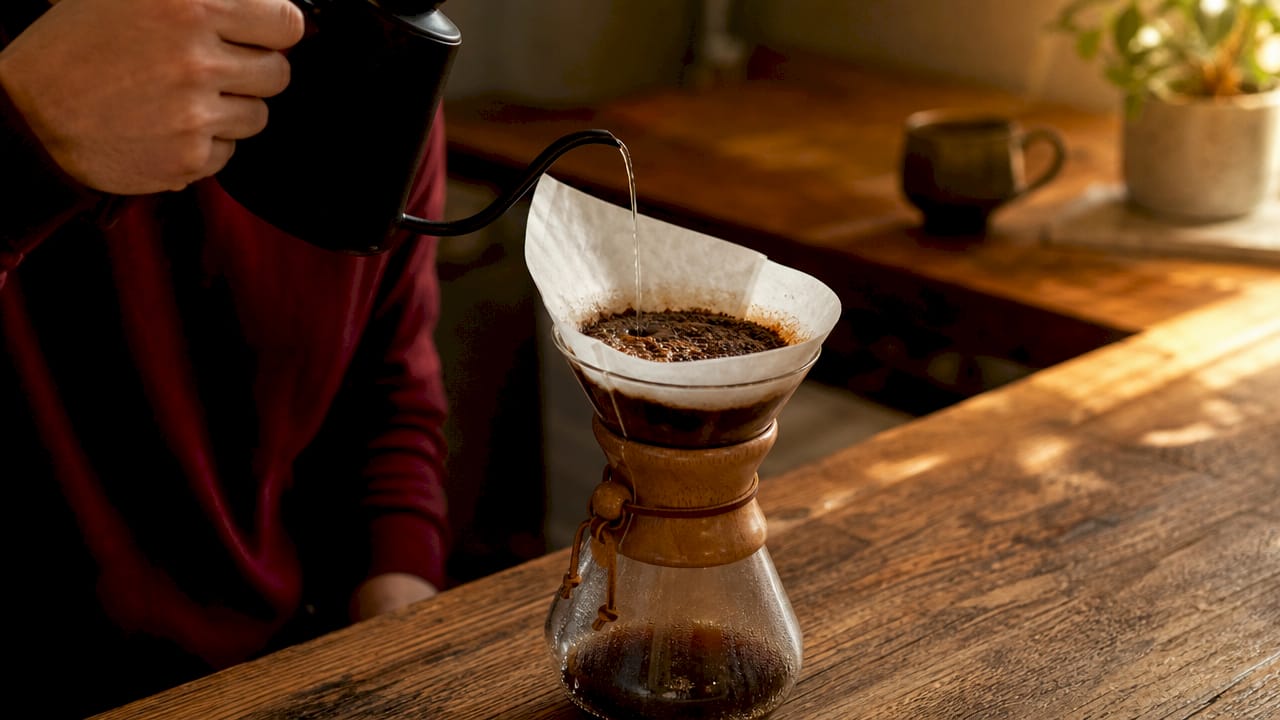
The industry term for this calibration is “grind setting,” and it varies by grinder model. The visual sea salt benchmark is your universal starting point regardless of which grinder you use.
Why grind size matters more for Chemex than other methods
Chemex’s thick bonded paper filter is the defining variable. It slows water flow more than the thinner filters used in a Hario V60 or Kalita Wave. That slower flow means water spends more contact time with the grounds, which amplifies any grind error. A grind that works fine in a V60 will over-extract in a Chemex.
The Chemex filter produces fines accumulation that clogs the filter and stalls extraction. This is the core mechanical reason why grind consistency matters more here than in almost any other brew method. Fines are the tiny dust-like particles that escape even from decent grinders. In a French press, fines sink to the bottom and you simply avoid them. In a Chemex, they press against the filter and block flow entirely.
Here is how Chemex grind requirements compare to other common brew methods:
| Brew method | Grind size | Filter type | Brew time |
|---|---|---|---|
| Chemex | Medium-coarse | Thick bonded paper | 4.5–5 minutes |
| Hario V60 | Medium | Thin paper | 3–4 minutes |
| French press | Coarse | Metal mesh | 4 minutes |
| Kalita Wave | Medium | Flat-bottom paper | 3–4 minutes |
| AeroPress | Medium-fine | Thin paper or metal | 1–2 minutes |
The French press uses a coarser grind, but its metal mesh filter tolerates fines without clogging. The V60 uses a finer grind, but its thinner filter passes water faster. Chemex sits in a specific middle zone where both particle size and consistency are non-negotiable.
How to choose the right grind setting on popular grinders
The Baratza Encore is the most widely recommended entry-level burr grinder for Chemex brewing. The Baratza Encore setting 18–20 produces the medium-coarse grind that Chemex requires. That 40-step grind range gives you enough resolution to make small, meaningful adjustments without overshooting.
Burr grinders are the only practical choice for Chemex. Blade grinders produce uneven particles with fine dust that clogs the Chemex filter and creates unpredictable flavor. A burr grinder cuts each bean between two abrasive surfaces, producing uniform particles at a consistent size. That uniformity is what the Chemex filter demands.
The type of burr also matters. Ceramic burrs tend to produce more fines than steel burrs. If you use a ceramic burr grinder such as the Baratza Vario+ or Forté AP, you need to grind coarser than expected to compensate for the extra fines output. Steel burr grinders like the Baratza Encore or Fellow Ode hit the target range more predictably.
Recommended grinders and starting settings for Chemex:
- Baratza Encore (steel burrs): Setting 18–20
- Fellow Ode Gen 2 (steel burrs): Setting 4–5
- Baratza Vario+ (ceramic burrs): Start at a coarser setting than you expect and adjust down
- Comandante C40 (hand grinder, steel burrs): Around 25–30 clicks
- 1Zpresso JX (hand grinder, steel burrs): Around 3.0–3.5 on the dial
Pro Tip: Write down your grind setting every time you brew. Small setting changes produce noticeable flavor shifts in Chemex, and tracking your adjustments lets you repeat a great cup without guessing.
How to dial in your Chemex grind step by step
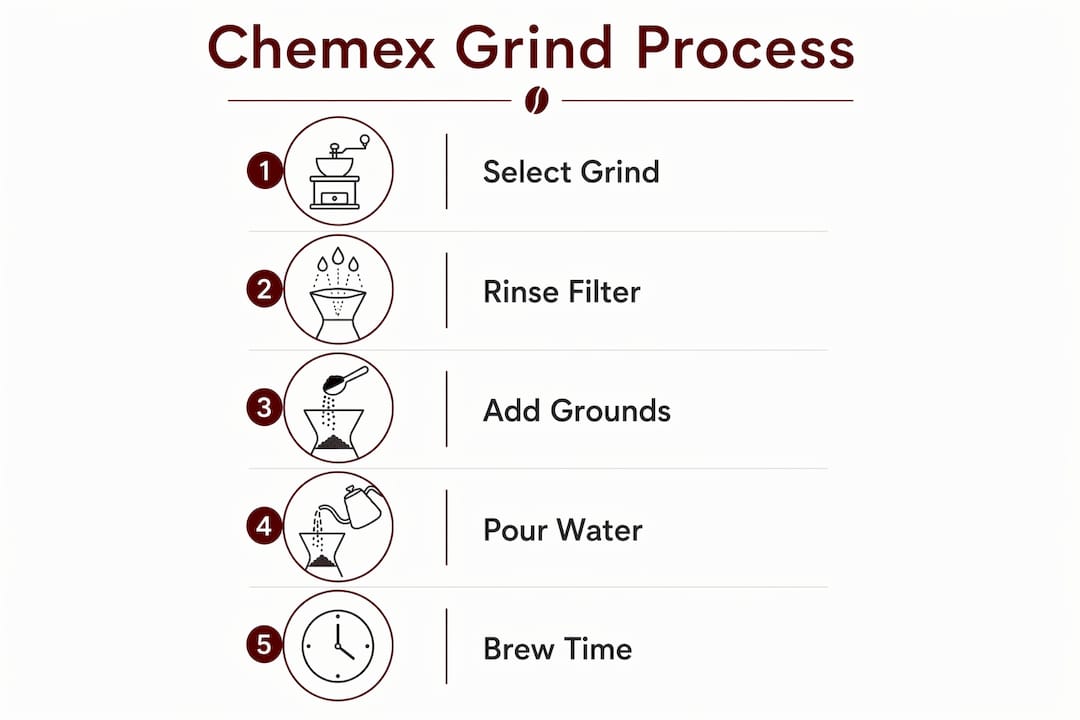
Dialing in your chemex grind setting is a systematic process, not a one-time guess. Start at medium-coarse, brew a full batch, and evaluate both the brew time and the taste before making any changes.
- Set your grinder to medium-coarse. On the Baratza Encore, that is setting 18. Use the sea salt visual as your reference.
- Brew and time the full drip. Target brew time is 4.5–5 minutes, measured from the first pour to the last drop falling through the filter.
- Evaluate the brew time first. If the brew finishes in under 3 minutes, the grind is too coarse. If it runs longer than 6 minutes, the grind is too fine. Adjust by one or two steps and brew again.
- Taste the coffee. Brew time tells you where you are mechanically. Taste tells you where you need to go. Sharp, sour, or thin coffee means the grind is too coarse and water moved through too fast. Bitter, heavy, or harsh coffee means the grind is too fine and water sat too long.
- Adjust grind, not ratio. When flavor is off, adjust grind size first before changing your coffee-to-water ratio. Grind size is the primary lever for extraction control.
- Lock in and repeat. Once you hit a brew time between 4.5 and 5 minutes and the taste is balanced, note the exact grind setting and use it consistently.
Water temperature also affects extraction. Aim for 200°F (about 30 seconds off a full boil). Pouring technique matters too. A slow, steady spiral pour keeps the coffee bed evenly saturated and prevents channeling, where water finds a path of least resistance through the grounds.
Pro Tip: Rinse your Chemex filter with hot water before adding grounds. This removes any papery taste from the filter and preheats the brewer, which stabilizes your brew temperature from the first pour.
Common grind-related Chemex problems and how to fix them
Most Chemex problems trace back to grind size or grind consistency. Recognizing the symptom tells you exactly which direction to adjust.
- Filter clogging or very slow drip: The grind is too fine, or your grinder produces excessive fines. With ceramic burr grinders, this is especially common. Grind coarser by two to three steps and check whether flow improves. If clogging persists, your grinder may need cleaning or a burr upgrade.
- Bitter, harsh, or heavy coffee: Over-extraction caused by a grind that is too fine or a brew that ran too long. Move the grind coarser by one or two steps. Check that your water temperature is not above 205°F.
- Weak, sour, or watery coffee: Under-extraction caused by a grind that is too coarse. Water passed through too quickly and did not pull enough flavor. Move the grind finer by one or two steps.
- Inconsistent flavor from brew to brew: Grinder inconsistency is the likely cause. Blade grinders produce this problem by design. If you use a burr grinder, check for worn burrs, coffee oil buildup, or static causing grounds to clump unevenly.
- Papery or flat taste with correct brew time: The filter was not rinsed before brewing. Rinse with hot water, discard the rinse water, and brew again.
The most common mistake is adjusting the coffee-to-water ratio when the real problem is grind size. Ratio changes mask extraction problems rather than fix them. Grind adjustment is always the first correction to make.
Key takeaways
The ideal Chemex grind size is medium-coarse, resembling coarse sea salt, with a target brew time of 4.5–5 minutes and consistent burr-ground particles to prevent clogging and ensure balanced extraction.
| Point | Details |
|---|---|
| Target grind size | Medium-coarse, similar to coarse sea salt, is the correct starting point for Chemex. |
| Brew time window | Aim for 4.5–5 minutes; under 3 minutes means too coarse, over 6 minutes means too fine. |
| Grinder choice | Use a burr grinder; the Baratza Encore at setting 18–20 is a reliable starting point. |
| Ceramic burr adjustment | Ceramic burr grinders produce more fines and require a coarser setting than steel burrs. |
| Fix flavor with grind first | Adjust grind size before changing your coffee-to-water ratio when flavor is off. |
Grind size is where most Chemex brews actually fail
I have watched a lot of coffee enthusiasts spend serious money on a Chemex, buy quality beans, and still end up with a mediocre cup. Almost every time, the grind is the problem. Not the beans. Not the water. The grind.
The part that surprises most people is how small the margin is. Moving from setting 18 to setting 16 on a Baratza Encore is two clicks. That is the difference between a clean, sweet cup and something bitter and flat. The Chemex amplifies grind errors more than any other brewer I have used because the filter gives water nowhere to go if the grounds are even slightly too fine.
The other thing I have learned is that grinder consistency matters as much as the setting itself. A worn burr set or a dirty grinder produces a wider range of particle sizes, which means some grounds over-extract while others under-extract in the same brew. The cup tastes muddy and confused. Cleaning your grinder regularly and replacing burrs when they dull is not optional maintenance. It is the foundation of repeatable results.
My honest advice: track every brew. Write down the grind setting, the brew time, and one word describing the taste. After ten brews, you will have a clear picture of your grinder’s behavior and your own palate. That record is worth more than any single tip.
— Jett
Espritkaffe roasts worth brewing in your Chemex
The Chemex rewards coffee with clarity, and that means roast quality shows up directly in the cup. Espritkaffe’s medium roast with mushrooms is built for exactly this kind of brewing. Its balanced body and clean finish come through beautifully at the medium-coarse grind size this guide recommends.

If you prefer something bolder, the dark roast option holds up well through the Chemex’s longer brew time without turning harsh. Both roasts are sourced and roasted with the kind of intentionality that makes the difference when your grind is dialed in and your technique is solid. Espritkaffe is built for brewers who care about what is in the cup, not just the ritual around it.
FAQ
What grind size should I use for Chemex?
Use a medium-coarse grind, similar in texture to coarse sea salt. This grind size balances water flow through the Chemex’s thick bonded paper filter and produces a clean, well-extracted cup.
How long should a Chemex brew take?
The target brew time is 4.5–5 minutes from first pour to last drop. If the brew finishes in under 3 minutes, grind finer. If it runs longer than 6 minutes, grind coarser.
Can I use a blade grinder for Chemex?
Blade grinders are not suitable for Chemex. They produce uneven particles and fine dust that clog the Chemex filter and create inconsistent, unpredictable flavor. A burr grinder is the correct tool.
What setting should I use on a Baratza Encore for Chemex?
Start at setting 18–20 on the Baratza Encore. That range produces the medium-coarse grind Chemex requires, and you can adjust one or two steps in either direction based on brew time and taste.
Why does my Chemex filter keep clogging?
Filter clogging is caused by fines accumulation, not just average grind size. If you use a ceramic burr grinder, grind coarser than you expect. Clean your grinder regularly to prevent coffee oil buildup from increasing fines output.